
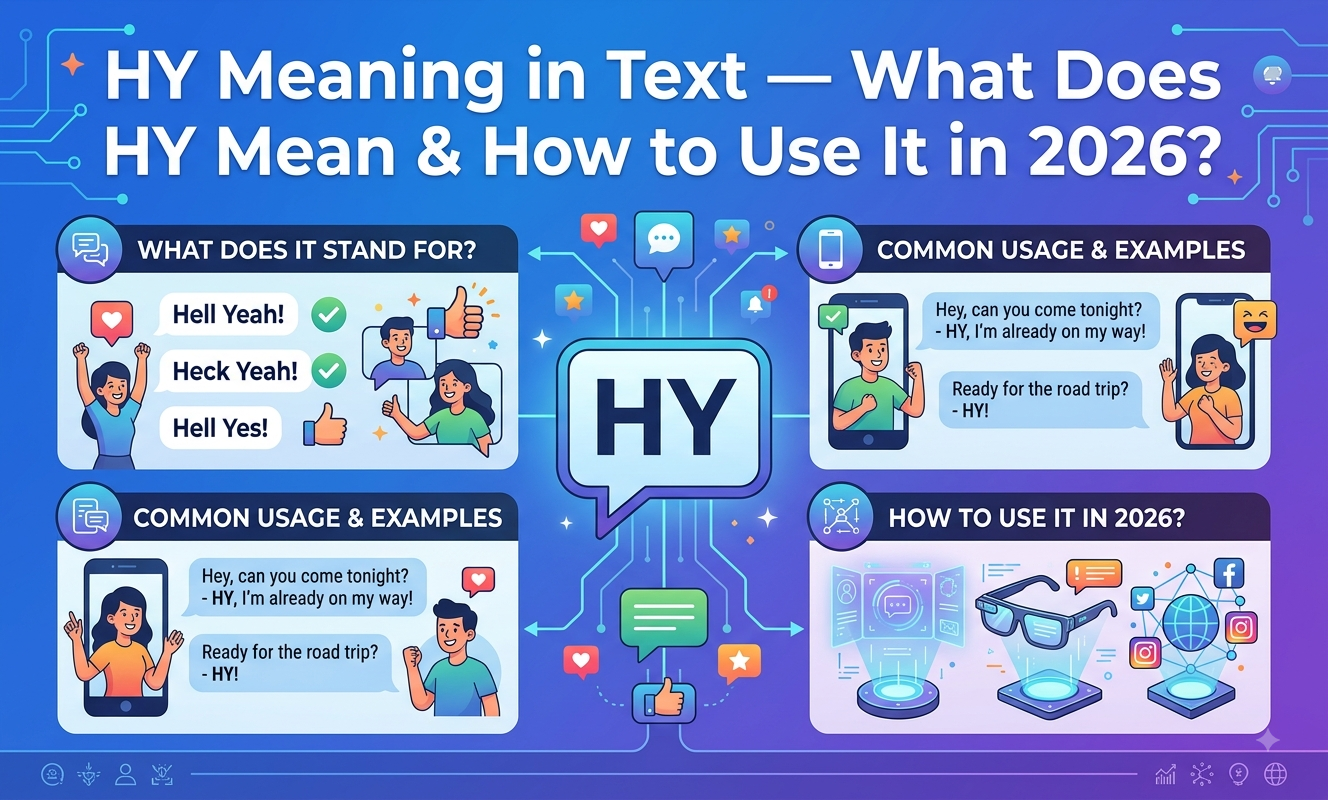
Quick Answer: HY in text messaging most commonly means either a casual greeting (“Hi” or “Hey”) or an enthusiastic reaction (“Hell Yes”). The correct meaning depends entirely on context — HY at the start of a chat is almost always a greeting, while HY as a reply to a question is usually excitement or agreement.
Introduction
Someone just texted you “HY” and now you’re stuck staring at your phone wondering what they meant. Are they saying hello, or are they hyped about something you asked? You’re not overthinking it — hy meaning in text genuinely shifts depending on where it shows up in a conversation. This short two-letter abbreviation has quietly become one of the more confusing pieces of texting slang because it carries two completely different jobs.
In this guide, you’ll learn exactly what HY means, where it came from, how it’s used across WhatsApp, Snapchat, TikTok, and Instagram in 2026, whether it’s considered rude, and how to reply to it. We’ll also cover similar slang terms so you never have to guess again. Whether you’re a teen texting friends or a parent trying to keep up, this breakdown will make HY instantly clear.
What Does HY Mean?
HY is a texting abbreviation that carries two main meanings, and both are extremely common in 2026 chat culture.
The first and most frequent meaning is a casual, stylized version of “Hi” or “Hey.” In this form, HY isn’t really an acronym at all — it’s a phonetic shortcut where the “y” stands in for the soft “i” sound at the end of “hi.” People type it because it’s quick, feels a little more playful than a plain “hi,” and fits naturally into fast-paced group chats.
The second meaning is “Hell Yes” (sometimes written as “Hell Yeah”). In this form, HY functions as an enthusiastic way to agree with something, accept an invitation, or react positively to news. This usage grew out of spoken slang that has existed for decades and simply got shortened for texting and social media character limits.
Both meanings became especially widespread in 2026 as Gen Z texting culture leaned further into abbreviation-heavy, low-effort typing styles. The rule of thumb: HY at the start of a message is a greeting; HY as a standalone reply is usually excitement or agreement.
HY Full Form Explained
Since HY isn’t a traditional acronym like “LOL” or “BRB,” it doesn’t have one fixed full form. Instead, it maps to different phrases depending on tone and placement.
| Letter Breakdown | Possible Full Form | Common Usage |
|---|---|---|
| H | Hi / Hell | Opens a greeting or an exclamation |
| Y | Y (stylized “i” sound) / Yes | Completes “Hi” or completes “Yes” |
| Full Term | “Hi” or “Hey” | Casual greeting |
| Full Term | “Hell Yes” / “Hell Yeah” | Enthusiastic agreement |
Unlike acronyms with a single fixed meaning, HY works more like a flexible shorthand. That’s exactly why context matters so much when you’re trying to figure out what someone meant.
How to Use HY — Real Examples
Here are real-world example situations showing how HY shows up in everyday texting, along with the emotion behind each one.
| Situation | Example | Emotion |
|---|---|---|
| Starting a chat with a friend | “HY! What are you up to today?” | Friendly / Casual |
| Replying to an invite | “Wanna come to the game tonight?” — “HY, I’m in!” | Excited |
| Agreeing with an opinion | “This is the best show on TV right now.” — “HY it really is” | Strong Agreement |
| Greeting in a group chat | “HY everyone, did we decide on a time?” | Warm / Inclusive |
| Reacting to good news | “I got the internship!” — “HY!! Let’s gooo” | Enthusiastic |
| Confirming plans | “Still on for 6pm?” — “HY, see you then” | Confident |
| Random check-in text | “HY, haven’t heard from you in a while” | Caring / Casual |
| Responding to a bold statement | “I could eat pizza every single day.” — “HY same” | Playful Agreement |
| Starting a DM to someone new | “HY, love your recent post!” | Friendly / Approachable |
| Reacting to a challenge or dare | “Bet you won’t do it.” — “HY watch me” | Confident / Hyped |
Notice how the emotion shifts based on where HY appears. As a greeting, it feels warm and low-key. As a reaction, it feels energetic and confident.
HY on Different Platforms (2026)
Texting slang doesn’t behave the same way everywhere. Here’s how HY plays out across the biggest platforms teens and young adults use today.
On WhatsApp
WhatsApp remains one of the most popular messaging apps worldwide in 2026, and HY shows up frequently in both one-on-one chats and group conversations. It’s commonly used as a quick greeting when opening a conversation, especially in casual or family group chats where people drop in and out throughout the day. The “Hell Yes” usage also appears often when confirming plans or reacting to shared updates.
On Snapchat
Snapchat’s fast, disappearing message format encourages short, punchy replies, which makes HY a natural fit. Here it leans more toward the “Hell Yes” meaning, especially in Snap replies to stories or quick chats where users want to react without typing a full sentence.
On TikTok
In TikTok comment sections, HY usually shows up as a reaction to a video’s content, most often meaning “Hell Yes” when someone strongly agrees with a point, a trend, or a caption. It’s a fast way to show support without writing a full comment.
On Instagram
On Instagram, HY appears in both DMs and comments. As a DM opener, it typically means “Hi” or “Hey,” especially when messaging someone new or replying to a story. In comments, it more often leans toward “Hell Yes” as an excited reaction to a post.
Is HY Rude or Offensive?
For the most part, HY is not considered rude. When it’s used as a greeting, it’s simply a casual, friendly way to say hello — no different from texting “hi” with a little extra personality.
The situation is slightly different when HY means “Hell Yes.” Because the full phrase technically contains mild language, some people prefer to avoid it in more formal or professional settings, or when texting someone they don’t know well, like a teacher, boss, or older relative. Among friends, though, it’s widely accepted as harmless enthusiasm rather than actual profanity.
Context matters most. If you’re unsure how the other person feels about mild slang, it’s safer to stick with the greeting meaning or spell out “yes” instead.
How to Reply to HY
Not sure how to respond when someone sends you HY? Here are some natural reply options depending on the context.
| Their Message | Your Reply | Tone |
|---|---|---|
| “HY!” (as a greeting) | “Hey! What’s up?” | Friendly |
| “HY!” (as a greeting) | “HY! Long time no talk” | Casual |
| “HY” (agreeing with plans) | “Awesome, see you then!” | Confirming |
| “HY!!” (excited reaction) | “Right?? So hyped” | Matching Energy |
| “HY” (reacting to news) | “Congrats, that’s amazing!” | Supportive |
| “HY” (unclear context) | “Haha HY to you too — what’s going on?” | Playful / Clarifying |
If you’re genuinely unsure which meaning was intended, it’s completely fine to ask. A quick “wait, HY as in hi or HY as in hell yes? 😂” keeps the conversation light while clearing up any confusion.
HY Alternatives and Similar Slang
HY isn’t the only short greeting or reaction floating around group chats. Here are some related terms worth knowing.
| Term | Meaning |
|---|---|
| HEY | Standard spelling of a casual greeting |
| YO | Informal greeting, often used among friends |
| SUP | Short for “what’s up,” a casual opener |
| HELLA | Slang for “very” or “a lot,” often paired with agreement |
| FR | “For real,” used to emphasize agreement |
| ABSOLUTELY | Formal way of expressing strong agreement |
| BET | Casual way of saying “yes” or “I agree” |
| FOSHO | Slang spelling of “for sure” |
These terms often appear alongside HY in the same conversations, so recognizing them helps you follow fast-moving chats more easily.
Frequently Asked Questions (FAQ)
Q: What does HY mean in text messages? A: HY in text messages usually means either a casual greeting like “Hi” or “Hey,” or an enthusiastic reaction meaning “Hell Yes.” The correct meaning depends on where it appears in the conversation.
Q: What is the full form of HY in texting? A: HY doesn’t have one single full form. It’s shorthand for either “Hi/Hey” as a greeting or “Hell Yes/Hell Yeah” as an enthusiastic response.
Q: Is HY the same as saying hello? A: When used at the start of a conversation, yes — HY functions almost exactly like “hi” or “hello,” just with a more casual, texting-friendly spelling.
Q: Is HY slang appropriate for professional texting? A: It’s best avoided in professional or formal conversations, since one of its meanings (“Hell Yes”) contains mild language. Stick to full words like “hello” or “yes” in those settings.
Q: Why do people use HY instead of typing the full word? A: Texting culture favors speed and brevity. Short forms like HY let people communicate quickly while still keeping a casual, expressive tone in fast-moving chats.
Q: Does HY mean the same thing on every platform? A: Mostly yes, though the balance shifts — WhatsApp and Instagram DMs lean more toward the greeting meaning, while TikTok and Snapchat comments lean more toward the “Hell Yes” meaning.
Conclusion
HY might only be two letters, but it carries real weight depending on context. As a greeting, it’s a friendly, low-key way to say hi. As a reaction, it’s a punchy way to show excitement or strong agreement. Once you know to read the surrounding conversation, the hy meaning in text stops being confusing and starts feeling like second nature.
Also read MB Meaning in Text — What Does MB Mean & How to Use It?
