
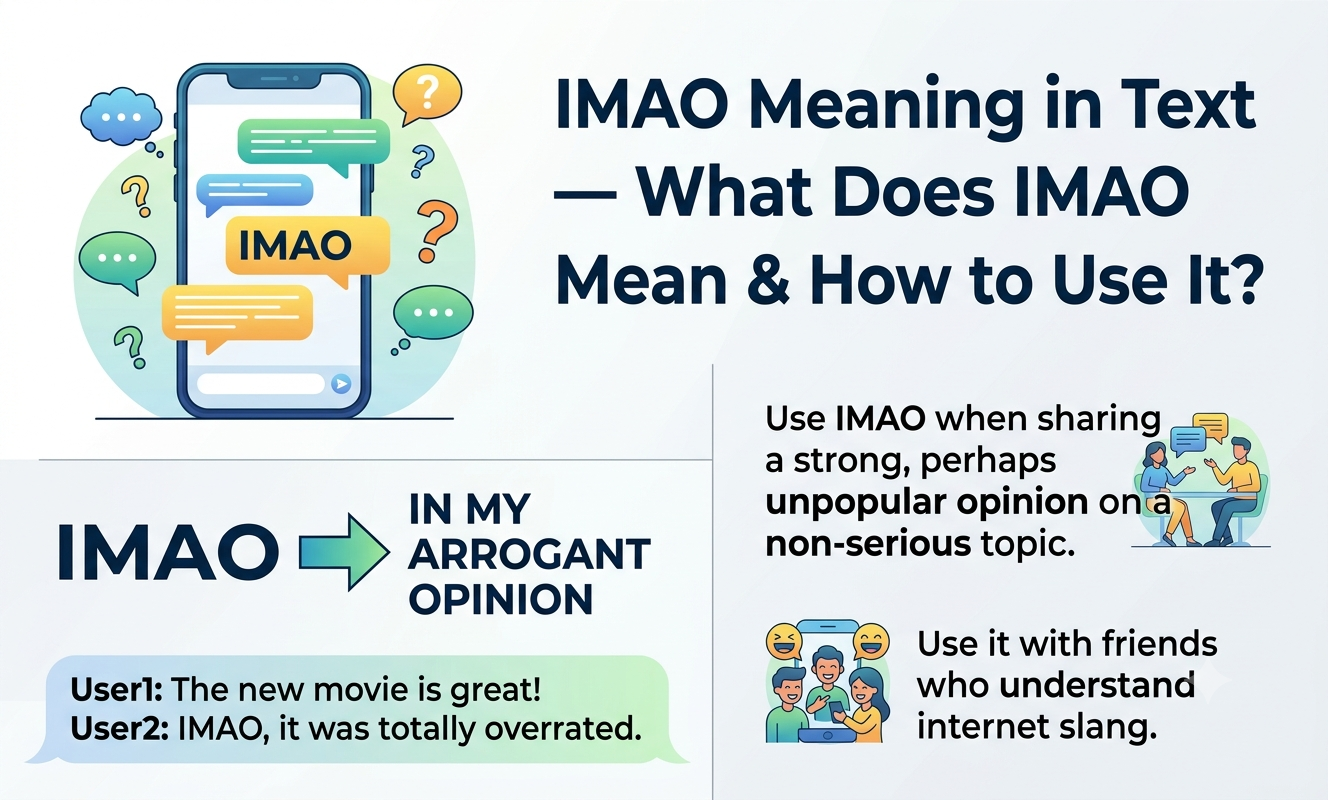
Quick Answer: IMAO stands for “In My Arrogant Opinion.” It’s a sarcastic, joking twist on IMHO (“In My Humble Opinion”), used when someone wants to sound playfully cocky or overconfident about a statement rather than genuinely humble.
Introduction
Ever seen someone type IMAO in a group chat and wondered if it was a typo for something else? You’re not alone. With so many texting acronyms flying around — IMO, IMHO, LMAO — it’s easy to mix them up. The IMAO meaning in text is actually pretty simple once you break it down, and it’s a fun one because it flips a common phrase on its head.
In this article, you’ll learn exactly what IMAO stands for, where it came from, how it differs from similar acronyms, and how people actually use it across platforms like WhatsApp, Snapchat, TikTok, and Instagram. We’ll also cover whether it can come across as rude, how to reply to it, and some close alternatives you might see instead.
What Does IMAO Mean?
IMAO stands for “In My Arrogant Opinion.” It’s a tongue-in-cheek variation of the much older acronym IMHO (“In My Humble Opinion”). Instead of downplaying their opinion, the person using IMAO is jokingly exaggerating their confidence — basically saying, “I know I’m right, and I’m not being modest about it.”
It’s almost always used with a wink, not literal arrogance. Think of it as sarcasm baked into three letters. Someone might type “IMAO pineapple belongs on pizza” not because they think they’re an authority on pizza toppings, but because they’re being playfully dramatic about a harmless opinion.
The acronym has roots in early internet forum culture and instant messaging from the late 1990s and 2000s, when abbreviated opinion-tags like IMO and IMHO were everywhere. IMAO emerged as a humorous spin-off. It never became as mainstream as IMO or IMHO, but it has held steady as a niche favorite among people who like a bit of self-aware sass in their texting. Heading into 2026, it continues to show up most often in casual group chats, meme captions, and comment sections where a joking tone is already established.
IMAO Full Form Explained
Since IMAO is an acronym, here’s what each letter stands for:
| Letter | Stands For |
|---|---|
| I | In |
| M | My |
| A | Arrogant |
| O | Opinion |
Put together: “In My Arrogant Opinion.” The key word doing all the work here is “Arrogant” — it’s what separates IMAO from its more polite cousin, IMHO (“In My Humble Opinion”), and its neutral cousin, IMO (“In My Opinion”).
How to Use IMAO — Real Examples
IMAO works best when the opinion itself is low-stakes and a little exaggerated for comedic effect. Here are examples across different emotional tones:
| Situation | Example | Emotion |
|---|---|---|
| Debating food preferences | “IMAO, ketchup on eggs is a crime.” | Playful/joking |
| Movie discussion | “IMAO that sequel was way better than the original.” | Confident/teasing |
| Group chat banter | “IMAO I’m the funniest person in this chat, no debate.” | Cocky/humorous |
| Fashion opinion | “IMAO oversized hoodies are the only correct hoodie.” | Assertive/light |
| Music taste | “IMAO this album is a top 3 of all time, fight me.” | Bold/exaggerated |
| Sports rivalry | “IMAO our team wins this weekend, easy.” | Confident/friendly trash talk |
| Trivial daily choice | “IMAO cereal before milk is the objectively correct order.” | Silly/mock-serious |
| Reacting to a meme | “IMAO this is the best meme I’ve seen all week.” | Amused/enthusiastic |
| Friendly disagreement | “IMAO you’re wrong but I still love you lol.” | Teasing/affectionate |
| Self-deprecating joke | “IMAO I probably shouldn’t have an opinion on this but here we go.” | Ironic/self-aware |
Notice the pattern: it’s almost never used for genuinely serious or sensitive topics. Using IMAO in a heated argument about something important can come across as dismissive, since the whole point of the term is lighthearted overconfidence.
IMAO on Different Platforms (2026)
Texting acronyms tend to shift slightly in flavor depending on where they’re used. Here’s how IMAO tends to show up across major platforms.
On WhatsApp
WhatsApp remains a hub for close friend groups and family chats, so IMAO shows up mostly in casual, familiar conversations — debates about weekend plans, food, or inside jokes. Because WhatsApp threads are often ongoing and personal, the sarcastic tone of IMAO reads clearly to people who already know the sender’s texting style.
On Snapchat
On Snapchat, brevity is everything, and IMAO fits neatly into quick captions or chat replies attached to snaps. It’s often paired with a joking selfie or reaction snap, reinforcing the sarcastic, not-actually-serious intent behind the phrase.
On TikTok
In TikTok comment sections, IMAO frequently appears as a way to state a bold or funny take on a video without sounding preachy. Commenters use it to signal “this is my joking hot take” before dropping an opinion about a trend, sound, or creator.
On Instagram
On Instagram, IMAO tends to show up in comment threads under posts or Reels, often as a quick, witty one-liner. It pairs well with the platform’s caption-heavy culture, where a short, punchy acronym can land a joke faster than a full sentence.
Across all these platforms in 2026, the underlying trend is the same: shorter, punchier texting acronyms continue to thrive in comment sections and casual chats, especially where video and image content sets a joking tone before any text is even read.
Is IMAO Rude or Offensive?
IMAO is not inherently rude or offensive — but context matters.
Why it’s usually harmless:
- It’s typically self-aware and exaggerated, not meant to be taken literally.
- It’s most often used about trivial topics like food, movies, or music.
- The sender is usually poking fun at themselves, not attacking anyone else.
When it could land wrong:
- If used in a serious conversation, it can come across as dismissive or like the sender isn’t taking the topic seriously.
- With someone who doesn’t know the acronym, it might just look confusing or oddly confrontational at first glance.
- In professional or formal settings, it’s best avoided entirely, since sarcasm doesn’t always translate well over text.
The safest rule of thumb: use IMAO with people who already understand your sense of humor, and skip it in situations that call for genuine sensitivity.
How to Reply to IMAO
If someone sends you an IMAO opinion, the reply usually matches the same playful energy. Here are a few options:
| Their Message | Your Reply | Tone |
|---|---|---|
| “IMAO this show is overrated.” | “Lol agree to disagree, arrogantly.” | Playful pushback |
| “IMAO I make the best pasta.” | “Prove it then 😏” | Teasing challenge |
| “IMAO Mondays should be illegal.” | “No arguments here honestly.” | Agreement |
| “IMAO that was the best comeback ever.” | “You’re not wrong lol.” | Light agreement |
| “IMAO I’m always right.” | “In your arrogant dreams maybe.” | Sarcastic tease |
| “IMAO this is the best song of the year.” | “Bold claim, but I respect it.” | Amused acknowledgment |
IMAO Alternatives and Similar Slang
If you want to mix things up, here are similar acronyms and what they mean:
| Acronym | Full Form | Meaning/Tone |
|---|---|---|
| IMO | In My Opinion | Neutral, straightforward opinion |
| IMHO | In My Humble Opinion | Polite, modest framing |
| TBH | To Be Honest | Casual honesty |
| NGL | Not Gonna Lie | Blunt admission |
| FR | For Real | Emphasizing sincerity |
| LMAO | Laughing My *** Off | Strong laughter reaction |
| IDC | I Don’t Care | Indifferent opinion |
| SMH | Shaking My Head | Disappointment or disbelief |
Frequently Asked Questions (FAQ)
Q: What does IMAO mean in texting? A: IMAO means “In My Arrogant Opinion.” It’s a sarcastic, joking version of IMHO, used when someone wants to sound playfully overconfident about their opinion.
Q: Is IMAO the same as IMHO? A: No. IMHO means “In My Humble Opinion” and signals modesty, while IMAO flips that tone into exaggerated confidence for comedic effect.
Q: Is IMAO rude to use in a conversation? A: Not usually. It’s meant as a joke, but it can come across as dismissive if used in a serious or sensitive discussion, so context matters.
Q: How do I reply when someone texts me IMAO? A: Match the playful tone — a teasing agreement, a joking challenge, or a light “no arguments here” all work well.
Q: Where is IMAO most commonly used? A: It shows up most in casual group chats, comment sections on platforms like TikTok and Instagram, and quick captions on Snapchat and WhatsApp.
Q: Does IMAO mean the same thing as IMO? A: Not quite. IMO is a neutral “In My Opinion,” while IMAO deliberately adds a joking, arrogant twist that IMO doesn’t have.
Conclusion
IMAO is a small acronym with a fun twist — it takes the familiar “in my opinion” format and turns it into a joke by swapping humility for exaggerated arrogance. Now that you know the IMAO meaning in text, you’ll be able to spot it in group chats and comment sections and know exactly when it’s appropriate to use it yourself. Just remember to save it for lighthearted moments, not serious conversations. Bookmark this page next time a texting acronym has you scratching your head.
Also read OTW Meaning in Text — What Does OTW Mean & How to Use It?
