
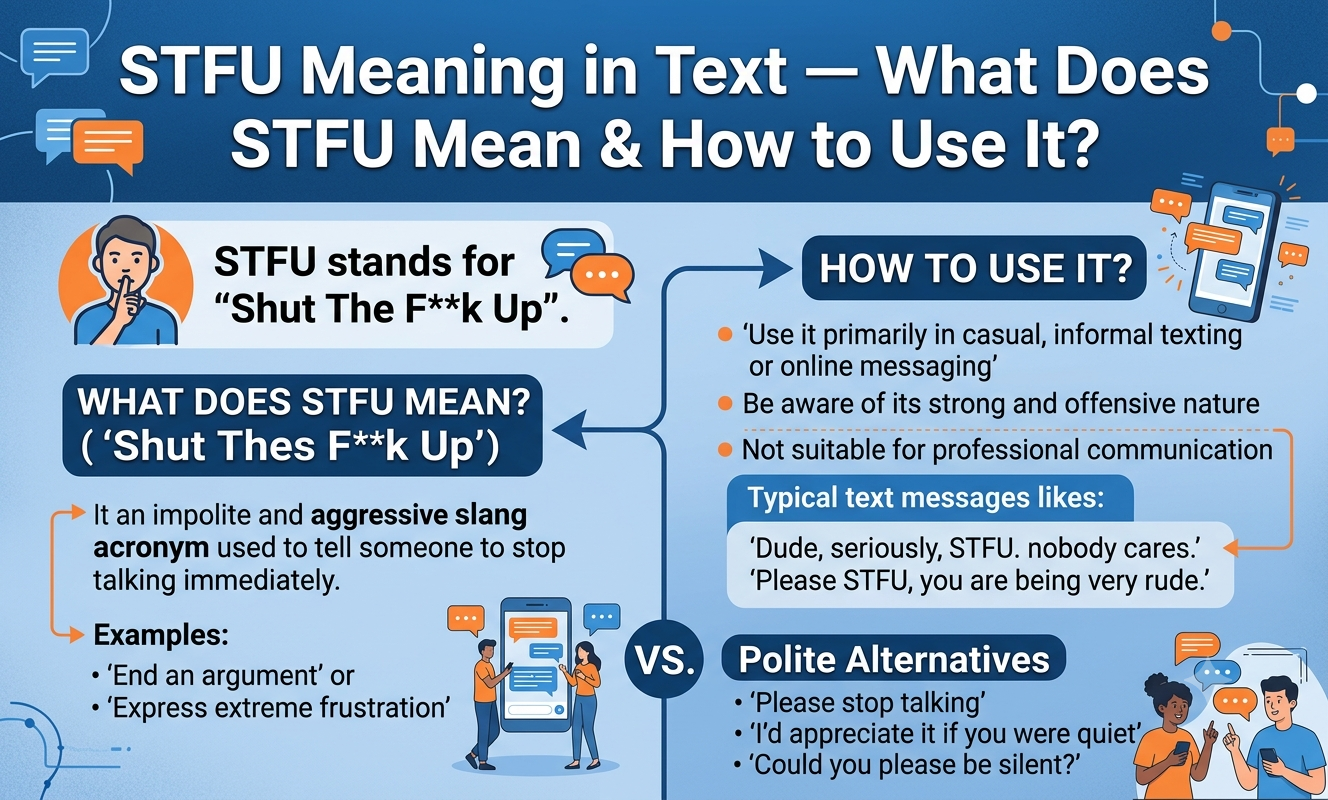
Quick Answer: STFU stands for “Shut The F* Up**.” It’s an internet slang abbreviation used to tell someone — often bluntly or jokingly — to stop talking. It can be genuinely rude when sent in anger, or completely playful and affectionate when sent between close friends reacting to shocking or funny news.
Introduction
Someone sends you “STFU” in a group chat and you’re not sure if they’re mad at you or just shocked by what you said. Sound familiar? The stfu meaning in text confuses a lot of people, especially parents scrolling through their teen’s messages for the first time.
This guide breaks down exactly what STFU means, where it came from, and how it’s actually used across WhatsApp, Snapchat, TikTok, and Instagram in 2026. You’ll get real examples, tone-based context, reply ideas, and a list of similar slang terms so you never have to guess again.
What Does STFU Mean?
STFU is a texting abbreviation for “Shut The F* Up**.” It’s one of the older, more established pieces of internet slang, tracing back to early 2000s chatrooms and instant messaging platforms like AIM and MSN Messenger, long before smartphones existed.
By 2026, STFU has settled into two very different lanes depending on who’s using it and why:
- Literal/rude usage — telling someone to stop talking because you’re annoyed, angry, or done with the conversation.
- Reactive/playful usage — an exaggerated reaction to surprising, funny, or unbelievable news, similar to saying “no way” or “shut up, seriously?”
This second meaning is by far the more common one in casual texting and social media comments today. Language researchers who track slang trends note that acronyms like STFU have shifted from purely aggressive insults toward multi-purpose reaction words, largely because of how they’re used in comment sections and group chats rather than direct arguments.
STFU Full Form Explained
Here’s the breakdown letter by letter:
| Letter | Stands For |
|---|---|
| S | Shut |
| T | The |
| F | F*** (a strong swear word) |
| U | Up |
Put together, the stfu full form is “Shut The F*** Up.” Because it contains a swear word, it’s considered mildly to moderately vulgar — more intense than acronyms like “STOP” or “IDC,” but generally less severe than harsher insults.
Some people soften it in writing by using variations like “STFUp,” “shut the front up” (a joking, kid-friendly version), or simply typing “stfu” in lowercase to make it feel more casual and less harsh.
How to Use STFU — Real Examples
Context and tone change everything with this term. Below are common situations showing how the same three-letter word can mean very different things.
| Situation | Example | Emotion |
|---|---|---|
| Friend shares shocking gossip | “Wait she did WHAT? STFU 😭” | Shock/disbelief |
| Genuine argument | “STFU, I don’t want to hear it right now.” | Anger/frustration |
| Reacting to good news | “You got the internship?? STFU that’s amazing!” | Excitement |
| Teasing a friend | “STFU you’re not that funny lol” | Playful sarcasm |
| Annoyed at repeated joking | “Okay STFU already, it wasn’t that deep.” | Mild irritation |
| Reacting to a plot twist in a show | “STFU I did NOT see that coming” | Surprise |
| Sibling banter | “Bro stfu, you cried during the movie too” | Lighthearted mockery |
| Someone brags a lot | “STFU we get it, you won.” | Sarcastic annoyance |
| Complimenting someone unexpectedly | “You look really good today. — STFU stop 😂” | Flattered/embarrassed |
| Serious online argument | “STFU. You don’t know what you’re talking about.” | Hostility |
Notice how tone, punctuation, emojis, and relationship between the people involved almost always signal whether it’s friendly or hostile.
STFU on Different Platforms (2026)
Slang doesn’t behave the same way everywhere. Here’s how STFU typically shows up across major platforms this year.
On WhatsApp
WhatsApp usage skews toward close friends, family groups, and one-on-one chats. Because conversations are more personal, STFU on WhatsApp tends to appear in its playful, reactive form — reacting to gossip, memes, or unexpected updates from people you already trust. Voice notes have also made the term common as a spoken reaction, not just typed text.
On Snapchat
Snapchat’s fast, disappearing-message culture leans heavily on short reactions. STFU is frequently used as a quick reply to Snap stories or streaks-related banter. Because messages vanish, tone is often exaggerated with caps (“STFUUU”) or extra letters to convey excitement rather than anger.
On TikTok
In TikTok comment sections, STFU is almost always used as a reaction to surprising or relatable content, not as an insult. You’ll see it stacked with laughing emojis under videos that reveal a twist, a coincidence, or something the commenter strongly relates to. TikTok’s comment culture in 2026 continues to favor short, punchy reaction phrases like this over full sentences.
On Instagram
On Instagram, STFU shows up in both DMs and comment replies. In DMs it functions similarly to WhatsApp — reactive and friendly. In public comments under influencer or meme posts, it’s typically used to express disbelief or amusement, especially in response to relatable captions or unexpected reveals.
Is STFU Rude or Offensive?
The honest answer: it depends entirely on context.
When it can be offensive:
- Sent during a genuine disagreement or argument
- Used by someone in a position of authority toward someone else disrespectfully
- Sent to a stranger or in a professional setting
- Used repeatedly to shut down someone trying to express themselves
When it’s usually not offensive:
- Sent between close friends reacting to surprising news
- Used with laughing emojis, multiple letters, or exclamation points signaling excitement
- Common in comment sections as a stand-in for “no way” or “seriously?”
For parents, the important thing to know is that seeing STFU in your teen’s messages doesn’t automatically mean something is wrong. Reading the surrounding conversation — who sent it, what came before it, and what emojis or punctuation followed — usually makes the tone obvious. If it appears in a heated exchange or seems aimed at hurting someone, that’s worth a conversation. If it follows a funny meme or exciting news, it’s almost certainly harmless slang.
How to Reply to STFU
How you respond depends on whether it was sent playfully or with genuine attitude.
| Their Message | Good Reply | Tone |
|---|---|---|
| “STFU that’s insane 😭” | “I KNOW right, I couldn’t believe it either” | Matching excitement |
| “STFU you’re lying” | “I’m dead serious, look 👇” | Playful confirmation |
| “STFU. Just stop talking to me.” | “Okay, I hear you. Let’s talk when you’re ready.” | De-escalating |
| “stfu lol” | “😂 okay okay I’ll stop” | Casual, going along with the joke |
| “STFU no way you did that” | “Yep, still can’t believe I did either” | Confident/amused |
| An angry “STFU” in an argument | “I don’t think that’s fair, can we talk calmly?” | Setting a boundary |
STFU Alternatives and Similar Slang
If you’ve seen STFU, you’ve probably come across these related terms too.
| Term | Meaning |
|---|---|
| STFU | Shut The F*** Up |
| GTFO | Get The F*** Out |
| IDC | I Don’t Care |
| SMH | Shaking My Head |
| NGL | Not Gonna Lie |
| FR | For Real |
| LMAO | Laughing My A** Off |
| WTF | What The F*** |
These terms often appear together in the same conversations, since they belong to the same family of blunt, reaction-driven internet slang.
Frequently Asked Questions (FAQ)
Q: What does STFU mean in text? A: STFU means “Shut The F*** Up.” It’s used either as a rude command to stop talking or, more commonly today, as a playful reaction to shocking or exciting news.
Q: What is the STFU full form? A: The full form of STFU is “Shut The F*** Up,” with each letter representing one word in that phrase.
Q: Is STFU always meant as an insult? A: No. While it can be used rudely during arguments, it’s very often used as a friendly, exaggerated reaction similar to saying “no way” or “seriously?”
Q: Is it okay for teens to use STFU with friends? A: Many teens use it casually and non-aggressively with close friends. Context matters more than the word itself — check tone, emojis, and the relationship between the people texting.
Q: What’s a polite way to respond to STFU? A: If it’s playful, matching their energy with a laugh or confirmation works well. If it feels aggressive or hurtful, calmly acknowledging their frustration and asking to talk it through is a healthier response than escalating.
Q: Does STFU mean the same thing on every platform? A: The core meaning stays the same, but tone shifts by platform. It tends to be more reactive and playful on TikTok and Instagram comments, and more personal (either playful or heated) on WhatsApp and Snapchat.
Conclusion
STFU is one of those texting abbreviations that changes meaning entirely based on tone, punctuation, and who’s sending it. While its literal meaning — “Shut The F*** Up” — sounds harsh, it’s frequently used in 2026 as a lighthearted reaction rather than a genuine insult. Understanding the stfu meaning in text comes down to reading the full conversation, not just the word itself.
Also read WYS Meaning in Text — What Does WYS Mean & How to Use It?
