
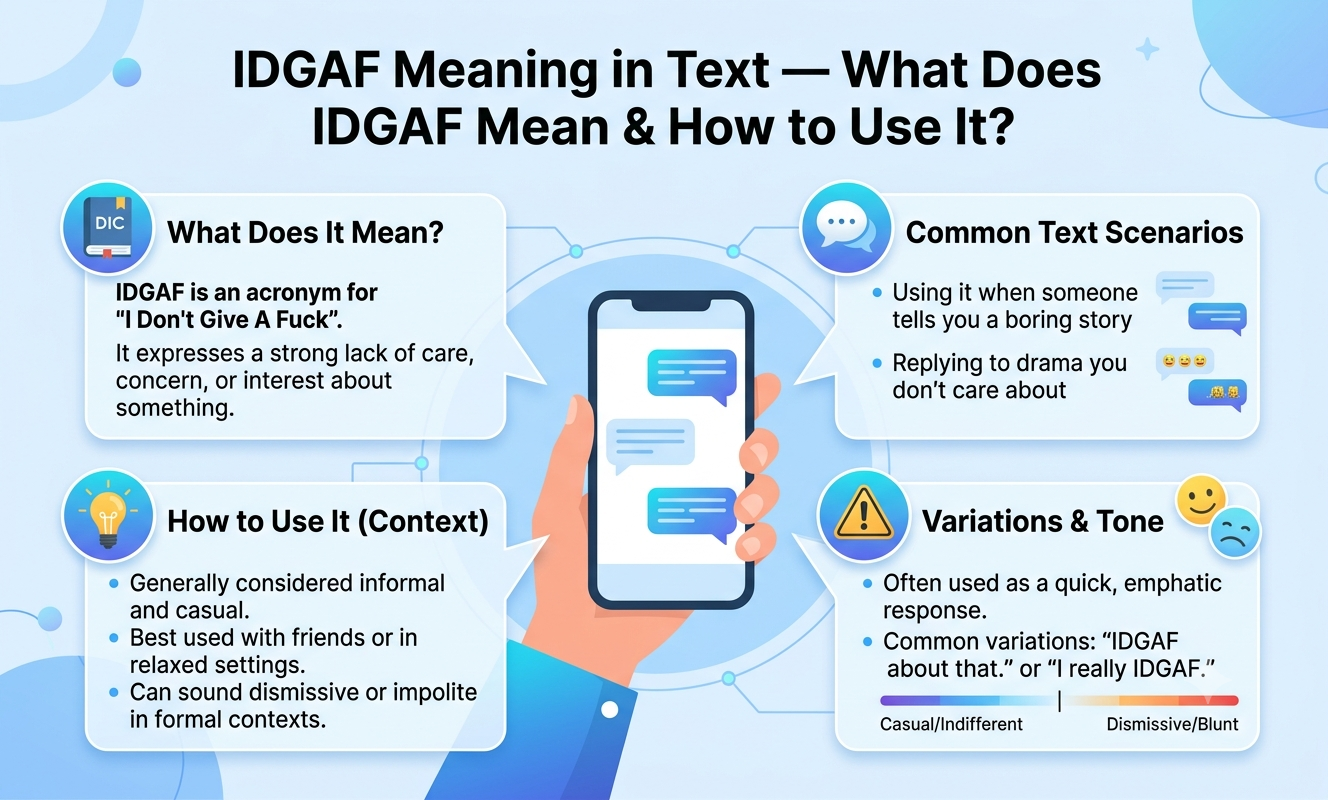
Quick Answer: IDGAF stands for “I don’t give a f*.”** In text messages and on social media, it means the person doesn’t care about something at all. It can be used as a joke, a brush-off, or an angry statement, depending on the tone and who you’re talking to.
Introduction
Ever got a message that just said “idgaf” and had no idea if the person was joking, angry, or totally over it? You’re not alone.
IDGAF meaning in text is simple on paper, but the feeling behind it changes a lot from chat to chat. Teens use it dozens of times a day. Parents often see it on a screen and feel confused, or a little worried.
In this guide, you’ll learn what IDGAF stands for, where it came from, and how people use it on WhatsApp, Snapchat, TikTok, and Instagram. You’ll also get real examples, reply ideas, similar slang, and answers to the most common questions.
Let’s start with the basics.
What Does IDGAF Mean?
IDGAF is an internet acronym for “I don’t give a f*.”** It’s a blunt way to say, “I don’t care about this at all.”
It has a stronger tone than a casual “I don’t care” because it includes a swear word. That’s why people use it when they feel very strongly, or when they want to sound bold, funny, or dramatic.
Origin and Background
IDGAF grew out of early internet chat rooms, forums, and text messaging in the 2000s. Back then, typing was slow, so people shortened everything. Long phrases became short letter groups like LOL, BRB, and SMH.
The phrase spread much wider in the 2010s, when social media and pop music made it part of everyday language. Songs, memes, and viral posts all helped IDGAF become a familiar phrase for young people around the world.
Is IDGAF Still Popular in 2026?
Yes. In 2026, IDGAF is still widely understood across texting apps and social platforms. It hasn’t become the trendiest slang of the year, but it has become a stable, long-running term, the kind people keep using because it’s quick and clear.
Newer slang comes and goes fast, but IDGAF has stayed in use for well over a decade. Many younger users now pair it with softer or funnier terms, or swap it for milder options like “idc” when they don’t want to sound harsh.
The meaning has stayed consistent, but the tone has become more flexible. Today, IDGAF can mean:
- Real anger or frustration (“I’m done with this”)
- Confidence (“I don’t care what people think”)
- Playful humor (“idgaf if it’s raining, we’re going out”)
- Emotional walls (acting like something doesn’t matter when it does)
IDGAF Full Form Explained
IDGAF is an acronym, which means each letter stands for a word. Here is the letter-by-letter breakdown:
| Letter | Stands For | Meaning |
|---|---|---|
| I | I | The speaker |
| D | Don’t | Negative word |
| G | Give | To care or offer attention |
| A | A | Connecting word |
| F | F*** | Strong swear word for emphasis |
Put together, IDGAF = “I don’t give a f*.”**
The last word is what makes the phrase strong. It adds emphasis, like underlining “I really don’t care.”
Good to know: Some people write “IDGAF” in all capital letters for extra force. Others type it in lowercase (“idgaf”) for a more relaxed, casual feel.
How to Use IDGAF — Real Examples
The best way to understand IDGAF in texting is to see it in action. The same word can carry very different feelings.
Here are 10 real-world examples across different emotional situations:
| Situation | Example | Emotion |
|---|---|---|
| Friend asks where to eat | “Honestly idgaf, pick anything 😂” | Relaxed / Indifferent |
| Someone gossips about you | “They can talk all they want, idgaf.” | Confident |
| After a big argument | “Do whatever you want. idgaf anymore.” | Angry |
| Being teased about your outfit | “Wear what you like, idgaf what anyone thinks” | Bold / Empowered |
| Group chat debate about a movie | “Idgaf who wins the Oscar, I just want snacks” | Playful / Funny |
| Ignoring drama | “Not my problem, idgaf.” | Detached |
| Hiding hurt feelings | “Nah I’m fine, idgaf lol” | Sad / Defensive |
| Ready to leave a bad situation | “I’m done trying. idgaf at this point.” | Exhausted |
| Joking with best friend | “You’re late AGAIN? idgaf, I already ate 😭” | Sarcastic / Joking |
| Setting a personal boundary | “I quit caring about their opinions. idgaf.” | Liberated |
Tips for Reading the Tone
Since text has no voice or face, watch for clues:
- Emojis (😂, 😭) usually mean the message is playful.
- Punctuation like “idgaf.” with a period can sound cold or serious.
- Context matters most. If it comes after an argument, it likely isn’t a joke.
- The person’s usual style helps. Some friends use it in almost every message, and it doesn’t mean much.
IDGAF on Different Platforms (2026)
Every app has its own texting culture. IDGAF is used everywhere, but the style changes from platform to platform.
Here’s a quick overview of the four big ones. These platforms all count their users in the hundreds of millions to billions, so one short phrase can travel very fast.
On WhatsApp
WhatsApp is one of the most-used messaging apps in the world, with well over 3 billion monthly users reported by its parent company. It’s especially big in India, Brazil, and much of Europe and Africa.
On WhatsApp, IDGAF shows up mostly in private chats and friend groups. It’s usually casual, like “idgaf where we go, just get me chai.” In family group chats, you’ll see it much less, because the audience is different.
Typical use: Casual humor and quick replies between close friends.
On Snapchat
Snapchat has around 900 million monthly users worldwide, and its audience skews young. Because messages disappear, people write more freely and more dramatically.
On Snapchat, IDGAF often appears on Stories, captions, and quick chats. You might see it on a selfie with a caption like “new hair, idgaf 💁.” It’s often used to show attitude or confidence.
Typical use: Personal expression, attitude, and dramatic captions.
On TikTok
TikTok has well over 1 billion monthly users, and its slang moves quickly. Trends and sounds can make a phrase go viral overnight.
On TikTok, IDGAF is used in captions, comments, and video text. Creators use it in “I don’t care what people think” style videos, glow-up clips, and comedy skits. In comments, it can also be a way of shrugging off negativity.
Typical use: Confidence content, humor, and reacting to trends.
On Instagram
Instagram has reached roughly 3 billion monthly users, and it mixes photos, Reels, Stories, and DMs.
On Instagram, IDGAF appears in bios, captions, and DMs. Some people put it in a bio to show a “don’t care what you think” attitude. In DMs, it’s more casual and personal.
Typical use: Bios, aesthetic captions, and private chats.
Note: These numbers come from the companies’ own public reports and change regularly, so treat them as approximate figures.
Is IDGAF Rude or Offensive?
The honest answer: it depends on who you’re talking to and how you use it.
The Case That It’s Not Offensive
- Among close friends, IDGAF is often just casual, joking language.
- It’s usually not aimed at a person. It’s aimed at a situation (“idgaf about the exam”).
- It’s very common in songs, memes, and everyday online talk.
The Case That It Can Be Rude
- It contains a swear word, even when abbreviated.
- Said to someone directly (“idgaf about you”), it can hurt feelings or feel disrespectful.
- In school, at work, or with family and elders, it can come across as unprofessional or impolite.
A Simple Rule of Thumb
Ask yourself two questions before sending it:
- Who is reading this? Best friend = usually fine. Teacher or boss = not a good idea.
- Am I aiming it at a person or a situation? Situations are safer than people.
A Note for Parents
If you see your teen using IDGAF, it’s usually normal slang and not a sign of trouble. But if it appears alongside signs of sadness, withdrawal, or constant anger, it may be worth a calm, friendly check-in. Sometimes “idgaf” is a way of hiding hurt.
How to Reply to IDGAF
Your reply depends on the situation and the tone you sense. Here are six options:
| Situation | Reply Example | Tone |
|---|---|---|
| Friend is joking | “Haha okay boss 😂” | Playful |
| Friend seems upset | “Hey, you okay? You can talk to me.” | Caring |
| You disagree politely | “Fair enough, but it matters to me.” | Calm |
| The person is being rude | “That’s not a nice way to say it.” | Firm |
| You want to lighten the mood | “Same, let’s get pizza instead.” | Funny |
| You suspect they’re hurt | “I’m here if you want to talk later.” | Supportive |
Reply Tips
- Don’t react in anger. Take a breath before you answer.
- Read the mood first. Playful and serious messages need different replies.
- When in doubt, ask. A simple “Are you joking or upset?” clears things up fast.
IDGAF Alternatives and Similar Slang
Not everyone wants to use a swear word. Here are similar terms, from milder to stronger:
| Slang | Meaning | Strength |
|---|---|---|
| IDC | I don’t care | Mild |
| IDK / IDRC | I don’t know / I don’t really care | Mild |
| NBD | No big deal | Very mild |
| Whatever | I’m not interested or don’t mind | Mild |
| IDGAS | I don’t give a s*** | Strong |
| IDGAD | I don’t give a d*** | Strong |
| IDFC | I don’t f***ing care | Strong |
| Couldn’t care less | I have zero interest | Medium |
Which One Should You Choose?
- With friends: IDGAF or IDC both work.
- With family or teachers: Stick to IDC or “I don’t mind.”
- Online in public: IDC is safer, since your post could be seen by anyone.
Frequently Asked Questions (FAQ)
Q: What does IDGAF mean in text?
A: IDGAF means “I don’t give a f***.” In text messages, it shows that the person doesn’t care about a topic, person, or situation.
Q: What is the full form of IDGAF?
A: The IDGAF full form is “I Don’t Give A F***.” Each letter stands for one word: I, Don’t, Give, A, F***.
Q: Is IDGAF a bad word?
A: IDGAF is slang that includes a swear word, so it can be considered impolite. It’s usually fine between close friends, but not appropriate for school, work, or formal talk.
Q: What is the difference between IDGAF and IDC?
A: IDC means “I don’t care” and is milder. IDGAF carries the same meaning but with stronger emotion and emphasis.
Q: How do I respond if someone texts me IDGAF?
A: Read the tone first. If it seems like a joke, reply playfully. If the person seems upset, check in kindly. If it feels rude, you can calmly say you don’t like that tone.
Q: What does IDGAF mean on Snapchat or TikTok?
A: On Snapchat and TikTok, IDGAF slang usually shows confidence or attitude. People use it in captions and comments to say they don’t care about criticism or trends.
Q: Can I use IDGAF in a professional message?
A: No. Avoid IDGAF in emails, school messages, or work chats. Use professional wording like “I have no preference” instead.
Conclusion
To wrap it up, IDGAF meaning in text is “I don’t give a f***,” a strong way of saying you don’t care. It can be funny, confident, angry, or even a mask for hurt feelings, so the tone and context are everything.
Remember these key points:
- IDGAF is an acronym with a swear word, so use it carefully.
- It’s common among friends on WhatsApp, Snapchat, TikTok, and Instagram.
- Milder options like IDC are safer for family, school, and work.
- Always read the mood before you reply.
Found this guide helpful? Bookmark this page so you can check the next time a confusing slang term pops up in your chat. And share it with a friend or parent who’s still asking, “Wait, what does idgaf mean?”
Also read BD Meaning in Text — What Does BD Mean & How to Use It?

1 Comment
Pingback: RQ Meaning in Text — What Does RQ Mean & How to Use It? (2026)