
Ever got a message like “ima text you when I get home” and wondered if it was a typo? You’re not alone. Parents, teachers, and even some teens get confused by this tiny word.
The good news: ima meaning in text is simple. It is a short form of “I’m going to,” and once you spot it, you’ll see it everywhere in chats, comments, and captions.
In this guide, you’ll learn what ima means, where it came from, and how to use it in real conversations. You’ll also see how it shows up on WhatsApp, Snapchat, TikTok, and Instagram in 2026. We’ll cover whether it’s rude, how to reply, and which similar slang words you should know.
Whether you’re a teen who wants to text naturally or a parent trying to decode your child’s messages, this article has you covered.
What Does Ima Mean in Text?
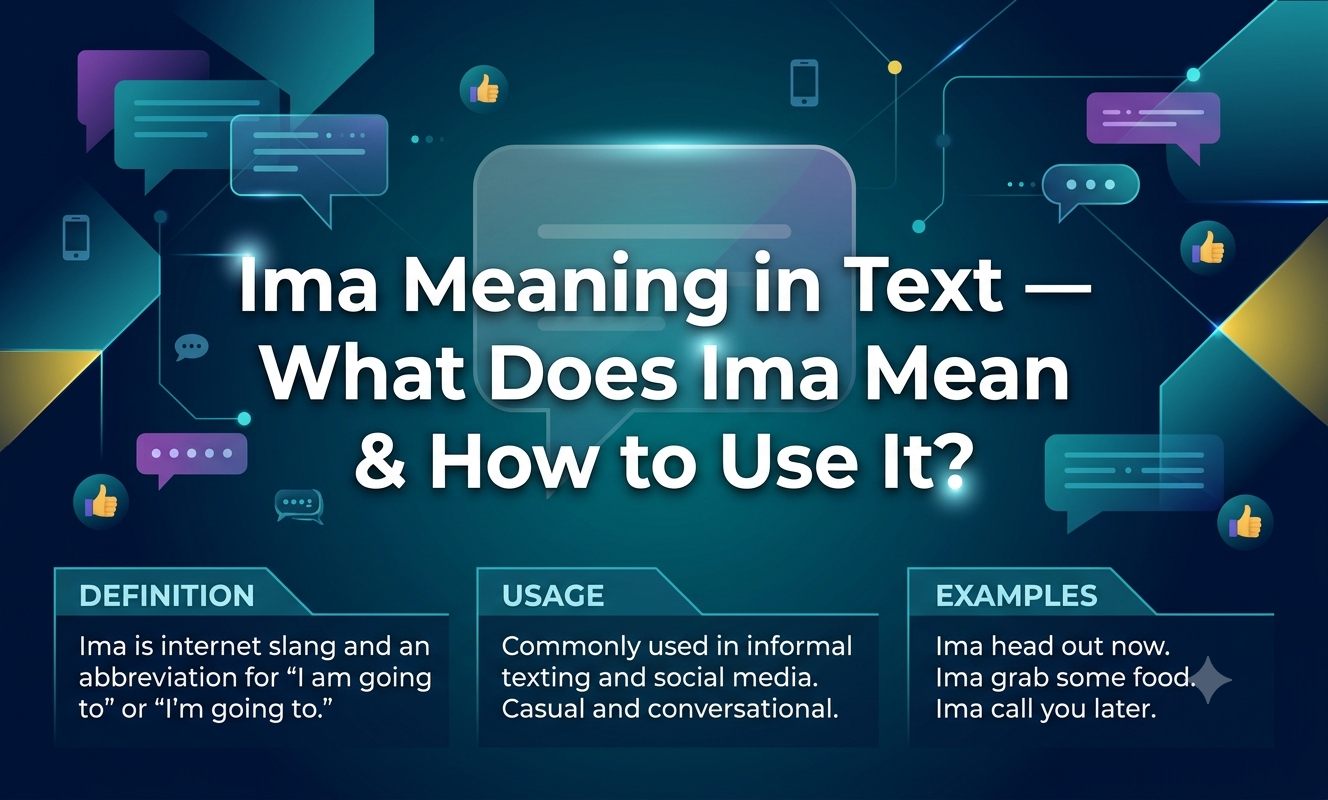
Ima is a casual contraction. It squeezes “I am going to” or “I’m going to” into one quick word. People use it to state a plan, an intention, or a promise.
Here are the most common ways you’ll see it:
- “Ima eat first, then call you.”
- “Ima be late, sorry!”
- “Ima send you the link now.”
You may also see it written as “I’ma” with an apostrophe. Both mean the same thing. In fast texting, most people drop the apostrophe and write ima.
Where Does Ima Come From?
Ima didn’t start online. It comes from spoken English, where “I’m going to” gets shortened step by step:
- I am going to
- I’m going to
- I’m gonna
- I’ma
The “I’ma” form has long been used in African American English and spread widely through music, especially hip-hop and R&B. From there it moved into everyday speech and then into texting. People write the way they talk online, so spoken “I’ma” naturally became typed ima.
Why Is Ima Still Popular in 2026?
Texting is built for speed. In 2026, most chats happen on phones, often with voice-to-text or one thumb. Short forms like ima save time and sound relaxed.
Ima is also a “sounds like I talk” word. Short-form video and voice notes keep spoken-style language in the spotlight, so it keeps showing up in messages and captions. It has been around for years and shows no sign of fading.
Ima Meaning in Text: Full Form Explained
Ima is not a true acronym like LOL or BRB. It is a contraction, a short form that blends words together. Still, you can break it down piece by piece.
| Part | What It Stands For |
|---|---|
| I | I |
| ‘m | am |
| a | going to (from “gonna” → “a”) |
So the full form of ima is “I am going to” or “I’m going to.”
Here’s how it compares to similar forms:
| Written Form | Full Meaning | Tone |
|---|---|---|
| I am going to | Formal, complete | Neutral |
| I’m gonna | Casual | Relaxed |
| I’ma / ima | Very casual | Fast, spoken-style |
A quick note: ima is not the same as “IMA” in capital letters, which can be a company name, an abbreviation in other fields (like medical or business groups), or a username. In texting, lowercase ima almost always means “I’m going to.”
How to Use Ima — Real Examples
The trick to using ima is simple: put it before a verb (an action word). Think “ima + do something.”
Here are real-life examples across different moods and situations:
| Situation | Example | Emotion |
|---|---|---|
| Making a plan | “Ima meet you at the mall at 5.” | Neutral |
| Running late | “Ima be 10 mins late, don’t start without me.” | Apologetic |
| Getting excited | “Ima screenshot this and show everyone 😂” | Excited |
| Being determined | “Ima finish this project tonight, no excuses.” | Motivated |
| Feeling tired | “Ima sleep for like 12 hours.” | Exhausted |
| Feeling annoyed | “Ima block him if he texts again.” | Frustrated |
| Showing love | “Ima cook your favorite dinner tonight.” | Caring |
| Joking around | “Ima be famous one day, remember this text.” | Playful |
| Giving a warning | “Ima tell mom if you don’t clean up.” | Teasing |
| Feeling nervous | “Ima ask her out tomorrow, wish me luck.” | Nervous |
Quick Tips for Using Ima
- Use it before a verb: “ima go,” “ima call,” “ima eat.”
- Keep it to casual chats with friends and family.
- Don’t use it in school essays, work emails, or job applications.
- Pair it with emojis if you want to show your mood.
Next, let’s see how ima looks on the apps people use every day.
Ima on Different Platforms (2026)
Ima works the same way everywhere, but each platform has its own style. Here’s what to expect in 2026.
On WhatsApp
WhatsApp is the go-to app for family chats, friend groups, and voice notes. In 2026 it remains one of the biggest messaging apps worldwide.
On WhatsApp, ima usually appears in quick plan-making:
- “Ima reach in 10 minutes.”
- “Ima send the photos in the group.”
Because family and friends mix in one app, you’ll see ima next to more formal messages. That’s normal. People switch tone depending on who they’re talking to.
On Snapchat
Snapchat is all about fast, casual, in-the-moment messages. Snaps and chats disappear quickly, so spelling and grammar take a back seat.
Common Snapchat uses:
- “Ima snap you when I’m out.”
- “Ima send this to the group chat 😭”
Ima fits well here because Snapchat conversations feel like talking out loud.
On TikTok
On TikTok, ima shows up in captions, comments, and sounds. Creators use it to hype up what they’re about to do or show.
Examples:
- “Ima try this recipe so you don’t have to 😂”
- Comment: “Ima use this sound for my next video.”
In 2026, TikTok-style short video keeps spoken-style language popular, and viewers often copy phrases they hear in videos. That helps ima stay familiar.
On Instagram
On Instagram, ima appears in DMs, Stories, Reels captions, and comments.
Examples:
- Story text: “Ima be posting more this month, stay tuned.”
- Comment: “Ima need this outfit in my life 😍”
Instagram tends to be a bit more polished than Snapchat, but ima still fits in casual captions and replies.
Platform Trends to Know in 2026
- Voice notes and voice-to-text are common, so typed words often mirror how people speak.
- Short-form video keeps casual slang circulating quickly across platforms.
- People often use the same slang across apps, so what you see on TikTok soon shows up in DMs.
Is Ima Rude or Offensive?
Short answer: no, ima is not rude or offensive. It’s a harmless contraction. Still, context matters.
Why Ima Is Usually Fine
- It’s simply a short way to say “I’m going to.”
- It carries no bad meaning or hidden insult.
- Friends, family, and classmates use it all the time.
When Ima Might Feel Out of Place
- Formal settings: Emails to teachers, bosses, or clients should use full words.
- Professional writing: Resumes, reports, and school work need proper grammar.
- Misunderstanding the tone: Phrases like “Ima tell you something” can sound serious, or even like a threat, if the context is tense. For example, “Ima get you back” may be a joke between friends or a real warning, so tone and emojis matter.
A Note for Parents
If you see ima in your child’s messages, there’s nothing to worry about. It is normal informal language, not code for anything harmful. If a message feels worrying, look at the whole conversation rather than one word.
How to Reply to Ima
You don’t reply to the word ima itself. You reply to what the person plans to do. Here are easy reply options:
| Message | Sample Reply | Tone |
|---|---|---|
| “Ima be there in 5.” | “Cool, see you soon!” | Friendly |
| “Ima call you later.” | “Sounds good, talk then.” | Casual |
| “Ima need your help tomorrow.” | “Sure, what do you need?” | Helpful |
| “Ima skip the party tonight.” | “Aw, why? Everything okay?” | Caring |
| “Ima tell you a secret.” | “Ooh, go on 👀” | Playful |
| “Ima be late again, sorry.” | “No worries, just text me when you’re close.” | Understanding |
Reply Tips
- Match the other person’s tone.
- Keep it short in casual chats.
- Use emojis when the mood is light.
- If you don’t understand a message, just ask: “What do you mean?”
Ima Alternatives and Similar Slang
Ima has plenty of cousins in texting. Here are similar terms and what they mean:
| Slang | Meaning | Example |
|---|---|---|
| Gonna | Going to | “I’m gonna text you later.” |
| Imma | Another spelling of ima (“I’m going to”) | “Imma head out now.” |
| I’ma | The apostrophe form of ima | “I’ma call you soon.” |
| Wanna | Want to | “I wanna see that movie.” |
| Gotta | Got to / have to | “I gotta go, bye!” |
| Finna | Fixing to / about to (mainly Southern U.S. and African American English) | “I’m finna leave.” |
| Tryna | Trying to | “I’m tryna study right now.” |
| BRB | Be right back | “BRB, grabbing food.” |
Most of these follow the same pattern: people blend words together to sound like they’re speaking out loud.
Frequently Asked Questions (FAQ)
Q: What does ima mean in text?
A: Ima meaning in text is “I’m going to.” It is a casual short form used to talk about something you plan to do, like “Ima call you later.”
Q: What is the full form of ima?
A: The full form of ima is “I am going to” or “I’m going to.” It is a contraction, not a true acronym.
Q: Is ima the same as imma or I’ma?
A: Yes. Ima, imma, and I’ma are all different spellings of the same phrase. All of them mean “I’m going to.”
Q: Is ima slang or proper English?
A: Ima is informal slang. It’s fine for texting and chatting with friends, but you should avoid it in formal writing, such as school essays or work emails.
Q: Is ima rude or offensive?
A: No. Ima is not rude. It only becomes confusing or sharp if the sentence around it is aggressive, such as “Ima get you back.”
Q: How do you use ima in a sentence?
A: Put ima before a verb. For example: “Ima eat dinner,” “Ima watch that show,” or “Ima be there soon.”
Q: Can ima mean something else?
A: In lowercase texting, ima almost always means “I’m going to.” In capital letters, IMA can be an organization name or abbreviation outside of slang, so check the context.
Conclusion
Now you know that ima meaning in text is simply “I’m going to,” a quick, casual way to share what you’re about to do. It grew out of everyday speech, spread through music and social media, and is still widely used across WhatsApp, Snapchat, TikTok, and Instagram in 2026.
Remember the key points: ima goes before a verb, it’s not rude, and it belongs in casual chats rather than formal writing. If you ever get confused by a message, check the full sentence for context.
Want to keep up with other texting slang? Bookmark this page and share it with a friend or parent who’s still wondering about the ima meaning in text.
Also read FWM Meaning in Text — What Does FWM Mean & How to Use It?

1 Comment
Pingback: TS Meaning in Text Instagram: What Does TS Mean & How to Use It (2026)