
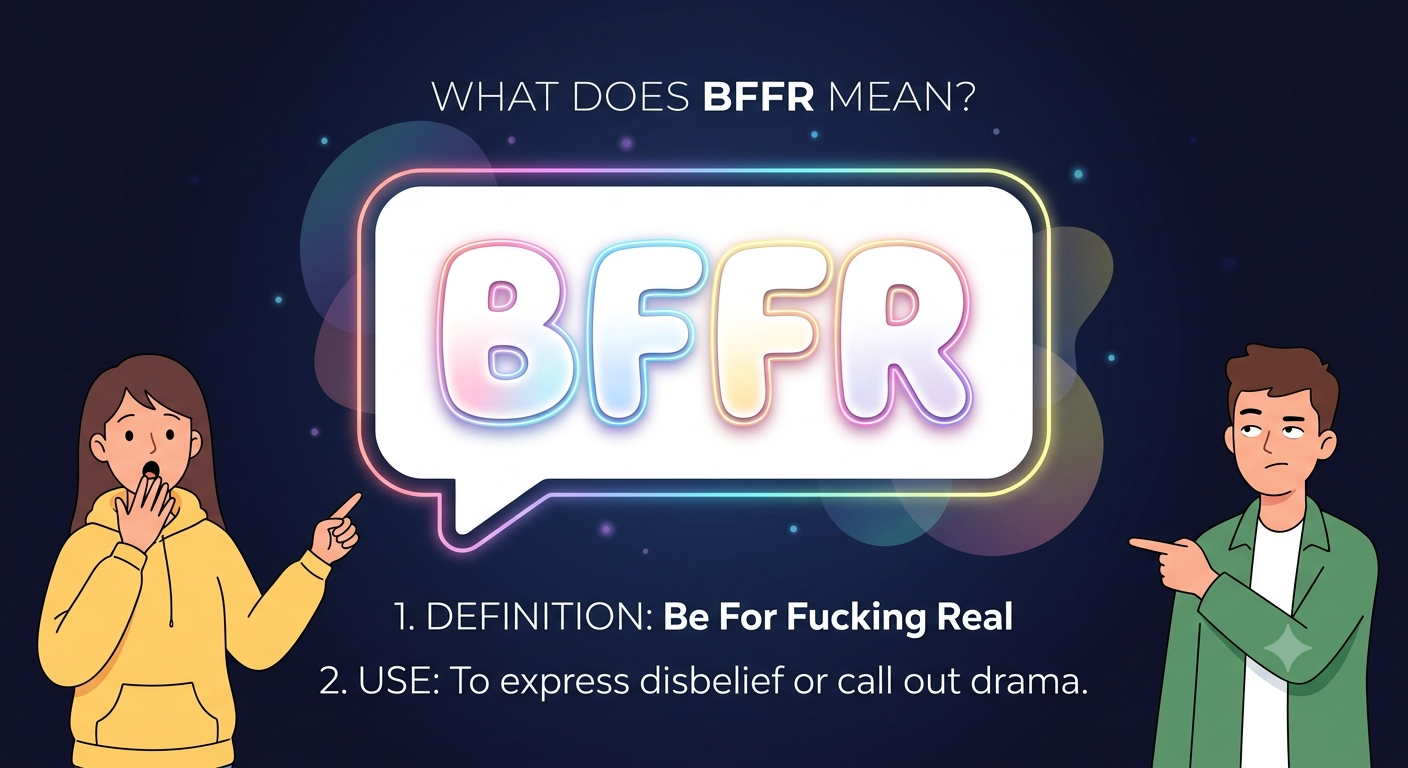
BFFR meaning in text is “Be F**king For Real.” It’s a slang phrase used online and in texting to call out something as unbelievable, exaggerated, or dramatic. People use it when they want someone to stop joking, stop lying, or admit the truth — basically saying, “seriously, stop playing.”
Introduction
Scrolling through a group chat and someone drops “BFFR” and you have no idea what’s going on? You’re not alone. This short slang term has taken over comment sections, Snapchat streaks, and TikTok replies, and if you’re not up to date, it can feel like reading a different language.
The bffr meaning in text boils down to one simple idea: someone thinks you’re not being serious, and they want the real story. It’s blunt, it’s a little sassy, and it’s everywhere in 2026 texting culture.
In this guide, you’ll learn exactly what BFFR stands for, where it came from, how teens and adults use it across different apps, whether it’s considered rude, and how to reply when someone sends it to you. By the end, you’ll be able to use it confidently — or at least understand it the next time it lands in your notifications.
What Does BFFR Mean?
BFFR is an internet acronym that expanded from “Be For Real“ — an older, milder phrase — into the more intense “Be F**king For Real.” Both versions mean roughly the same thing: stop exaggerating, stop joking around, or tell me the actual truth.
The phrase grew out of everyday spoken slang, where “for real?” has long been used to question something surprising. Adding “be” in front turned it into a command, and internet culture added the emphasis word to make it hit harder.
According to 2026 slang-tracking data from platforms like Urban Dictionary and social listening tools, BFFR usage spiked heavily starting around 2023 on TikTok comment sections, then carried into Gen Z texting habits through 2025 and 2026. It’s now considered a staple of everyday casual chat slang, right alongside terms like “no cap” and “ong.”
Unlike some slang that fades fast, BFFR has stuck around because it’s short, expressive, and works in almost any situation where someone doubts what they’re hearing.
BFFR Full Form Explained
Breaking the acronym down letter by letter makes it easy to remember:
| Letter | Stands For |
|---|---|
| B | Be |
| F | F**king |
| F | For |
| R | Real |
So the full phrase reads: “Be F**king For Real.” Some people use the softer version, “Be For Real” (without the middle word), especially in family group chats, school settings, or workplace messages where stronger language isn’t appropriate. Both mean the same thing — it’s really just a matter of tone and audience.
How to Use BFFR — Real Examples
BFFR works in almost any emotional context: disbelief, excitement, frustration, or even affection. Here are examples across different situations.
| Situation | Example | Emotion |
|---|---|---|
| Friend brags about a huge achievement | “I just got accepted into three colleges.” “BFFR?? That’s amazing!” | Shock/Excitement |
| Someone tells an unbelievable story | “My cat opened the fridge and made itself a sandwich.” “Bffr right now.” | Disbelief/Humor |
| Sarcastic exaggeration | “I haven’t slept in four days.” “Bffr, you slept in class yesterday.” | Playful teasing |
| Genuine frustration | “He said he’d text back and never did.” “BFFR, that’s so annoying.” | Annoyance |
| Reacting to gossip | “Apparently they broke up again.” “Bffr? For the fifth time?” | Surprise |
| Complimenting someone | “You look amazing today.” “Bffr, stop it.” | Flattered disbelief |
| Calling out a lie | “I totally meant to do that.” “Bffr, you clearly didn’t.” | Calling out |
| Reacting to good news | “I got the job!” “BFFR LETS GOOO” | Joy |
| Doubting a plan | “We’re leaving at 6 am sharp.” “Bffr, you’re never on time.” | Skepticism |
| Emphasizing seriousness | “I need you to actually be honest with me. Bffr.” | Sincerity |
Notice how the tone shifts depending on punctuation and capitalization — all lowercase feels casual, while all caps (“BFFR”) adds extra energy or shock.
BFFR on Different Platforms (2026)
Slang doesn’t behave the same way across every app. Here’s how BFFR shows up depending on where you’re texting.
On WhatsApp
WhatsApp tends to be used for closer, more personal conversations — family, close friends, or small group chats. On WhatsApp in 2026, BFFR usually appears in reaction to voice notes or long text stories, often paired with laughing emojis or exclamation marks to soften the tone.
On Snapchat
Snapchat is where BFFR feels most natural, since conversations are quick, casual, and full of back-and-forth banter. It’s commonly typed in chat replies to Snap stories, especially reacting to bold outfit choices, surprising updates, or streak-related jokes.
On TikTok
TikTok comment sections are arguably where BFFR became mainstream. In 2026, it’s extremely common under videos showing wild claims, dramatic reveals, or “storytime” content, where commenters use it to express collective disbelief at what they just watched.
On Instagram
On Instagram, BFFR shows up most in DMs and comment replies to Reels or Stories. It’s frequently used sarcastically under posts with captions that seem exaggerated, like “best day of my life” attached to a mundane photo.
Across all four platforms, the core meaning stays the same — the only thing that changes is the tone, based on the platform’s overall vibe.
Is BFFR Rude or Offensive?
This depends heavily on context and who you’re talking to.
Why some people find it fine: Among friends, BFFR is almost always harmless. It’s playful slang used to react, tease, or express shock — not meant to insult anyone. Most teens and young adults treat it like any other casual internet expression.
Why some people find it inappropriate: Because the full form includes a swear word, some parents, teachers, or older relatives may see it as disrespectful, especially in formal or unfamiliar settings. Using it toward a stranger, a boss, or in a serious conversation could come across as dismissive or rude.
Context matters most. Between close friends in a casual chat, BFFR is generally seen as normal slang. In professional messages, school assignments, or conversations with people you don’t know well, it’s safer to skip it — or use the softer “Be For Real” version instead.
How to Reply to BFFR
If someone sends you “BFFR,” here are a few natural ways to respond depending on the situation.
| Their Message | Your Reply | Tone |
|---|---|---|
| “Bffr??” (in disbelief) | “I know, right?! It’s true though.” | Confirming |
| “BFFR” (accusing you of exaggerating) | “Okay fine, maybe I stretched the truth a little.” | Admitting |
| “Bffr, that’s crazy!” | “Literally, I couldn’t believe it either.” | Agreeing |
| “Bffr rn” (about something you said) | “Dead serious, I promise.” | Reassuring |
| “BFFR😭” (laughing in shock) | “I can’t make this stuff up lol” | Playful |
| “Bffr, stop joking” | “Not joking at all, ask anyone.” | Firm |
BFFR Alternatives and Similar Slang
BFFR isn’t the only phrase teens and young adults use to express disbelief. Here are similar terms you might see alongside it.
| Slang | Meaning |
|---|---|
| No cap | No lie, telling the truth |
| Fr fr | For real, for real — emphasizing sincerity |
| Ong | On God, swearing something is true |
| Deadass | Seriously, not joking |
| Bet | Agreement or confirmation |
| Sus | Suspicious or questionable |
| Lowkey / Highkey | Somewhat / very much (used to soften or emphasize a statement) |
| Say less | Understood, no more explanation needed |
These terms often appear together in the same conversation, layering on top of each other for extra emphasis, like “no cap, bffr, this actually happened.”
Frequently Asked Questions (FAQ)
Q: What does BFFR mean in text? A: BFFR meaning in text is “Be F**king For Real,” a slang phrase used to question whether someone is exaggerating or to demand honesty.
Q: What is the BFFR full form? A: The full form of BFFR is “Be F**king For Real,” though a softer version, “Be For Real,” is also common in less casual settings.
Q: Is BFFR the same as “no cap”? A: Not exactly. “No cap” means someone isn’t lying, while BFFR is a reaction asking someone to confirm they’re being truthful or to stop exaggerating.
Q: Is BFFR appropriate to use with parents or teachers? A: It’s generally better to avoid it in formal settings due to the language involved. The milder “Be For Real” works as a safer alternative.
Q: Where did BFFR slang come from? A: BFFR grew out of casual phrases like “for real?” and became popular through TikTok comments and Gen Z texting slang, gaining mainstream traction through the mid-2020s.
Q: Can BFFR be used positively? A: Yes. It’s often used to react to good news or impressive achievements, expressing excited disbelief rather than doubt or annoyance.
Conclusion
BFFR is one of those small texting terms that packs a lot of personality into four letters. Whether it’s reacting to an unbelievable story, calling out an exaggeration, or expressing shock at good news, the bffr meaning in text always comes back to one thing: wanting the real, honest truth.
Now that you know what it stands for, how it shows up across WhatsApp, Snapchat, TikTok, and Instagram, and when it’s okay (or not okay) to use, you’ll never be confused by it again. Bookmark this page so you’re always ready to decode the latest texting slang — BFFR and beyond.
