
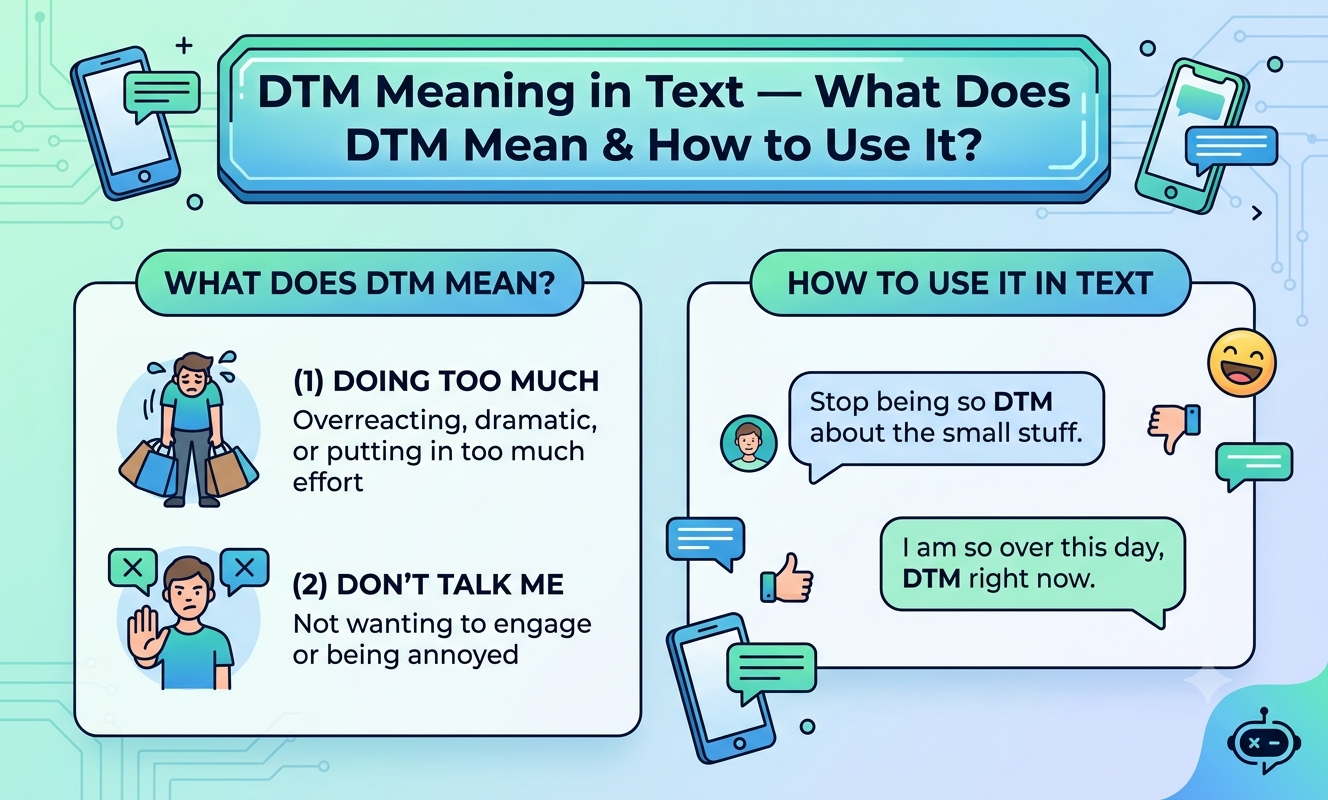
Quick Answer: DTM in text usually means “Doing Too Much,” used to call out someone who’s being extra or overreacting. Depending on the conversation, it can also mean “Down to Meet,” “Don’t Text Me,” or “Dead to Me.” The right meaning always depends on context, platform, and who’s texting.
Introduction
You open your phone, see a text that just says “DTM,” and your brain goes blank. Sound familiar?
That three-letter combo shows up everywhere in 2026 — group chats, TikTok comments, Snapchat replies — and it doesn’t mean the same thing twice. The DTM meaning in text shifts depending on who sent it, what the conversation was about, and even the platform it landed on.
This guide breaks down every version of DTM you’ll actually run into, shows you real example texts for each one, tells you how to reply without embarrassing yourself, and covers whether it’s considered rude. By the end, you’ll never have to stare at a “DTM” text wondering what just happened.
What Does DTM Mean?
DTM is a texting abbreviation with more than one common meaning, which is what makes it tricky. Unlike acronyms with one fixed definition, DTM is a context-dependent slang term — the letters stay the same, but the meaning bends to fit the conversation.
The four meanings you’ll see most often are:
- Doing Too Much — the most widely used version, describing someone being overly dramatic or putting in more effort than a situation calls for
- Down to Meet — a casual way of saying you’re open to hanging out or meeting up
- Don’t Text Me — a blunt way of shutting down a conversation
- Dead to Me — a dramatic (often joking) way of saying someone is cut off
Like most internet slang, DTM didn’t come from one single source. It grew out of the same texting culture that gave us abbreviations like “LOL” and “SMH” — people looking for a fast way to react to something without typing a full sentence. “Doing Too Much” became the dominant meaning through its heavy use in reaction comments and memes, where calling something “DTM” is a quick way to say “this is a lot” without sounding harsh.
Because DTM never fully settled into one meaning, reading the room is more important than memorizing a definition. A text from a friend reacting to a dramatic Instagram story means something completely different from a text your crush sends after you ask to hang out.
DTM Full Form Explained
Since DTM isn’t tied to a single phrase, there’s no one “correct” full form — but here’s how each version breaks down letter by letter.
| Letter | Doing Too Much | Down to Meet | Don’t Text Me | Dead to Me |
|---|---|---|---|---|
| D | Doing | Down | Don’t | Dead |
| T | Too | to | Text | to |
| M | Much | Meet | Me | Me |
Doing Too Much is the version you’ll see most in comment sections and casual chats. Down to Meet shows up more in dating apps and plans-making texts. Don’t Text Me and Dead to Me both appear when someone is annoyed or ending contact, though often with a joking tone rather than a genuinely serious one.
How to Use DTM — Real Examples
The clearest way to understand DTM is to see it in action. Here are examples across different emotional contexts, so you can spot the tone instantly.
| Situation | Example Text | Emotion |
|---|---|---|
| Friend writes a three-paragraph caption about a minor inconvenience | “Bro wrote an essay about spilled coffee, DTM” | Playful teasing |
| Someone spends hours perfecting a simple selfie | “She edited that pic for 2 hours… DTM” | Amused/mocking |
| A friend asks if you want to grab food later | “DTM if you’re down, just lmk the time” | Casual, friendly |
| Someone gets extremely upset over a small mistake | “He’s yelling over a typo, this is so DTM” | Exasperated |
| A group chat is planning a weekend hangout | “DTM this weekend, count me in” | Enthusiastic |
| A friend keeps texting after being asked to stop | “I said DTM like three times already” | Annoyed |
| Someone overreacts to a joke | “It was a joke and they blocked me… DTM” | Frustrated |
| A person creates an elaborate plan for something simple | “He made a slideshow to ask her to prom, kinda DTM but cute” | Mixed — impressed and amused |
| Ex reaches out after months of silence | “Nah, they’re DTM after what they did” | Cold, final |
| Friend overanalyzes a text for an hour | “You’re being so DTM about one emoji” | Gently mocking |
Notice how tone, punctuation, and the relationship between the two people change what DTM communicates — even though the letters never change.
DTM on Different Platforms (2026)
DTM shows up differently depending on where you’re texting or scrolling. Each platform has developed its own flavor of the term.
On WhatsApp
WhatsApp conversations tend to be more personal and ongoing, so DTM here usually leans toward “Down to Meet” or “Doing Too Much” used between friends and family in longer chat threads. Voice notes have also made it common for people to say the full phrase out loud rather than typing the abbreviation.
On Snapchat
Because Snapchat conversations are quick, disappearing, and casual, DTM often shows up as a fast reaction to a Snap or Story — usually the “Doing Too Much” meaning, reacting to someone’s over-the-top post or Snap.
On TikTok
TikTok comment sections are where “Doing Too Much” really took off. People drop “DTM” under videos showing exaggerated reactions, elaborate setups for simple tasks, or dramatic storytelling — it’s become a shorthand way to call out content that’s a little much, usually affectionately.
On Instagram
On Instagram, DTM appears in both comments and DMs. In comments, it mirrors the TikTok usage — calling out an over-the-top caption or post. In DMs, especially between people getting to know each other, it can lean toward “Down to Meet” when making plans.
Across all these platforms, one trend holds steady in 2026: short-form video comment culture (TikTok and Instagram Reels) is the biggest driver of the “Doing Too Much” meaning, while direct messaging apps (WhatsApp, Snapchat DMs) are where the “Down to Meet” and “Don’t Text Me” meanings are more common.
Is DTM Rude or Offensive?
DTM isn’t inherently rude, but like a lot of slang, tone and relationship context decide whether it lands as playful or hurtful.
Why it’s usually fine:
- Among friends, “DTM” (Doing Too Much) is typically light teasing, similar to saying “you’re so extra”
- It’s rarely meant as a genuine insult — it’s more observational humor
- “Down to Meet” is a neutral, friendly way to confirm plans
When it can sting:
- If someone is going through something serious and gets called “DTM,” it can feel dismissive of real emotions
- “Don’t Text Me” or “Dead to Me,” even as a joke, can come across as genuinely harsh if the relationship is already strained
- Using it repeatedly toward the same person can start to feel like mockery rather than teasing
The safest rule: if you’re not sure how the other person will take it, don’t send it. Context and tone matter more than the word itself.
How to Reply to DTM
How you respond depends entirely on which meaning was intended. Here are solid replies for each situation.
| Their Message | Likely Meaning | Good Reply |
|---|---|---|
| “DTM lol” (after you share a dramatic story) | Doing Too Much | “I KNOW, I can’t help it 😂” |
| “DTM this weekend?” | Down to Meet | “Yes! What time works?” |
| “DTM, stop texting” | Don’t Text Me | “Got it, sorry — I’ll leave you be.” |
| “You’re DTM after that” | Dead to Me | “Can we talk about what happened?” |
| “This whole thing is so DTM” (about a situation, not a person) | Doing Too Much | “Right?? Way more drama than it needed” |
| “DTM if you guys are planning something” | Down to Meet | “We’re doing dinner Friday, you in?” |
Reading the sentence around “DTM” (not just the abbreviation) usually tells you exactly which reply fits.
DTM Alternatives and Similar Slang
DTM isn’t the only abbreviation doing this kind of work. Here are similar terms you’ll likely run into alongside it.
| Term | Meaning |
|---|---|
| Extra | Describes someone being over-the-top or dramatic, similar to the “Doing Too Much” sense of DTM |
| DTF | “Down to [Anything]” — a more direct version of “Down to Meet,” often used in dating contexts |
| IDGAF | “I Don’t Give A F***” — expresses indifference, sometimes used near “Dead to Me” situations |
| SMH | “Shaking My Head” — expresses disapproval or disbelief, often paired with DTM reactions |
| TMI | “Too Much Information” — similar overshare energy to “Doing Too Much” |
| GG | “Good Game” — used to close out a situation, sometimes with the same finality as “Dead to Me” |
| NGL | “Not Gonna Lie” — often precedes a DTM-style observation about someone’s behavior |
| LWK | “Low-Key” — used to soften an opinion, often paired with DTM commentary (“lwk you’re being dtm rn”) |
Frequently Asked Questions
Q: What does DTM mean in a text message? A: DTM most commonly means “Doing Too Much,” used to describe someone being overly dramatic or excessive. It can also mean “Down to Meet,” “Don’t Text Me,” or “Dead to Me,” depending on the conversation.
Q: What is the DTM full form in slang? A: There’s no single official full form. The letters can stand for “Doing Too Much,” “Down to Meet,” “Don’t Text Me,” or “Dead to Me,” and the right one depends entirely on context.
Q: Is DTM the same as being “extra”? A: When DTM means “Doing Too Much,” yes — it’s very close in meaning to calling someone “extra” or over-the-top.
Q: Can DTM be used in a serious way? A: Yes. “Don’t Text Me” and “Dead to Me” can both be used seriously when someone genuinely wants to cut off contact, even though they’re often used jokingly too.
Q: How do I know which meaning of DTM someone intended? A: Look at the full sentence and the relationship. If it follows a dramatic story, it likely means “Doing Too Much.” If it follows a question about plans, it likely means “Down to Meet.” If it follows a conflict, it may mean “Don’t Text Me” or “Dead to Me.”
Q: Is DTM only used by teens? A: No. While teens use it heavily on TikTok and Instagram, adults use it too, particularly the “Down to Meet” and “Doing Too Much” versions in casual group chats.
Conclusion
DTM is one of those texting abbreviations that rewards context over memorization. Whether someone means “Doing Too Much,” “Down to Meet,” “Don’t Text Me,” or “Dead to Me,” the surrounding conversation is what tells you which one applies. Once you get used to reading tone and platform habits, decoding a random “DTM” text becomes second nature.
Also read PMO Meaning in Text — What Does PMO Mean & How to Use It?
