
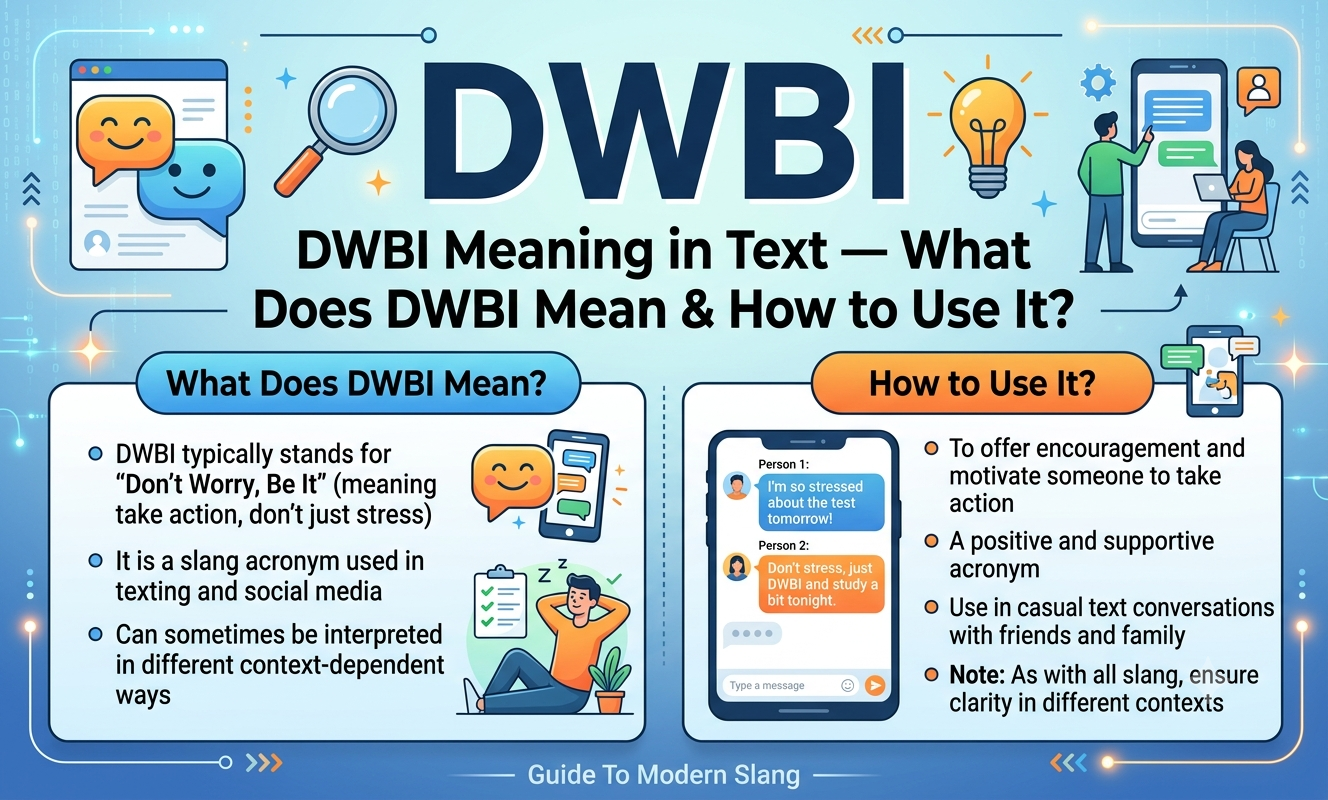
introduction to DWBI Meaning in Text
Quick Answer: DWBI stands for “Don’t Worry About It” or “Don’t Worry Bout It.” It’s a casual texting abbreviation people use to reassure someone, brush off a small problem, or let a friend know that something isn’t worth stressing over.
Ever gotten a text that just says “DWBI” and had no clue what your friend meant? You’re not alone. Slang like this pops up in group chats and DMs faster than most people can keep track of, and it’s easy to feel a little lost when a new one lands in your inbox.
If you searched dwbi meaning in text, you’re in the right place. This guide breaks down exactly what DWBI means, where it came from, how to use it correctly, and how to reply when someone sends it to you. By the end, you’ll be able to spot DWBI in the wild — on WhatsApp, Snapchat, TikTok, or Instagram — and use it naturally in your own conversations.
What Does DWBI Mean?
DWBI is short for “Don’t Worry About It” (sometimes written as “Don’t Worry Bout It”). People use it when they want to reassure someone, dismiss a small worry, or let a conversation move on without making a big deal out of something.
It works a lot like saying “it’s fine” or “no big deal” out loud, just compressed into four letters that are quicker to type. You’ll usually see it show up in these kinds of moments:
- A friend apologizes for something minor, and you want to tell them it’s not a problem.
- Someone asks a question you don’t feel like fully explaining right now.
- A person seems anxious about a situation, and you want to calm them down.
Where did it come from? Like most texting abbreviations, DWBI grew out of the everyday spoken phrase “don’t worry about it,” which has been common in English for generations. As mobile texting, group chats, and character-limited platforms became the main way people talk day to day, shortening common phrases into acronyms became second nature — the same pattern that gave us LOL, BRB, and IDK.
DWBI has never reached the mainstream fame of those older acronyms, but heading into 2026 it has become a familiar sight in youth-driven spaces like group chats, comment sections, and short-form video captions, where quick, low-effort reassurance is part of the everyday texting rhythm. It’s still considered a “niche” slang term compared to giants like LOL, but it shows up often enough that most active texters have seen it at least once.
One thing worth knowing: because DWBI is an informal, community-driven acronym, some corners of the internet occasionally stretch it into joke meanings (like a made-up phrase for fun). Those variations are rare and context-specific — in the vast majority of real conversations, DWBI simply means “don’t worry about it.”
DWBI Full Form Explained
Breaking DWBI down letter by letter makes the meaning easy to remember.
| Letter | Stands For |
|---|---|
| D | Don’t |
| W | Worry |
| B | ‘Bout (About) |
| I | It |
So the full form reads: Don’t Worry Bout It — commonly written in full English as “Don’t Worry About It.”
Some people also expand it slightly differently as “Don’t Worry, Be [something]” as a playful twist in specific communities, but this is a joke variation rather than the standard meaning. If you see DWBI in a normal conversation, assume it means “don’t worry about it” unless the context clearly points to a joke.
How to Use DWBI — Real Examples
DWBI fits into all kinds of emotional situations, from comforting to sarcastic. Here are examples across different tones so you can see how flexible it is.
| Situation | Example | Emotion |
|---|---|---|
| Friend apologizes for being late | “DWBI, I just got here too.” | Reassuring |
| Someone worried about a mistake | “You forgot to reply? DWBI, seriously.” | Comforting |
| Avoiding a long explanation | “Why were you upset earlier? DWBI, it’s handled.” | Dismissive (light) |
| Reassuring before an event | “DWBI about the interview, you’ve got this.” | Supportive |
| Playing something off casually | “Yeah I broke my phone screen. DWBI, I’ll fix it.” | Nonchalant |
| Comforting after a small argument | “I know I sounded annoyed. DWBI, we’re good.” | Warm |
| Brushing off a compliment or thanks | “Thanks for helping me move! – DWBI, anytime.” | Friendly |
| Calming pre-exam nerves | “DWBI, you studied enough. You’ll be fine.” | Encouraging |
| Sarcastic use with close friends | “Left you on read for 3 days. DWBI though 😅” | Playful/sarcastic |
| Downplaying a bigger issue | “My car broke down but DWBI, I’ll figure it out.” | Stoic/reassuring |
Notice how the same four letters can sound sincere, sarcastic, supportive, or dismissive depending on the words around it and who’s saying it. That flexibility is a big part of why it has stuck around in casual texting.
DWBI on Different Platforms (2026)
The way DWBI is used shifts slightly depending on the app, mostly because each platform has its own texting culture and pace.
On WhatsApp
WhatsApp conversations tend to run longer and more personal, so DWBI usually shows up mid-conversation as genuine reassurance — often paired with a follow-up message explaining more. Family and close-friend group chats are common places to see it used sincerely.
On Snapchat
Snapchat’s fast, disappearing-message style makes DWBI a quick way to close out a topic without a long back-and-forth. It’s often sent as a standalone snap caption or a quick chat reply when someone doesn’t want to dwell on a small issue.
On TikTok
On TikTok, DWBI shows up heavily in comment sections and captions, often used in a lighthearted or meme-adjacent way rather than as sincere reassurance. Heading into 2026, short-form video slang moves quickly, and DWBI is one of many compact acronyms that trend in comment threads before fading and resurfacing again later.
On Instagram
On Instagram, you’ll most often spot DWBI in DMs, Story replies, and comment threads. It’s commonly used to respond to a friend’s venting Story or a caption where someone shares a minor mishap — a quick way to show support without writing a paragraph.
2026 trend note: Across all these platforms, the broader pattern is the same — younger users continue to favor short, low-effort acronyms for emotional reassurance because they fit naturally into fast-scrolling, high-volume messaging habits. DWBI remains a smaller, community-specific term rather than a universal one like LOL, but its usage has grown steadily as texting shorthand keeps expanding.
Is DWBI Rude or Offensive?
DWBI is not inherently rude or offensive. In most cases, it’s a friendly, casual way to reassure someone. But like a lot of slang, tone and context matter more than the letters themselves.
Why it can feel supportive:
- It’s often used to comfort someone who feels anxious or embarrassed.
- It signals “this isn’t a big deal, relax.”
- It’s common between close friends as a shorthand for care.
Why it can sometimes feel dismissive:
- If someone asks a genuine, serious question and gets “DWBI” as the only reply, it can feel like they’re being brushed off.
- Sending it instead of actually explaining something can come across as avoidant, especially with parents, teachers, or in a work-related chat.
- In a serious conversation (money issues, safety concerns, relationship problems), DWBI alone can feel dismissive rather than comforting.
The general rule: DWBI is best used for small, low-stakes moments. For anything that genuinely needs an explanation or reassurance with substance, it’s better to say a bit more than just the acronym.
How to Reply to DWBI
If someone sends you DWBI, your reply usually depends on whether you’re satisfied with the reassurance or want more detail.
| Their Message | Your Reply | Tone |
|---|---|---|
| “DWBI, it’s handled.” | “Okay, if you say so 😊” | Trusting |
| “DWBI, seriously don’t stress.” | “Alright, thanks for saying that.” | Grateful |
| “DWBI.” (no explanation) | “Wait, actually tell me what happened.” | Curious/pushing for detail |
| “DWBI, I got it covered.” | “You’re the best, thank you!” | Appreciative |
| “DWBI 😅” (used sarcastically) | “Lol okay, sure, DWBI.” | Playful/matching tone |
| “DWBI about the exam.” | “Easier said than done, but okay 😭” | Lighthearted honesty |
Matching their tone is usually the safest move — if they’re being sincere, reply sincerely; if they’re joking, feel free to joke back.
DWBI Alternatives and Similar Slang
If you want to mix things up, here are other acronyms with a similar reassuring or dismissive meaning.
| Acronym | Meaning |
|---|---|
| NBD | No Big Deal |
| IDC | I Don’t Care |
| NP | No Problem |
| CBA | Can’t Be Bothered |
| IKR | I Know, Right |
| TBH | To Be Honest |
| JK | Just Kidding |
| IDGAF | I Don’t Give A [F] — a stronger, more intense version of “don’t worry about it” |
Each of these can slot into similar conversations, though the tone shifts slightly — NBD and NP feel warmer and gentler, while CBA and IDGAF carry a more indifferent or blunt edge.
Frequently Asked Questions (FAQ)
Q: What does DWBI mean in text? A: DWBI means “Don’t Worry About It” or “Don’t Worry Bout It.” It’s used to reassure someone or tell them a situation isn’t a big deal.
Q: What is the full form of DWBI? A: The full form is Don’t Worry Bout It, commonly written as “Don’t Worry About It” in full sentences.
Q: Is DWBI the same as NBD or NP? A: They’re similar in meaning but not identical. DWBI, NBD (“No Big Deal”), and NP (“No Problem”) are all used to downplay a concern, but DWBI leans slightly more toward active reassurance rather than just saying something is fine.
Q: Is DWBI used more by teens or adults? A: DWBI is most common among teens and younger adults who are comfortable with texting shorthand, though it can appear in any casual conversation regardless of age.
Q: Can DWBI be used in a professional or work chat? A: It’s best to avoid DWBI in professional messages. It’s a casual, informal term suited for friends and family, not workplace or formal communication.
Q: Does DWBI always mean the same thing on every platform? A: The core meaning stays the same everywhere, but the tone can shift — more sincere on WhatsApp and Instagram DMs, more playful or meme-like on TikTok and Snapchat.
Final Thoughts
DWBI is a simple, friendly piece of texting slang that boils down to one comforting idea: don’t worry about it. Whether it shows up in a WhatsApp chat, a Snapchat reply, or a TikTok comment section, it’s usually meant to reassure, comfort, or lightly brush off a small concern rather than cause confusion.
Now that you know the DWBI meaning in text, you’ll be able to read the tone behind it and reply the right way — whether that’s a warm “thanks” or a playful “okay, sure.” Bookmark this page so you always have a quick reference the next time a new acronym lands in your messages.
Also read IWK Meaning in Text — What Does IWK Mean & How to Use It?
