
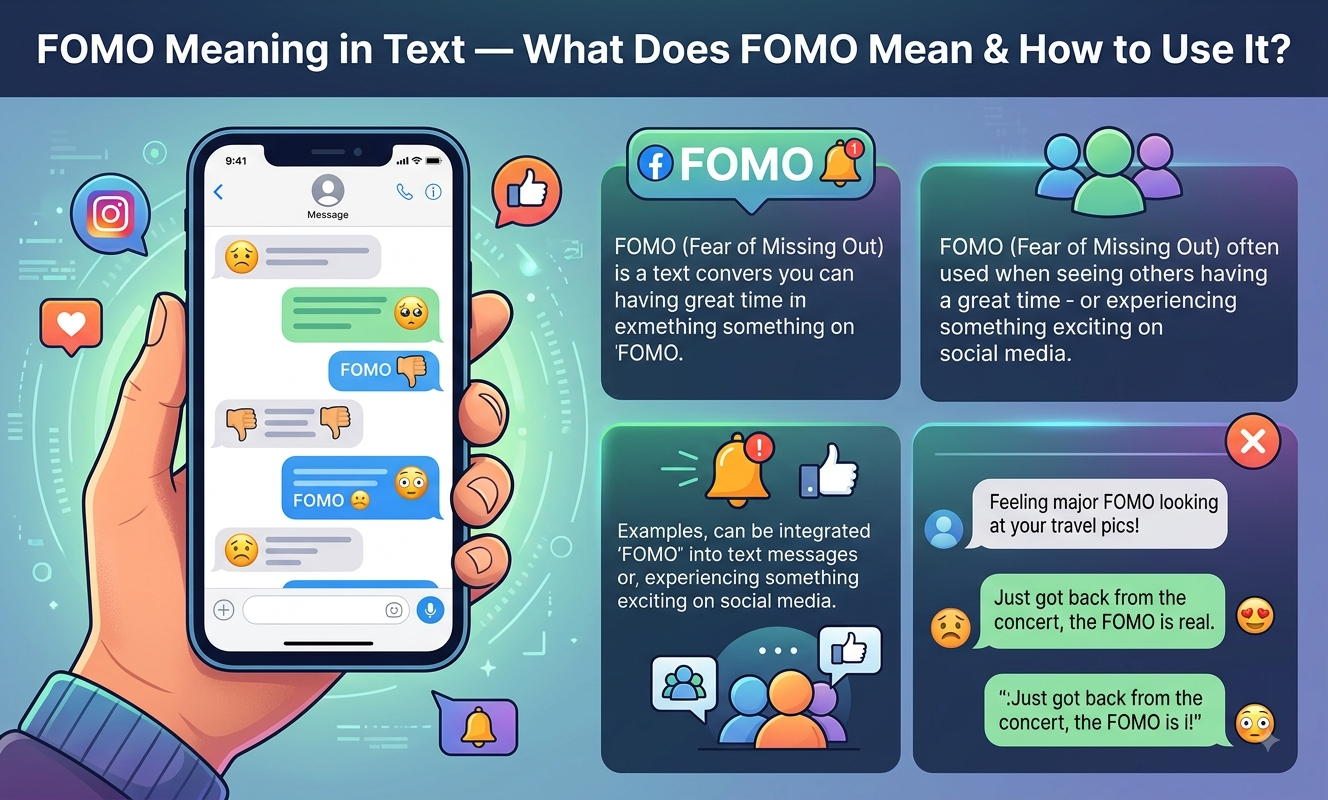
Quick Answer: FOMO stands for “Fear Of Missing Out.” It’s used in texting when someone feels anxious or left out because they think other people are having fun, going somewhere, or experiencing something exciting without them. It’s commonly used both as a feeling (“I have FOMO”) and as a warning (“Don’t get FOMO, it’s not that fun”).
Introduction
Ever seen a friend text “ngl I have major FOMO rn” and had no idea what they meant? You’re not alone. FOMO meaning in text has become one of the most common short forms used across group chats, social captions, and DMs in 2026.
This guide breaks down exactly what FOMO means, where it came from, and how people actually use it today. You’ll find real examples, platform-specific trends, reply ideas, and answers to the questions people search most on Google. By the end, you’ll never have to guess what FOMO means in a text again.
What Does FOMO Mean?
FOMO stands for “Fear Of Missing Out.” It describes the anxious or uneasy feeling people get when they believe others are enjoying an experience, event, or opportunity that they’re not part of.
The term started gaining traction in the early 2010s as social media made it easier to see what friends were doing in real time. By 2026, FOMO has grown beyond just “missing a party.” People now use it for missing sales, trending topics, viral moments, group chats, and even limited-time app features.
Marketing teams also use FOMO on purpose — phrases like “only 3 left in stock” or “offer ends tonight” are designed to trigger that same fear-of-missing-out feeling to push people to act quickly.
In everyday texting, though, FOMO is mostly used casually to describe a mood, not a diagnosis. It’s a feeling, not a formal term, and people use it lightly in most conversations.
FOMO Full Form Explained
FOMO is an acronym. Here’s what each letter stands for:
| Letter | Stands For |
|---|---|
| F | Fear |
| O | Of |
| M | Missing |
| O | Out |
Put together, it simply means the fear of missing out on something — an event, an experience, information, or a trend.
How to Use FOMO — Real Examples
FOMO can be used in many emotional contexts, from playful to genuinely anxious. Here are examples showing the range:
| Situation | Example | Emotion |
|---|---|---|
| Friend’s party you skipped | “Everyone looked like they had so much fun, I have serious FOMO rn” | Regret |
| Seeing vacation photos | “Ugh the FOMO from your Bali pics is unreal” | Envy |
| Missed a group hangout | “Ngl I had FOMO watching your snaps all night” | Sadness |
| Encouraging a friend to join | “Come out tonight, don’t let the FOMO get to you later” | Persuasion |
| Limited-time sale | “Buy now before it’s gone, don’t get FOMO later lol” | Urgency |
| Missed a viral trend | “Everyone’s doing the trend except me, major FOMO” | Left out |
| Skipping a concert | “I heard the concert was insane, I have such bad FOMO” | Disappointment |
| Reassuring a friend | “Don’t stress, there’s no FOMO, we barely did anything” | Comfort |
| Work event you missed | “Missed the office trip, definitely feeling the FOMO” | Mild frustration |
| Joking with friends | “FOMO is real, why didn’t anyone tell me about this?” | Humor |
FOMO on Different Platforms (2026)
The way people use FOMO shifts slightly depending on where they’re texting or posting. Here’s how it typically shows up across major apps in 2026.
On WhatsApp
FOMO is often used in personal or group chats when someone shares photos or updates from an event. It’s typically a quick, casual reaction rather than a full sentence — think a single message like “FOMO 😭” as a reply to a status update.
On Snapchat
Snapchat’s short-lived, real-time nature makes FOMO especially common here. Because Snaps disappear, people often express FOMO right after watching a friend’s story, since they feel like they’re catching a moment they can’t relive.
On TikTok
On TikTok, FOMO shows up heavily in comments under trending videos, challenges, or “you had to be there” style clips. Creators sometimes lean into it by captioning videos with phrases like “POV: you have FOMO watching this” to boost engagement.
On Instagram
Instagram Stories and Reels are a major driver of FOMO, since curated, highlight-reel content naturally invites comparison. People often comment or DM “FOMO is real” under travel, event, or celebration posts.
Across all these platforms, the common thread in 2026 is that FOMO is used less about literal missed events and more about missing the feeling of being part of a moment in real time.
Is FOMO Rude or Offensive?
FOMO itself is not considered rude or offensive. It’s a normal, widely accepted term used to describe a common emotion.
Why it’s usually fine:
- It’s self-descriptive — people mostly use it to talk about their own feelings.
- It’s used casually and often with humor.
- It’s widely understood across age groups, so there’s no confusion.
When context matters:
- If someone uses FOMO to guilt-trip a friend into attending something they don’t want to go to, it can feel manipulative.
- Constantly pointing out someone’s FOMO in a teasing way could come across as insensitive if they’re actually upset about being excluded.
In short, FOMO is a safe, everyday term — the tone and intent behind the message matter more than the word itself.
How to Reply to FOMO
Not sure how to respond when someone tells you they have FOMO? Here are some simple reply ideas:
| Their Message | Your Reply | Tone |
|---|---|---|
| “I have such bad FOMO rn” | “Aww don’t worry, we’ll do it again soon!” | Comforting |
| “FOMO is hitting hard watching your story” | “Haha come next time, you’re invited!” | Friendly |
| “Ugh major FOMO from your pics” | “It really was fun, wish you were there” | Honest |
| “I can’t believe I missed this” | “No stress, nothing crazy happened, don’t worry” | Reassuring |
| “FOMO is real today” | “Same tbh, everyone’s out except us” | Relatable |
| “Don’t want to have FOMO later” | “Then let’s go together this time!” | Encouraging |
FOMO Alternatives and Similar Slang
FOMO isn’t the only term people use to describe missing out or related feelings. Here are similar words you might see in texts:
| Term | Meaning |
|---|---|
| JOMO | Joy Of Missing Out — feeling happy about skipping something |
| YOLO | You Only Live Once — used to justify spontaneous decisions |
| FOBO | Fear Of Better Options — anxiety over choosing between options |
| FOMOMO | A playful exaggeration of FOMO, meaning extreme FOMO |
| Left out | Simple phrase describing exclusion from a group or event |
| Left on read | Being ignored after sending a message, sometimes linked to social anxiety |
| Ghosted | Being suddenly ignored or cut off by someone |
| Vibe check | Checking someone’s mood, sometimes used before inviting them somewhere |
Frequently Asked Questions (FAQ)
Q: What does FOMO mean in text? A: FOMO means “Fear Of Missing Out.” It’s used when someone feels anxious or left out because others seem to be enjoying something they’re not part of.
Q: What is the full form of FOMO? A: The full form of FOMO is “Fear Of Missing Out.”
Q: Is FOMO a real feeling or just internet slang? A: It’s both. FOMO started as internet slang but describes a genuine, commonly experienced feeling of anxiety about missing events, trends, or experiences.
Q: How do you use FOMO in a sentence? A: You can use it like this: “I have serious FOMO after seeing everyone’s vacation photos” or “Don’t let FOMO make you say yes to everything.”
Q: What is the opposite of FOMO? A: The opposite of FOMO is JOMO, which stands for “Joy Of Missing Out” — feeling content or relieved about not attending something.
Q: Is it okay to say you have FOMO? A: Yes, saying you have FOMO is completely normal and widely understood. It’s a casual way to describe feeling left out, not something to be embarrassed about.
Conclusion
FOMO meaning in text is simple once you break it down: it’s just the “Fear Of Missing Out,” and people use it every day across WhatsApp, Snapchat, TikTok, and Instagram to describe that familiar feeling of being left out of something fun.
Whether you’re using it to react to a friend’s story, reply to a group chat, or just express a mood, FOMO is a casual, harmless term that almost everyone understands in 2026.
Bookmark this page so you always have a quick reference the next time FOMO — or one of its many slang cousins like JOMO or FOBO — pops up in your texts.
Also read LMK Meaning in Text — What Does LMK Mean & How to Use It?
