
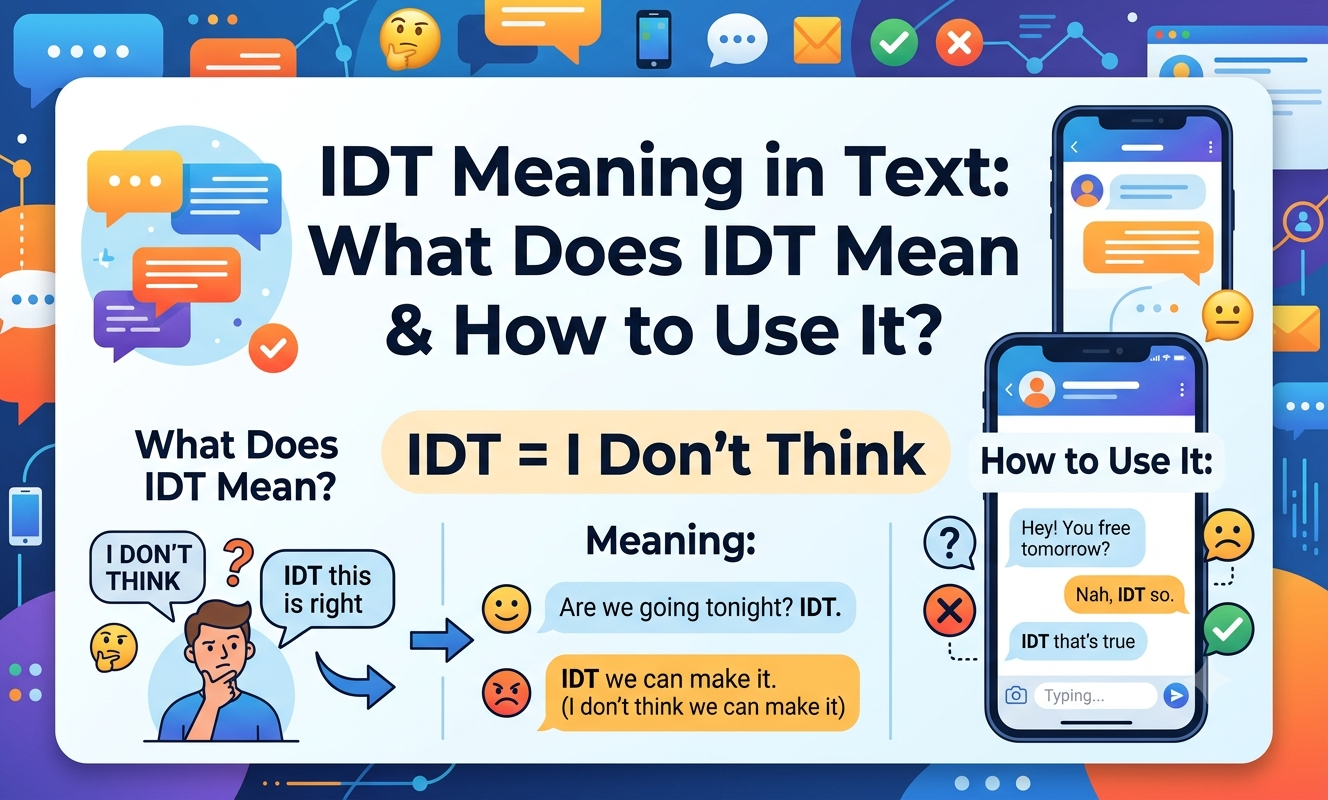
Quick Answer: IDT meaning in text is “I Don’t Think.” People use it to politely disagree, express doubt, or say they probably won’t do something. For example: “idt I can make it tonight” means “I don’t think I can make it tonight.”
Introduction
Has a friend ever texted you “idt so” and left you wondering what they meant? You’re not alone. Short slang like this shows up in chats every day, and it’s easy to miss the meaning if nobody explained it to you.
The idt meaning in text is simple once you know it. It’s a quick way to say “I don’t think” without typing the whole phrase. It’s common in group chats, comments, and direct messages.
In this guide, you’ll learn what IDT stands for, where it came from, and how to use it in real conversations. You’ll also see how it works on WhatsApp, Snapchat, TikTok, and Instagram, whether it’s rude, how to reply, and which similar slang terms to know. Whether you’re a teen or a parent trying to keep up, this guide will help.
What Does IDT Mean?
When someone asks, “What does IDT mean?”, the answer is short: IDT stands for “I don’t think.” It’s an abbreviation people use to share a doubt, an opinion, or a soft “no.”
Here’s what it usually signals:
- Doubt: “idt that’s true”
- Gentle disagreement: “idt that’s a good idea”
- A soft refusal: “idt I’m coming tonight”
- Uncertainty: “idt he saw my message”
IDT is less blunt than saying “no.” That’s why people like it. It leaves a little room for the other person to respond, and it sounds casual instead of harsh.
Origin and Background
IDT belongs to the same family as older texting shortcuts like IDK (I don’t know) and IDC (I don’t care). These “ID” abbreviations grew out of early SMS and instant messaging, when typing on a phone keypad was slow and every character counted.
The “I don’t” part of a sentence is something people say constantly. So it was natural for chat users to shorten it, and “I don’t think” became IDT.
Popularity Today
IDT is still a normal part of casual texting, and it has settled into everyday chat language. Short-form abbreviations remain popular because most messaging now happens on phones, in fast back-and-forth conversations, where speed and tone matter more than perfect grammar.
You’ll mostly see IDT in lowercase (“idt”), because lowercase feels more relaxed. Uppercase “IDT” is also fine. Neither version changes the meaning.
One thing to watch: outside of texting, “IDT” can also stand for other things, like a company name or a technical term. In casual chats and social media, though, it almost always means “I don’t think.”
IDT Full Form Explained
Because IDT is a three-letter acronym, it’s easy to break down.
| Letter | Stands For | Meaning |
|---|---|---|
| I | I | The person speaking |
| D | Don’t | A negative or “not” |
| T | Think | An opinion or belief |
Put together, IDT = I Don’t Think.
Notice that the “I” sits right at the front. That’s why IDT feels personal. The person is sharing their own view, not stating a hard fact.
Common IDT Variations
You may also come across these spin-offs:
- IDTS: “I don’t think so”
- IDT so: same as IDTS, written with a space
- IDTT: sometimes used for “I don’t think that”
- IDT tho: “I don’t think though,” used to soften or add a twist
The idt full form is the same in every case. The extra letters only change how the sentence ends.
How to Use IDT: Real Examples
The best way to understand idt in texting is to see it in action. IDT can carry many different feelings, from polite doubt to mild annoyance. Here are ten examples.
| Situation | Example | Emotion |
|---|---|---|
| Declining an invite | “idt I can come to the party tonight, I have homework” | Polite, apologetic |
| Doubting a rumor | “idt that’s actually true, who told you?” | Skeptical |
| Disagreeing with a friend | “idt that movie was as good as everyone says” | Mild disagreement |
| Feeling unsure about a plan | “idt we’ll make it on time if we leave now” | Worried |
| Reacting to a bad idea | “idt that’s a good idea, honestly” | Concerned |
| Joking with a friend | “idt you can eat that whole pizza by yourself 😂” | Playful, teasing |
| Expressing disappointment | “idt he’s going to reply. he left me on read” | Sad, resigned |
| Being sarcastic | “idt anyone asked, but ok 🙄” | Annoyed, sarcastic |
| Expressing relief | “idt I failed the test, I think I did okay!” | Hopeful, relieved |
| Setting a boundary | “idt I’m comfortable with that, sorry” | Firm but polite |
Tips for Using IDT Correctly
- Add context. “idt” alone can sound vague, so pair it with a short reason.
- Watch your tone. Emojis can make IDT sound friendlier or more sarcastic.
- Use it casually. It fits chats with friends, not formal emails.
- Don’t overuse it. Too many “idt” replies can come across as negative.
IDT on Different Platforms
IDT works the same way everywhere, but the style and tone shift a little from app to app. Fast, informal apps tend to favor short slang, so people have kept using abbreviations like this one across all the major platforms.
On WhatsApp
WhatsApp is where IDT often appears in personal and group chats. People use it to make plans, answer questions, and share quick opinions. Because WhatsApp is also used by families and coworkers, you’ll see IDT in both friendly and semi-serious conversations.
Example: “idt the meeting will end before 5, plan accordingly.”
On WhatsApp, IDT usually sounds calm and practical, not dramatic.
On Snapchat
Snapchat chats are fast, casual, and often disappear quickly, so shorthand fits well. Teens use idt in snaps, chats, and Story replies to react without typing much.
Example: “idt I’m allowed out tonight 😭”
The tone on Snapchat is usually playful or dramatic, with lots of emojis.
On TikTok
On TikTok, IDT shows up mostly in comments. Viewers use it to react to a video, question a claim, or join a debate.
Example (comment): “idt she’s telling the whole story 👀”
Comment sections move fast and attract strong opinions, so IDT is a quick way to voice doubt without starting a fight.
On Instagram
On Instagram, you’ll find IDT in DMs, comments, and Story replies. The tone here can be more polished, but IDT still fits friendly chats.
Example (DM): “idt I can make brunch Sunday, but let’s reschedule!”
Instagram users often pair IDT with a friendly emoji or a follow-up suggestion to keep things warm.
Platform Trends to Know
Across all these apps, short and quick messaging continues to dominate how young people talk online. Voice notes, stickers, and emojis are popular too, but text abbreviations like IDT haven’t gone away. They’re a fast, low-effort way to react, and that’s exactly why they stick around.
Is IDT Rude or Offensive?
Short answer: no, IDT is not rude or offensive. It’s a mild, everyday abbreviation. But like most slang, the way it feels depends on context and tone.
Why IDT Is Usually Polite
- It softens a “no.” Saying “idt” feels gentler than “no” or “that’s wrong.”
- It shows you’re sharing an opinion, not attacking someone.
- It leaves space for the other person to explain.
When IDT Can Sound Rude
- In serious conversations. Replying “idt” to something important, like a friend sharing bad news or a boss asking a direct question, can feel dismissive.
- With sarcasm. “idt anyone asked 🙄” is meant to sting.
- When it’s the whole message. A lone “idt” can feel cold, especially if the other person wanted more detail.
A Note for Parents
If you see your teen using IDT, there’s nothing to worry about. It’s ordinary texting language, like IDK or BRB. The only thing to pay attention to is the surrounding conversation, not the abbreviation itself.
Good rule of thumb: if you wouldn’t say it that way out loud, add a bit more explanation in your text.
How to Reply to IDT
When someone texts you “idt,” the best reply depends on what they’re responding to. Here are six easy options.
| Their Message | Your Reply | Why It Works |
|---|---|---|
| “idt I can come tonight” | “No worries, maybe next time!” | Friendly and understanding |
| “idt that’s a good idea” | “Why not? What would you change?” | Invites their opinion |
| “idt he’s coming” | “Ok, let’s plan without him then.” | Moves things forward |
| “idt that’s true” | “Really? Let me double-check.” | Keeps the chat open |
| “idt you should do that” | “Hmm, fair point. What do you suggest?” | Shows you’re listening |
| “idt anyone asked 🙄” | “Lol ok, my bad 😅” | Defuses the sarcasm |
Quick Tips for Replying
- Read the tone first. Is the person worried, joking, or annoyed?
- Ask a follow-up. A simple “why not?” keeps the conversation going.
- Stay kind. You don’t have to agree, but respond politely.
- Match their energy. If they’re playful, be playful back.
IDT Alternatives and Similar Slang
IDT isn’t the only shortcut for sharing doubt or disagreement. Here are eight similar terms you might see.
| Slang | Full Form | Meaning |
|---|---|---|
| IDK | I Don’t Know | You’re not sure about something |
| IDC | I Don’t Care | You have no strong feelings either way |
| IDTS | I Don’t Think So | A soft “no” to a specific question |
| IDGAF | I Don’t Give A F*** | A strong, rude way to say you don’t care |
| IMO | In My Opinion | Introduces your personal view |
| IKR | I Know, Right? | Strong agreement |
| NGL | Not Gonna Lie | Introduces an honest or blunt thought |
| TBH | To Be Honest | Signals you’re being truthful |
How IDT Differs From Its Cousins
- IDT vs. IDK: IDT shares an opinion (“I don’t think it’s true”), while IDK admits you have no answer.
- IDT vs. IDC: IDT still shows you care enough to have a view. IDC says you don’t.
- IDT vs. IDTS: They’re nearly identical, but IDTS is usually a direct answer to a yes/no question.
Knowing the difference helps you pick the right shortcut for the right moment.
Frequently Asked Questions (FAQ)
Q: What does IDT mean in text?
A: IDT means “I don’t think.” People use it in texts and social media chats to politely disagree, show doubt, or say they probably won’t do something.
Q: What is the IDT full form?
A: The IDT full form is “I Don’t Think.” The letters stand for I (the speaker), D (don’t), and T (think).
Q: Is IDT the same as IDK?
A: No. IDT means “I don’t think” and shares an opinion or doubt. IDK means “I don’t know” and says you have no answer. They look similar but mean different things.
Q: Is IDT slang rude?
A: Not normally. IDT is a mild, casual abbreviation. It only sounds rude when it’s paired with sarcasm, used in a serious conversation, or sent alone without any explanation.
Q: How do you use IDT in a sentence?
A: Put it at the start of your message, followed by your thought. For example: “idt I can finish this today” or “idt that’s the right answer.” Examples like these show how natural it feels in everyday chats.
Q: What does IDTS mean in texting?
A: IDTS means “I don’t think so.” It’s the longer version of IDT and is often used as a direct reply to a yes/no question, like “Are you coming?” “idts.”
Q: Can I use IDT in formal writing?
A: It’s best to avoid it. IDT is informal slang for texts, DMs, and social media. In emails, school work, or work messages, write out “I don’t think.”
Conclusion
Now you know the idt meaning in text: it simply stands for “I Don’t Think.” It’s a short, friendly way to share doubt, disagree gently, or say no without sounding harsh. You’ve seen the full form, real examples, how it appears on WhatsApp, Snapchat, TikTok, and Instagram, how to reply, and which similar slang to watch for.
The key is context. IDT is polite in most situations, but tone and emojis can change how it feels. When in doubt, add a few extra words so your message lands the way you intended.
If this guide helped you decode your chats, bookmark this page so you can come back whenever a new slang term pops up. Share it with a friend or parent who’s still wondering what “idt” means!
Also read BSF Meaning in Text — What Does BSF Mean & How to Use It?

2 Comments
Pingback: MFW Meaning in Text — What Does MFW Mean & How to Use It?
Pingback: S/U Meaning in Text: What Does S/U Mean & How to Use It?