
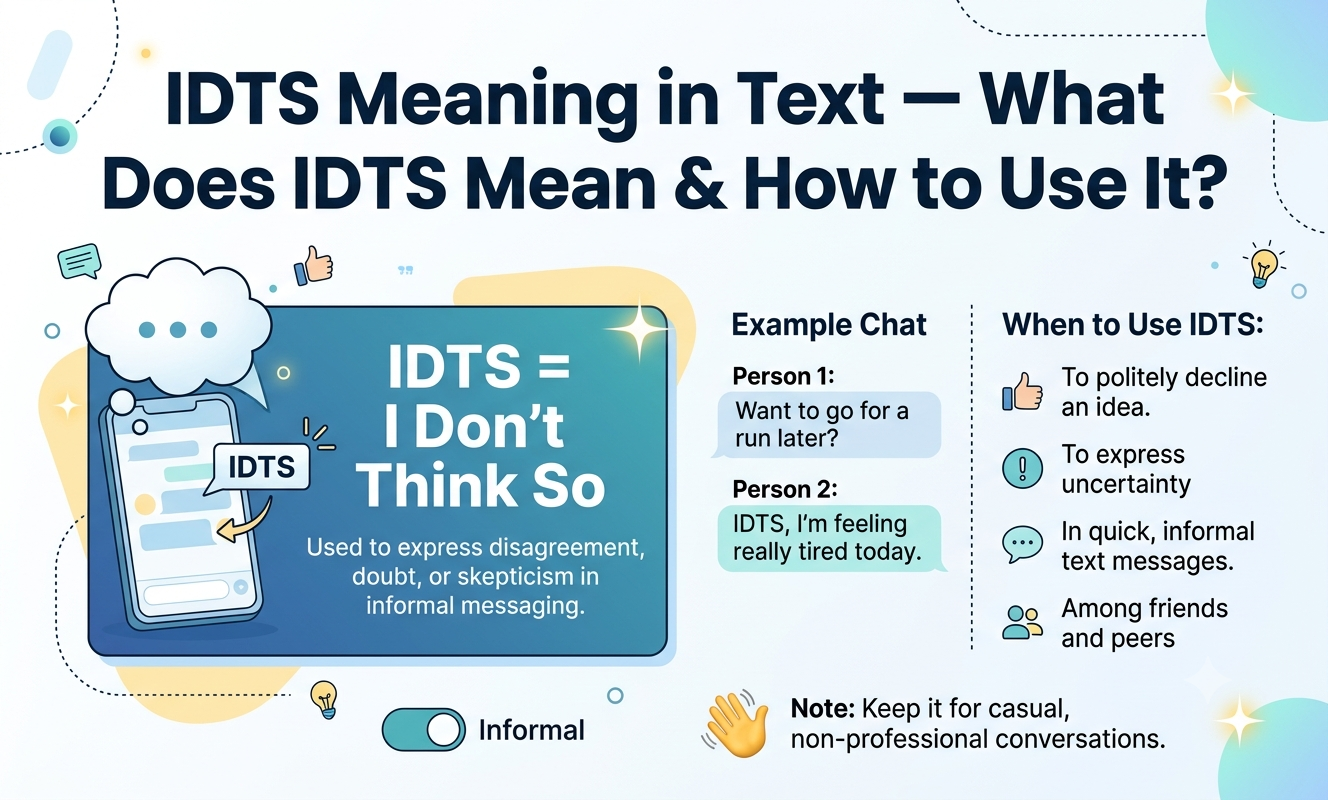
Quick Answer: IDTS stands for “I Don’t Think So.” It’s a texting abbreviation people use to politely (or bluntly) disagree with something, express doubt, or shut down a suggestion — commonly seen in WhatsApp chats, group texts, and social media comments.
Introduction
Scrolling through a group chat and suddenly someone replies with just “idts” — and you’re left wondering if that’s a typo or a whole new code? You’re not alone. Texting slang moves fast, and abbreviations like this one show up constantly in casual conversations between friends, classmates, and even coworkers joking around. The idts meaning in text is simple once you know it, but it can be confusing the first time you see it out of context.
In this guide, you’ll learn exactly what IDTS means, where it came from, how people are using it across WhatsApp, Snapchat, TikTok, and Instagram in 2026, whether it’s considered rude, and how to reply when someone sends it to you. By the end, you’ll be able to spot it, use it, and respond to it like a pro.
What Does IDTS Mean?
IDTS is a texting abbreviation for “I Don’t Think So.” It’s used when someone wants to express disagreement, doubt, or gentle refusal without writing out a full sentence.
The phrase has been floating around informal writing for years, but it picked up real momentum as part of the broader wave of shorthand texting slang that took off with SMS and early instant messaging in the 2000s. What’s changed by 2026 is where it shows up. It’s no longer just a texting-app abbreviation — it’s now common in comment sections, direct messages, and even voice-to-text captions on short-form video platforms, where fast typing and quick reactions matter more than ever.
Unlike some slang that’s tied to a specific app or trend, IDTS has stuck around because it fills a genuine gap: it lets someone push back on an idea casually, without sounding harsh or starting an argument.
IDTS Full Form Explained
Breaking IDTS down letter by letter makes it easy to remember:
| Letter | Stands For |
|---|---|
| I | I |
| D | Don’t |
| T | Think |
| S | So |
Put together, it reads: “I Don’t Think So.” It’s a first-person statement of doubt or disagreement, similar in tone to saying “I doubt it” or “probably not,” just shorter.
How to Use IDTS — Real Examples
IDTS can shift in tone depending on the conversation, punctuation, and who’s texting. Here are examples across different emotional contexts:
| Situation | Example | Emotion |
|---|---|---|
| Friend asks if you’re going to a party | “Are you coming tonight?” — “idts, I’m tired” | Casual/tired |
| Doubting a rumor | “Did you hear they broke up?” — “idts, they were together yesterday” | Skeptical |
| Declining a plan | “Wanna skip class?” — “idts that’s a good idea lol” | Playful caution |
| Disagreeing in a debate | “This movie is better than the first one.” — “idts, the original was way better” | Confident disagreement |
| Responding to a favor request | “Can you lend me $50?” — “idts, I’m low on cash rn” | Apologetic refusal |
| Reacting to gossip | “She’s mad at you.” — “idts, we talked yesterday and it was fine” | Reassuring |
| Questioning a plan’s success | “This project will be done by Friday.” — “idts, we barely started” | Concerned |
| Light teasing | “I could beat you in a race.” — “idts 😂” | Joking/sarcastic |
| Serious disagreement | “I think we should quit.” — “idts, let’s try one more time” | Firm but caring |
| Uncertainty about weather/plans | “Will it rain today?” — “idts, sky looks clear” | Neutral/informative |
Notice how tone shifts entirely based on punctuation and emojis. “idts.” can feel blunt, while “idts 😂” softens it into a joke.
IDTS on Different Platforms (2026)
Texting abbreviations don’t behave the same way everywhere. Here’s how IDTS shows up across major platforms in 2026.
On WhatsApp
WhatsApp remains the go-to app for close friend and family group chats, and IDTS is common in quick back-and-forth replies where people are typing fast on the go. Voice-to-text and quick-reply suggestions have made short abbreviations like this even more frequent in 2026, since predictive typing often auto-suggests shorthand phrases mid-conversation.
On Snapchat
On Snapchat, where conversations are fast, disappearing, and casual, IDTS often appears in Snap chats responding to a Snap or Story. Because messages vanish, users lean even harder into abbreviations to keep the pace quick.
On TikTok
In TikTok comment sections, IDTS is frequently used to disagree with a creator’s opinion or a trending take without writing a full paragraph. It’s also common in duet and stitch captions where someone is pushing back on the original video’s claim.
On Instagram
On Instagram, especially in DMs and comment replies, IDTS shows up when reacting to Reels, Stories, or captions — often paired with emojis to clarify tone, since text-only replies can be misread as harsh.
Across all four platforms, the core meaning stays the same — the difference is mostly in tone and how much emoji or punctuation gets added to soften or sharpen the message.
Is IDTS Rude or Offensive?
IDTS is generally not considered rude or offensive — but like most texting slang, context matters a lot.
Why it’s usually fine:
- It’s a normal way to express doubt or disagreement casually
- It’s commonly used between friends without any bad intent
- It’s shorter and often feels less confrontational than typing out a full disagreement
When it can come across as rude:
- If sent with no explanation in response to something serious or emotional
- If used repeatedly to dismiss someone without further conversation
- If the tone of the overall conversation is already tense
The safest approach: if you’re disagreeing with something important, pairing “idts” with a short reason (“idts, I think we should wait”) keeps it clear and friendly rather than dismissive.
How to Reply to IDTS
Not sure how to respond when someone sends you “idts”? Here are a few natural replies depending on the situation:
| Their Message | Your Reply | Tone |
|---|---|---|
| “idts we should go” | “Why not? What’s up?” | Curious |
| “idts that’s true” | “Fair, I might be wrong” | Agreeable |
| “idts lol” | “Lol okay okay” | Playful |
| “idts, I’m not going” | “No worries, next time then” | Understanding |
| “idts this will work” | “Let’s talk it through” | Collaborative |
| “idts” (no context) | “What do you mean?” | Clarifying |
IDTS Alternatives and Similar Slang
If you want to mix things up, here are similar terms with the same general meaning:
| Term | Meaning |
|---|---|
| IDK | I Don’t Know |
| IDC | I Don’t Care |
| IMO | In My Opinion |
| TBH | To Be Honest |
| IDTS | I Don’t Think So |
| NGL | Not Gonna Lie |
| IIRC | If I Recall Correctly |
| SMH | Shaking My Head |
Each of these expresses a slightly different shade of opinion or doubt, but they all serve the same purpose: quick, casual communication.
Frequently Asked Questions (FAQ)
Q: What does IDTS mean in a text message? A: IDTS means “I Don’t Think So.” It’s used to express doubt or disagreement in a casual way.
Q: Is IDTS the same as IDK? A: No. IDTS means “I Don’t Think So” (expressing doubt), while IDK means “I Don’t Know” (expressing lack of information).
Q: Is IDTS used only by teens? A: While it’s popular among teens, IDTS is also used by adults in casual texting, especially with friends or close coworkers.
Q: Can IDTS be used in a professional setting? A: It’s best to avoid it in formal or professional messages. Stick to “I don’t think so” or “I’m not sure that’s the case” instead.
Q: What’s the difference between IDTS and NGL? A: IDTS expresses disagreement or doubt, while NGL (“Not Gonna Lie”) is used to admit something honestly, often before sharing an opinion.
Q: Does IDTS mean the same thing on every platform? A: Yes, the core meaning stays consistent across WhatsApp, Snapchat, TikTok, and Instagram — only the tone and emoji usage tend to shift slightly.
Conclusion
IDTS is a simple but useful piece of texting slang that means “I Don’t Think So,” commonly used to express doubt or gentle disagreement across WhatsApp, Snapchat, TikTok, and Instagram. Its meaning stays consistent everywhere, but tone can shift depending on punctuation, emojis, and context. Now that you know the idts meaning in text, you’ll never be confused seeing it pop up in your messages again. Bookmark this page next time you run into a texting abbreviation you don’t recognize.
Also read PU Meaning in Text — What Does PU Mean & How to Use It?
