
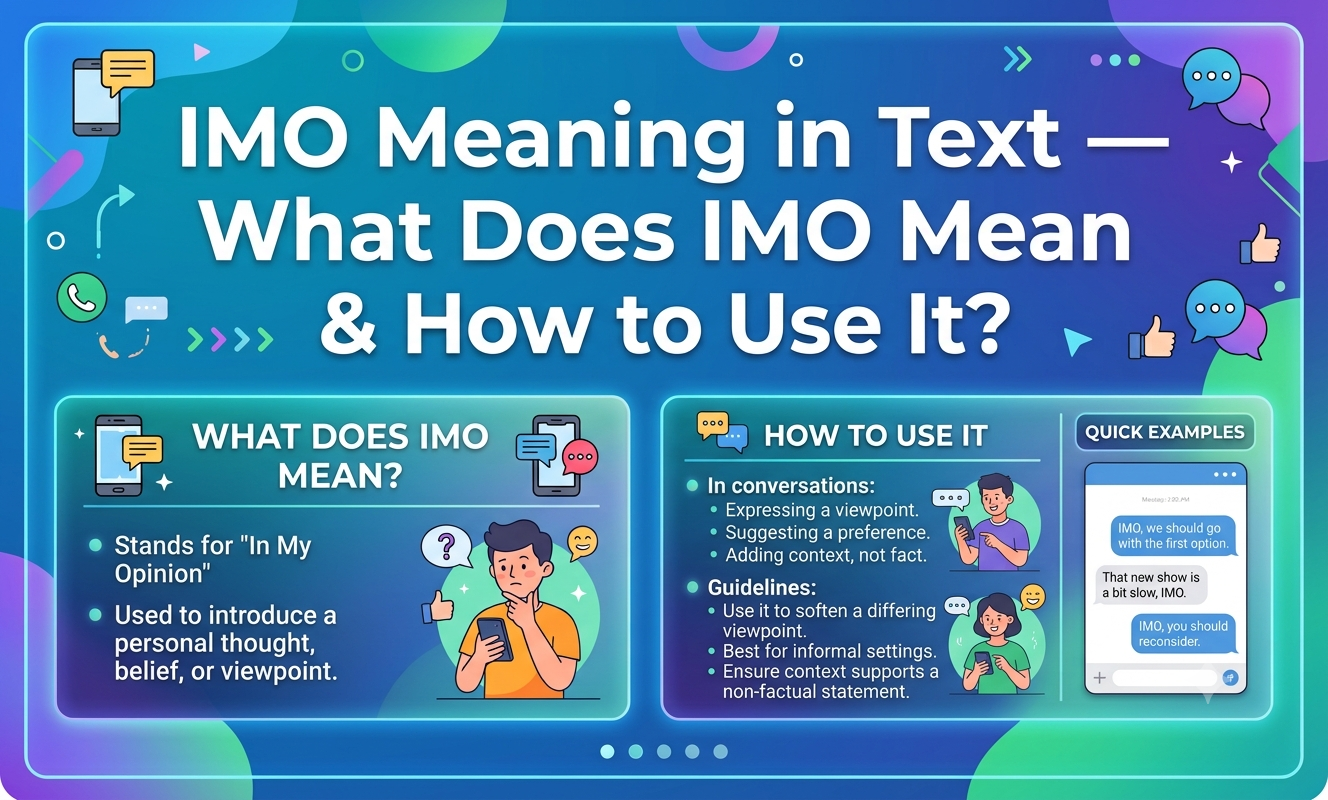
Quick Answer: IMO stands for “In My Opinion.” It’s a texting abbreviation people use before sharing a personal view, so the other person knows it’s a subjective take and not a fact. You’ll see it everywhere — group chats, Instagram comments, TikTok captions, and DMs.
Why Does Everyone Suddenly Use “IMO”?
Picture this: you’re texting a friend about a new restaurant, and they reply, “IMO the pizza there is overrated.” No explanation needed — you instantly understand they’re sharing a personal opinion, not stating a universal truth. That’s the entire point of imo meaning in text, and it’s one of the most common abbreviations you’ll run into on any messaging app.
This guide breaks down exactly what IMO means, where it came from, how to use it correctly, and how it shows up differently across WhatsApp, Snapchat, TikTok, and Instagram. Whether you’re a teen trying to keep up with group chat lingo or a parent trying to decode your kid’s texts, you’ll walk away knowing exactly how — and when — to use it.
What Does IMO Mean?
IMO is short for “In My Opinion.” It’s used to signal that whatever comes next is a personal viewpoint rather than a confirmed fact. The abbreviation has roots in early internet forums and chatrooms from the 1990s, where space and typing speed mattered, and it carried straight over into texting and social media culture.
By 2026, IMO has become one of the most stable, widely recognized abbreviations in digital communication. Unlike slang that trends and fades within a season, IMO has stuck around for decades because it serves a genuinely useful function — softening statements and clearly separating opinion from fact in fast-paced conversations.
You’ll find it used across every age group, not just teens. Professionals use it in Slack messages and emails, parents use it in family group chats, and it’s a staple in comment sections on nearly every platform.
IMO Full Form Explained
Since IMO is an acronym, here’s exactly what each letter stands for:
| Letter | Stands For |
|---|---|
| I | In |
| M | My |
| O | Opinion |
Full form: “In My Opinion”
There are also a couple of close cousins you’ll spot in the wild:
- IMHO — “In My Humble Opinion” (adds a touch of modesty)
- IMOO — a rarer, more emphatic variant, though far less common than IMO or IMHO
All three carry the same core meaning: what follows is a personal take, not an established fact.
How to Use IMO — Real Examples
IMO fits into almost any conversation where you want to share a view without sounding overly assertive. Here’s how it plays out across different emotional tones.
| Situation | Example | Emotion |
|---|---|---|
| Movie recommendation | “IMO that new sci-fi movie was way better than the first one.” | Enthusiastic |
| Disagreeing with a friend | “IMO you’re overreacting a little, but I get why you’re upset.” | Diplomatic |
| Food opinion | “IMO pineapple absolutely belongs on pizza.” | Playful |
| Group chat debate | “IMO we should just order from the place we always get.” | Casual |
| Giving honest feedback | “IMO the essay’s intro needs to be stronger.” | Constructive |
| Reacting to news | “IMO that decision is going to backfire.” | Skeptical |
| Fashion opinion | “IMO the black jacket looks better than the blue one.” | Supportive |
| Relationship advice | “IMO you should just talk to him directly instead of guessing.” | Caring |
| Sports discussion | “IMO that was the best game of the season.” | Excited |
| Workplace chat | “IMO we should push the deadline back a few days.” | Professional |
Notice how IMO can soften disagreement, add honesty to feedback, or simply flag that a statement is subjective. It’s flexible enough to work in almost any emotional context.
IMO on Different Platforms (2026)
The core meaning of IMO doesn’t change from app to app, but how often — and where — people use it does shift depending on the platform’s culture.
On WhatsApp
WhatsApp remains the go-to app for family and close-friend group chats worldwide, and IMO shows up constantly in these settings — planning trips, debating restaurant choices, or weighing in on family decisions. Because WhatsApp conversations tend to be more personal and ongoing, IMO is often used to gently offer input without dominating the conversation.
On Snapchat
On Snapchat, IMO tends to appear in chat replies and captions rather than in Snap Stories themselves, since Snapchat culture leans more visual and less text-heavy. When it does show up, it’s usually quick and casual — a fast opinion dropped in response to a photo or video a friend just sent.
On TikTok
TikTok comment sections are one of the biggest hotspots for IMO in 2026. Viewers use it to weigh in on trends, debates, and duets without sounding like they’re lecturing the creator. A comment like “IMO the original version of this sound was better” is extremely common under trending videos.
On Instagram
IMO shows up heavily in Instagram comments and DMs, especially under posts that spark debate — outfit checks, opinion polls in Stories, or controversial takes in caption text. Instagram’s comment culture, which leans toward quick reactions, makes short abbreviations like IMO a natural fit.
Across all these platforms, the underlying trend for 2026 is the same: as short-form video and quick-reply culture continue to dominate, abbreviations like IMO that save time while adding clarity are only becoming more common, not less.
Is IMO Rude or Offensive?
Short answer: no, IMO is not inherently rude. In fact, it often does the opposite — it makes statements sound more polite and less confrontational.
Why it’s generally seen as polite: Adding “IMO” before a statement signals humility. It tells the other person, “I know this is just how I see it, not the final word.” This can soften criticism and make disagreements feel less personal.
Why it can occasionally land wrong: Context matters. If someone uses IMO right before a harsh or blunt statement — like “IMO your plan is a bad idea” — the abbreviation itself isn’t rude, but the sentence around it can still feel sharp depending on tone, timing, and relationship. IMO doesn’t erase bluntness; it just labels the statement as subjective.
The general rule: IMO is a tone-softener, not a shield. How the rest of the sentence is phrased still matters.
How to Reply to IMO
Not sure how to respond when someone drops an “IMO” on you? Here are some natural ways to reply depending on whether you agree, disagree, or want more detail.
| Their Message | Your Reply | Tone |
|---|---|---|
| “IMO the sequel was better.” | “Honestly, same. The pacing was way tighter.” | Agreeing |
| “IMO you should take the job.” | “I hear you, but I’m still torn tbh.” | Respectfully disagreeing |
| “IMO that outfit doesn’t work.” | “Really? What would you change about it?” | Curious/asking for detail |
| “IMO we should cancel the trip.” | “Fair point, let’s talk about it tonight.” | Neutral/deferring |
| “IMO this is the best restaurant in town.” | “Okay now I have to try it lol.” | Playful |
| “IMO you’re overthinking this.” | “Maybe, but I’d rather be careful.” | Gentle pushback |
IMO Alternatives and Similar Slang
If you want to mix things up or you’re seeing similar abbreviations elsewhere, here’s a quick reference table.
| Abbreviation | Meaning |
|---|---|
| IMHO | In My Humble Opinion |
| TBH | To Be Honest |
| IDK | I Don’t Know |
| FWIW | For What It’s Worth |
| NGL | Not Gonna Lie |
| IIRC | If I Recall Correctly |
| AFAIK | As Far As I Know |
| IDC | I Don’t Care |
Each of these serves a similar purpose to IMO — quickly framing how confident or personal a statement is — but with slightly different shades of meaning.
Frequently Asked Questions (FAQ)
Q: What does IMO mean in a text message? A: IMO means “In My Opinion.” It’s used before a statement to show the person is sharing a personal view, not a fact.
Q: Is IMO the same as IMHO? A: They’re very close. IMO means “In My Opinion,” while IMHO means “In My Humble Opinion.” IMHO adds a slightly more modest tone, but both are used the same way.
Q: Can IMO be used in professional or formal writing? A: It’s fine for casual workplace chats like Slack or Teams messages, but it’s best avoided in formal emails, reports, or professional documents.
Q: What’s the difference between IMO and IMO’s full form used sarcastically? A: Sometimes people use IMO sarcastically to soften a joke or exaggerated statement, like “IMO pineapple pizza should be illegal.” The meaning stays the same — it just signals a lighthearted, opinion-based comment.
Q: Does IMO mean something different on Snapchat or TikTok? A: No, the meaning stays the same — “In My Opinion” — across every platform. Only the frequency and context of use shift slightly depending on the app’s culture.
Q: Is it okay to use IMO with someone I don’t know well? A: Yes. IMO is neutral and polite enough to use in most conversations, including with people you’re not close to, since it clearly frames your statement as a personal opinion rather than a demand or fact.
Wrapping It Up
IMO is one of the simplest and most useful texting abbreviations out there — short for “In My Opinion,” it helps people share personal views clearly and politely across every major platform, from WhatsApp to TikTok to Instagram. Whether you’re agreeing, disagreeing, or just weighing in on a group chat debate, IMO gives your message the right tone without extra typing.
Now that you know exactly what imo meaning in text refers to and how to use it naturally, you’ll never have to second-guess a message again. Bookmark this page so you can quickly check IMO, its alternatives, and reply examples whenever you need a refresher.
Also read WYD Meaning in Text — What Does WYD Mean & How to Use It?
