
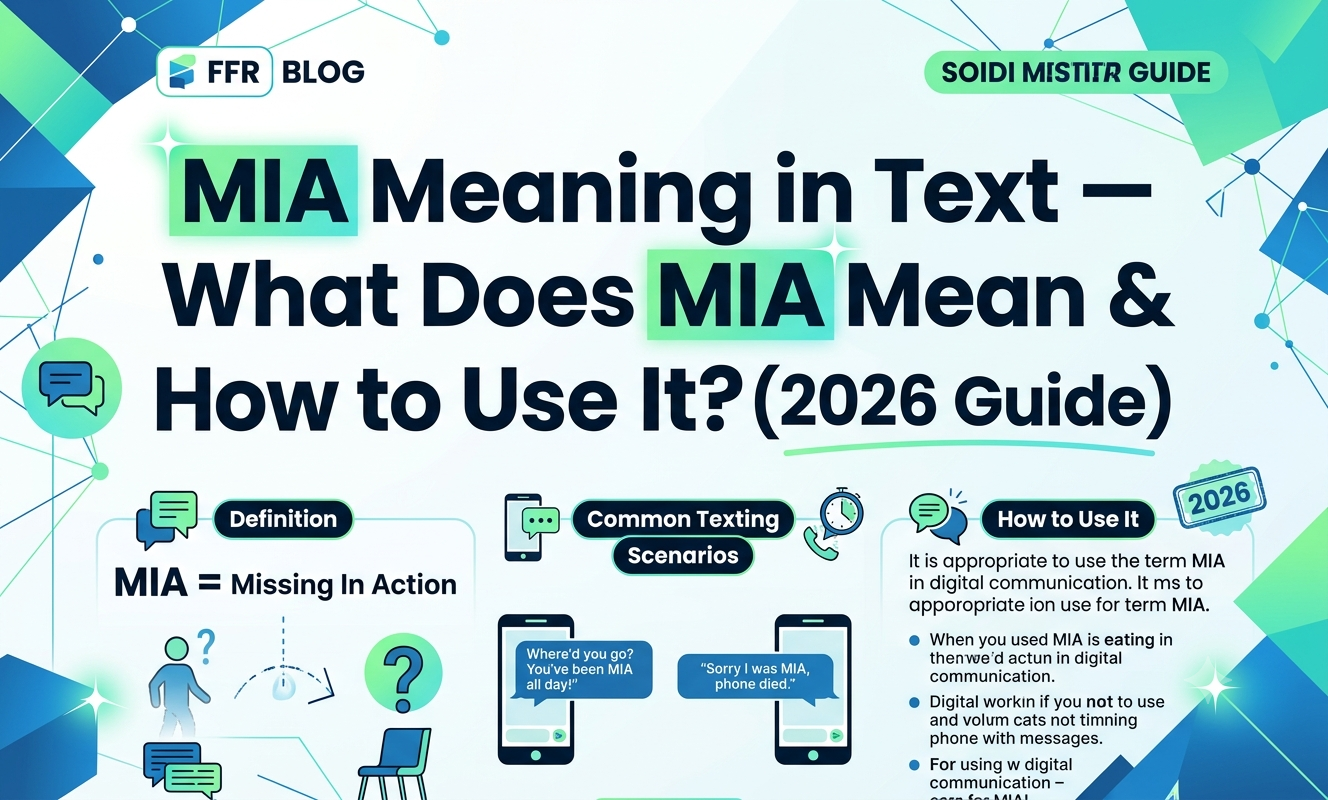
Quick Answer: MIA in texting stands for “Missing In Action.” It’s used when someone has gone quiet, disappeared from a group chat, stopped replying, or has been absent from social media for a while. It can be playful (“Where have you been, you’ve been MIA!”) or slightly annoyed, depending on the tone of the conversation.
Introduction
Ever texted a friend three times and gotten nothing back, then joked “wow, you’ve gone MIA”? You’re not alone — this is one of the most common pieces of texting slang used across every messaging app in 2026. If you’ve seen mia meaning in text pop up in a group chat or a caption and wondered what it actually means, you’re in the right place.
In this guide, you’ll learn exactly what MIA means in texting, where it came from, how people use it in 2026 on WhatsApp, Snapchat, TikTok, and Instagram, whether it can come across as rude, and how to reply when someone calls you out for being MIA. We’ll also cover similar slang terms so you never feel lost in a chat again.
What Does MIA Mean in Text?
MIA stands for “Missing In Action.” In texting and casual conversation, it’s used to describe someone who has disappeared, gone quiet, or stopped responding for a noticeable period of time. It doesn’t always mean something serious happened — most of the time it’s a light, casual way of saying “I haven’t heard from you in a while.”
The term originally comes from military language, where it was used to describe soldiers who were unaccounted for during combat. Over the decades, it moved into everyday pop culture and eventually into texting slang, where its meaning softened significantly. By the time smartphones and group chats became the main way friends communicated, MIA had shifted from a serious military term into a lighthearted way to call out a friend who ghosted the group chat.
In 2026, MIA remains one of the most widely recognized abbreviations across all age groups. Unlike newer slang that changes every few months, MIA has stayed consistent in meaning for years, which is part of why it’s still so common in texts, captions, and comments today.
Why MIA Became Popular in Texting
- It’s short and easy to type
- It works in almost any casual context — friends, family, coworkers
- It sounds less harsh than saying “why haven’t you replied”
- It fits naturally into captions like “sorry I’ve been MIA lately”
MIA Full Form Explained
MIA is an acronym, and breaking it down letter by letter makes the meaning very clear.
| Letter | Stands For | Meaning in Context |
|---|---|---|
| M | Missing | Someone is not present or not responding |
| I | In | Connecting word |
| A | Action | Refers to being absent from activity, conversation, or events |
Put together, Missing In Action simply means someone is absent, unreachable, or has gone quiet — whether that’s in a group chat, on social media, or in real life plans.
How to Use MIA — Real Examples
MIA can be used in many different emotional tones — from playful teasing to genuine concern. Here are examples covering a range of everyday situations.
| Situation | Example | Emotion |
|---|---|---|
| Friend hasn’t replied in days | “Bro you’ve been MIA, everything okay?” | Concerned |
| Teasing a friend who skipped a hangout | “Where were you? You went full MIA last night 😂” | Playful |
| Apologizing for being busy | “Sorry I’ve been MIA, work has been crazy” | Apologetic |
| Group chat callout | “@Sarah has officially gone MIA since Monday” | Humorous |
| Checking on someone after a breakup | “You’ve been MIA lately, just checking in ❤️” | Caring |
| Missing a scheduled call | “He went MIA right when the call was supposed to start” | Annoyed |
| Social media caption after a break | “Back from being MIA, missed you all!” | Nostalgic |
| Coworker not responding to messages | “Where’s the report? You’ve been MIA all week” | Professional/Frustrated |
| Friend disappearing during a trip | “She went MIA for two hours at the mall” | Worried |
| Gaming squad missing a player | “Our fourth player went MIA mid-match” | Casual/Annoyed |
As you can see, the emotional weight behind MIA depends entirely on context, punctuation, and emojis. Adding a “😂” softens it into a joke, while a “?” alone can signal real concern.
MIA on Different Platforms (2026)
Texting slang doesn’t behave the same way everywhere — how MIA is used on WhatsApp is different from how it shows up on TikTok. Here’s how it plays out across the major platforms in 2026.
On WhatsApp
WhatsApp remains the go-to app for both casual friend groups and family chats in 2026, and MIA shows up constantly in status updates and group messages. It’s commonly used when someone hasn’t opened a group chat in a while, especially in larger family or friend groups where read receipts make absences obvious. A typical WhatsApp status might read: “MIA this week, catching up on sleep.”
On Snapchat
On Snapchat, MIA is often tied to Snapstreaks and daily activity. If someone stops sending snaps and their streak breaks, friends will often comment that they’ve “gone MIA.” Because Snapchat is built around consistent daily interaction, disappearing for even a day or two is more noticeable, which keeps MIA usage high on the platform.
On TikTok
On TikTok, MIA is frequently used in comment sections and captions, especially by creators returning after a break. A comeback video caption like “I’ve been MIA, but I’m back” is extremely common in 2026, as creators use it to explain gaps in posting without over-explaining personal reasons.
On Instagram
Instagram usage of MIA leans toward captions and Story replies. Influencers and everyday users alike use it after a posting break, and it’s also common in comment sections when a friend hasn’t posted in weeks. Instagram’s algorithm-driven feed in 2026 means gaps in posting are more visible, which has kept “MIA” a popular self-aware caption choice.
Is MIA Rude or Offensive?
MIA is generally not considered rude or offensive. It’s a mild, widely accepted piece of slang used across age groups, workplaces, and social settings. That said, context matters.
When it’s harmless:
- Used between close friends as a light tease
- Used in captions to explain a personal break
- Used with a friendly emoji or lighthearted tone
When it can feel slightly off:
- Used repeatedly toward someone who is actually going through something difficult
- Used in a professional setting without enough context, which can come across as passive-aggressive
- Used publicly (like tagging someone in a comment) when the person may prefer privacy about their absence
The safest approach is to consider your relationship with the person and the tone of the conversation before using MIA, especially in group settings where others can see the message.
How to Reply to MIA
If someone calls you out for being MIA, here are a few natural ways to respond depending on the situation.
| Their Message | Your Reply | Tone |
|---|---|---|
| “You’ve been MIA!” | “Haha yeah, life’s been hectic, I’m back now!” | Light and casual |
| “Where have you been, you went MIA” | “Sorry, been dealing with some stuff, missed you guys” | Honest and warm |
| “Bro you’re MIA, everything good?” | “All good, just needed a break from my phone” | Reassuring |
| “You went full MIA on the group chat” | “Guilty 😅 catching up now” | Playful |
| “Have you been MIA on purpose?” | “No not at all, just been super busy with work/school” | Clarifying |
| “MIA much?” | “Lol fair, I owe you all a proper catch-up” | Humorous |
Keeping your reply short, warm, and a little self-aware usually smooths things over quickly.
MIA Alternatives and Similar Slang
MIA isn’t the only term used to describe someone going quiet. Here are similar phrases you’ll see in 2026 texting culture.
| Term | Meaning |
|---|---|
| Ghosted | Suddenly cutting off all contact, often used for dating or friendships |
| AFK | “Away From Keyboard,” typically used in gaming to show temporary absence |
| Off the grid | Completely unreachable, often intentionally, for a period of time |
| Radio silence | No response or communication at all |
| Went dark | Similar to MIA but implies a more sudden or noticeable disappearance |
| On a break | A softer, more intentional way of explaining an absence |
| Dipped | Casual slang for leaving abruptly, often used about in-person events |
| Laying low | Staying quiet or out of sight on purpose, often for personal reasons |
While these terms overlap with MIA, each carries a slightly different tone — MIA tends to be the most neutral and least dramatic of the group.
Frequently Asked Questions (FAQ)
Q: What does MIA mean in a text message? A: MIA means “Missing In Action.” It’s used when someone hasn’t responded to messages or has been absent from a conversation, group chat, or social media for a period of time.
Q: Is MIA a rude thing to say to someone? A: No, MIA is generally not rude. It’s a casual, widely used term. Tone and context matter, but on its own it’s considered friendly slang rather than an insult.
Q: What is the MIA full form in texting slang? A: The MIA full form is “Missing In Action,” originally a military term that has become common casual slang for someone who has gone quiet or disappeared from contact.
Q: How do you reply when someone says you’ve been MIA? A: A short, warm response works best, such as explaining you’ve been busy or apologizing lightly for the gap in communication, depending on your relationship with that person.
Q: Is MIA used the same way on every social media platform? A: The core meaning stays the same everywhere, but usage varies slightly — on Snapchat it often relates to streaks, on TikTok and Instagram it’s common in comeback captions, and on WhatsApp it usually appears in status updates or group chats.
Q: Does MIA always mean something bad happened? A: Not usually. Most of the time MIA is used casually to describe being busy, needing a break, or simply not checking messages — it rarely implies something serious unless the context suggests otherwise.
Conclusion
MIA is one of the simplest and most enduring pieces of texting slang, standing for “Missing In Action” and used whenever someone has gone quiet, disappeared from a chat, or taken a break from social media. Whether you see it on WhatsApp, Snapchat, TikTok, or Instagram in 2026, the meaning stays consistent: someone has been absent, and it’s usually said in a lighthearted way.
Now that you know exactly what MIA means and how to use it naturally, you’ll never be confused the next time it shows up in your messages. Bookmark this page so you can quickly check mia meaning in text anytime a new slang term leaves you scratching your head.
Also read LBVS Meaning in Text — What Does LBVS Mean & How to Use It?
