
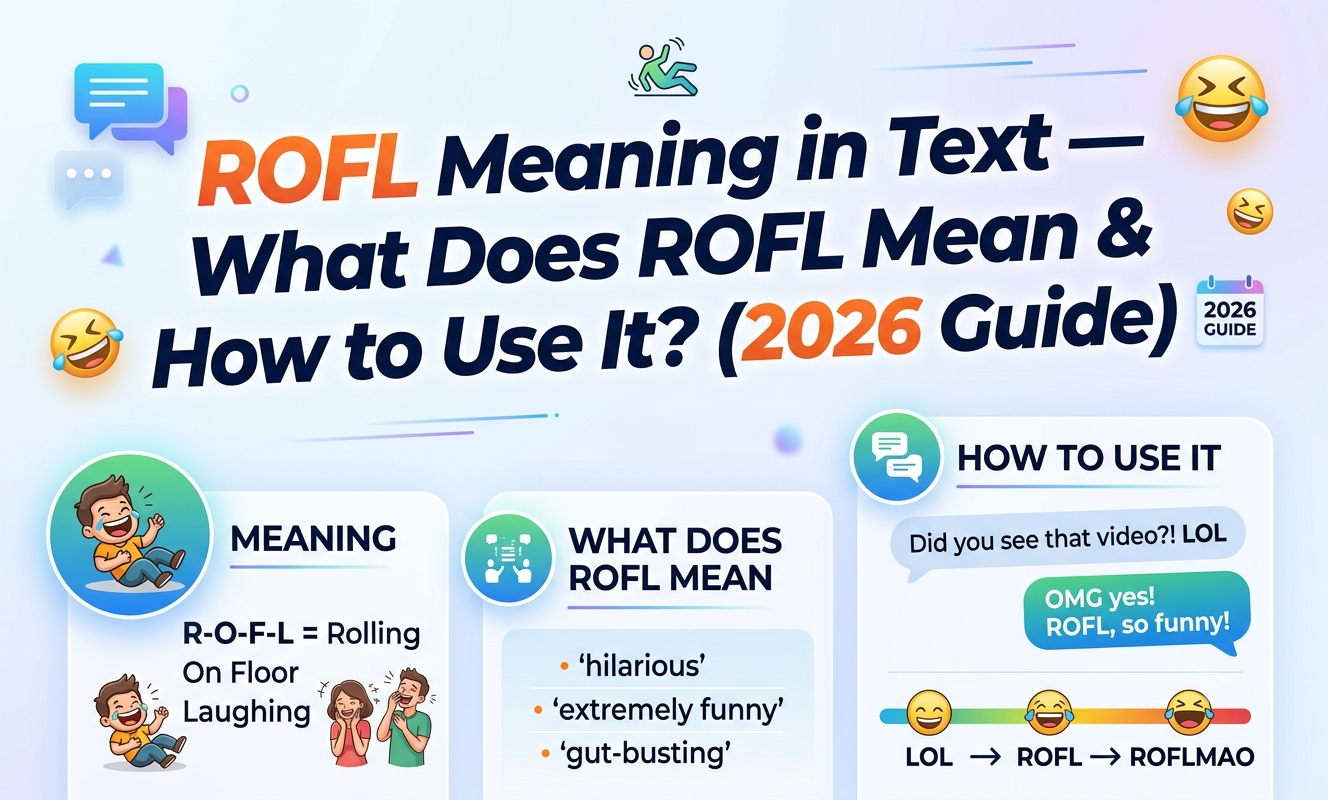
Quick Answer: ROFL stands for “Rolling On the Floor Laughing.” It’s an internet slang term used in texting and chats to show that something is extremely funny — funnier than a simple “lol.” People use it when a joke, meme, or video makes them laugh so hard they’d imagine themselves rolling on the floor.
Introduction
Ever gotten a text back that just says “ROFL” and wondered if you should be flattered or confused? You’re not alone. Texting slang moves fast, and even people who grew up online sometimes need a quick refresher.
ROFL meaning in text is simple once you break it down: it means “Rolling On the Floor Laughing.” It’s one of the oldest and most recognizable laughing acronyms still used across WhatsApp, Snapchat, Instagram, and TikTok in 2026. In this guide, you’ll learn where ROFL came from, how it compares to LOL and LMAO, real examples of how to use it, and whether it’s ever considered rude. By the end, you’ll be using it (and replying to it) like a pro.
What Does ROFL Mean?
ROFL is an acronym that stands for “Rolling On the Floor Laughing.” It’s used to express that something is so funny it caused (or would cause) intense, uncontrollable laughter — the kind where you’d physically fall over.
ROFL isn’t new. It actually dates back to early internet chatrooms and forums in the 1990s, alongside its cousin “LOL” (Laugh Out Loud). While LOL became the more casual, everyday response, ROFL was always meant to signal a bigger reaction — something genuinely hilarious rather than mildly amusing.
By 2026, ROFL has settled into a specific role in digital communication. It’s less common than LOL or “😂” as a default reply, but it’s still widely understood across generations. Recent language-trend reports on internet slang show that while Gen Z tends to favor emoji reactions and newer terms like “I’m deceased” or “no cap,” older millennials and Gen X users still frequently reach for ROFL, especially in group chats and WhatsApp family threads. It has become something of a “classic” acronym — instantly recognizable, rarely misunderstood, and still going strong decades after it started.
ROFL Full Form Explained
Breaking down the acronym letter by letter makes it easy to remember:
| Letter | Stands For | Meaning |
|---|---|---|
| R | Rolling | The action of moving back and forth |
| O | On | Positioned on top of |
| F | (the) Floor | The ground/surface you’re laughing on |
| L | Laughing | The act of laughing |
Put together: Rolling On the Floor Laughing — used to describe laughter so intense it’s exaggerated into a physical image.
How to Use ROFL — Real Examples
ROFL works best when something is genuinely funny, not just mildly amusing. Here are examples across different emotional contexts:
| Situation | Example | Emotion |
|---|---|---|
| Friend sends a funny meme | “ROFL this meme is too accurate 😂” | Amusement |
| Watching a comedy video | “ROFL I can’t breathe, send this to the group chat” | Uncontrollable laughter |
| Someone shares an embarrassing story | “Wait ROFL no way that actually happened to you” | Shock + humor |
| A sibling does something silly | “ROFL you’re actually the funniest person alive” | Affection + humor |
| Reacting to a pet video | “ROFL your cat is unhinged, I love it” | Delight |
| A joke lands perfectly | “Okay that joke got me, ROFL” | Genuine laughter |
| Group chat chaos | “ROFL this chat has gone completely off the rails” | Playful chaos |
| A sarcastic comment | “ROFL sure, and I’m the Queen of England” | Sarcasm |
| A funny typo or autocorrect fail | “ROFL did you mean to send that??” | Confusion + humor |
| Replying to a viral TikTok | “ROFL I’ve watched this 10 times already” | Obsession + amusement |
Notice ROFL usually appears at the start of a message, functioning almost like an exclamation before the reaction continues.
ROFL on Different Platforms (2026)
How ROFL gets used can shift slightly depending on where you’re texting or chatting. Here’s how it plays out on the major platforms in 2026.
On WhatsApp
WhatsApp remains one of the strongest homes for ROFL, especially in family groups and regional communities where users skew slightly older. It’s common to see ROFL paired with laughing emojis (😂🤣) in response to forwarded memes, voice notes, or viral videos shared in group chats.
On Snapchat
On Snapchat, ROFL shows up more in chat captions under funny Snaps or in response to a friend’s Story. Because Snapchat conversations tend to be quick and visual, ROFL often appears as a short standalone reply rather than a full sentence.
On TikTok
In TikTok comment sections, ROFL is frequently used to react to comedic skits, prank videos, or unexpected plot twists in short clips. It often appears alongside other slang like “I’m crying” or “not this 💀,” showing how multiple laughing expressions now coexist in the same comment thread.
On Instagram
On Instagram, ROFL pops up in DMs and comment replies, particularly on Reels and meme accounts. It’s slightly less common than “😭” or “💀” among younger users but still widely used, especially by users in their late 20s and older who grew up with it.
Across all four platforms, the general 2026 trend is that emoji-first reactions have taken over as the default, but ROFL remains a reliable, universally understood backup — especially in text-based conversations where emojis alone might not capture the tone.
Is ROFL Rude or Offensive?
Short answer: No, ROFL is not rude or offensive on its own. It’s simply an expression of amusement.
The case for it being completely harmless:
ROFL is a neutral, positive term. It shows enjoyment, connection, and shared humor. Using it in response to a friend’s joke, a funny video, or a lighthearted moment is universally acceptable and even encouraged as a way to keep conversations warm and engaging.
When context matters:
Like any laughing response, ROFL can come across as insensitive if used in the wrong context — for example, replying “ROFL” to someone sharing sad news, a serious problem, or bad news by mistake (like a typo reply). In these cases, the issue isn’t the word itself, but the mismatch between the message and the moment. It’s always worth double-checking who you’re replying to before hitting send.
In everyday casual conversation, though, ROFL is friendly, fun, and safe to use with almost anyone.
How to Reply to ROFL
Not sure what to say when someone sends you “ROFL”? Here are some natural replies:
| Their Message | Your Reply | Tone |
|---|---|---|
| “ROFL 😂” | “Right?? I couldn’t stop laughing either” | Agreeable |
| “ROFL this is too funny” | “I know, send me more like this” | Enthusiastic |
| “ROFL” (no context) | “Haha what happened 😂” | Curious |
| “ROFL I can’t” | “Same, I’m crying” | Playful |
| “ROFL you’re so dramatic” | “I’m just being honest 😂” | Teasing |
| “ROFL nooo” | “Yes it’s true, I saw it myself” | Confirming |
ROFL Alternatives and Similar Slang
ROFL isn’t the only laughing acronym out there. Here are other common terms with similar meanings:
| Term | Full Form | Meaning |
|---|---|---|
| LOL | Laugh Out Loud | General amusement, more casual than ROFL |
| LMAO | Laughing My *** Off | Strong laughter, slightly more informal/edgy |
| ROFLMAO | Rolling On the Floor Laughing My *** Off | An intensified combo of ROFL and LMAO |
| LMFAO | Laughing My Freaking *** Off | Even stronger emphasis version of LMAO |
| HAHA / HEHE | (Literal laugh sounds) | Direct, informal expression of laughing |
| 💀 (Skull Emoji) | “I’m dead” (from laughing) | Gen Z equivalent of dying from laughter |
| 😂 (Face with Tears of Joy) | — | The emoji equivalent of ROFL/LOL |
| IYKYK | If You Know You Know | Used alongside jokes only certain people will get |
Frequently Asked Questions (FAQ)
Q: What does ROFL mean in text?
A: ROFL means “Rolling On the Floor Laughing.” It’s used to show that something is extremely funny.
Q: Is ROFL the same as LOL?
A: Not exactly. LOL (“Laugh Out Loud”) is used for general amusement, while ROFL is meant to express a stronger, more intense reaction to something hilarious.
Q: Is ROFL still used in 2026?
A: Yes. While emoji reactions like 😂 and 💀 are now more common among younger users, ROFL is still widely understood and used, especially on WhatsApp and in text messages.
Q: Can I use ROFL in a professional setting?
A: It’s best to avoid ROFL in formal or professional communication, such as work emails. It’s suited for casual texting and social media, not business contexts.
Q: What’s the difference between ROFL and ROFLMAO?
A: ROFLMAO combines ROFL with LMAO (“Laughing My *** Off”), making it a more intense, slightly more informal version of the same laughing expression.
Q: Where did ROFL come from?
A: ROFL originated in early internet chatrooms and forums during the 1990s, around the same time as LOL, as part of early internet slang used for typing convenience.
Conclusion
ROFL is one of the internet’s original laughing acronyms, and even with newer slang and emoji reactions taking over group chats, it hasn’t disappeared. Knowing the ROFL meaning in text — Rolling On the Floor Laughing — helps you understand tone instantly, whether you’re texting a friend, replying in a WhatsApp group, or commenting on a TikTok video. It’s friendly, easy to use, and rarely misunderstood.
Bookmark this page next time you spot an unfamiliar acronym in your messages — you’ll always have a quick answer.
Also read ATP Meaning in Text — What Does ATP Mean & How to Use It?

1 Comment
Pingback: WFH Meaning in Text — What Does WFH Mean & How to Use It?