
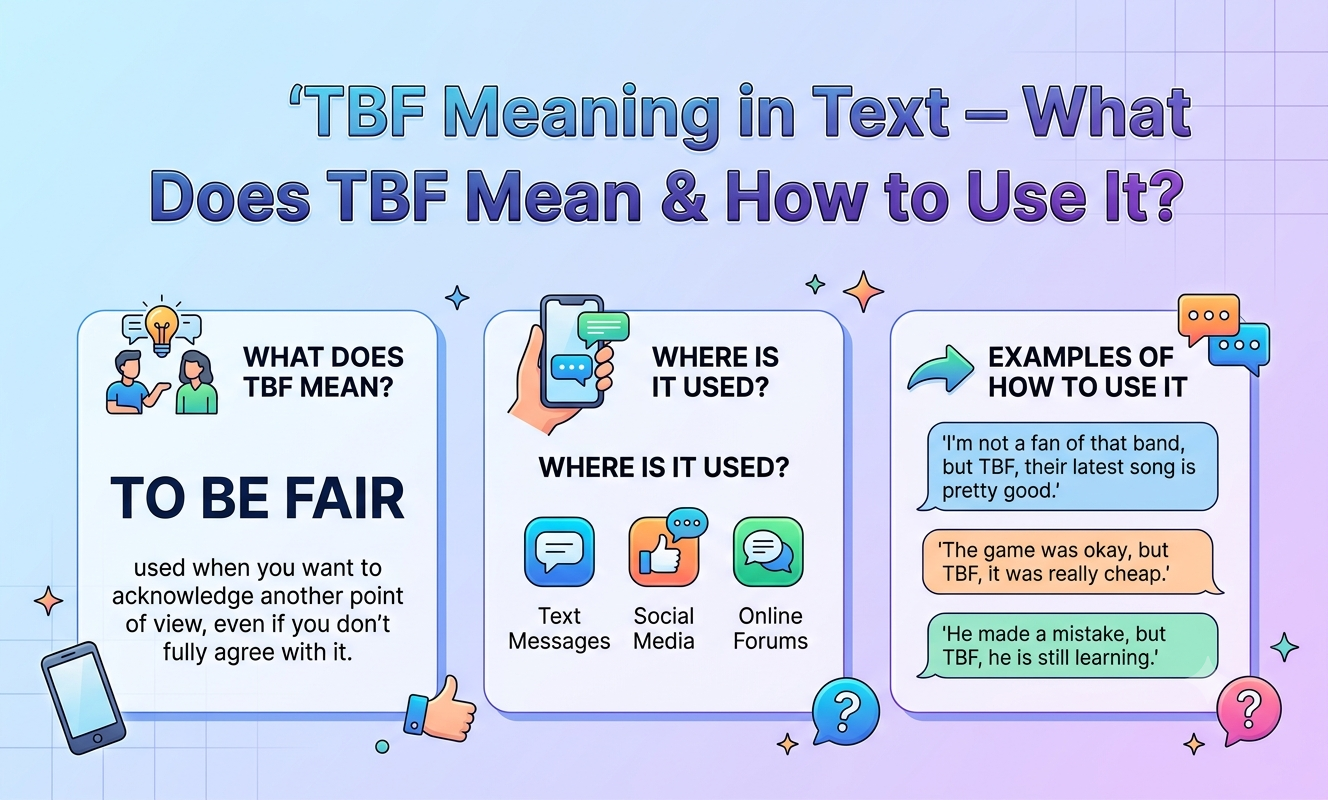
Quick Answer: TBF stands for “To Be Fair.” People use it in texts and on social media to add a fair, balanced, or slightly self-correcting point to a conversation — often right before agreeing with someone or admitting the other side has a point.
Introduction
Ever gotten a text that just said “tbf, you’re right” and wondered what it actually meant? You’re not alone. TBF meaning in text is one of those short forms that shows up everywhere — group chats, comment sections, TikTok captions — but rarely gets explained.
In simple terms, TBF means “To Be Fair.” It’s used when someone wants to acknowledge a fair point, soften a disagreement, or admit that another person’s argument has some truth to it, even if they don’t fully agree.
In this article, you’ll learn what TBF means, where it came from, how to use it correctly, how it shows up differently on WhatsApp, Snapchat, TikTok, and Instagram, whether it can come across as rude, and what to reply when someone sends it to you.
What Does TBF Mean?
TBF is a texting abbreviation for “To Be Fair.” It’s used to introduce a balanced or slightly contrarian point — a way of saying “okay, but let’s be honest here” or “I see your side too.”
Unlike slang that expresses pure emotion (like “lol” or “omg”), TBF is more of a conversational connector. It signals that the speaker is about to acknowledge nuance, correct themselves slightly, or admit fairness toward an opposing view.
TBF isn’t new. It’s been part of British and Irish internet slang for well over a decade, popular on forums and early texting culture long before smartphones took over. What’s changed by 2026 is where it shows up — it’s now common in TikTok comment threads, Instagram captions, and Gen Z group chats worldwide, not just in the UK and Ireland where it originally caught on. Short-form video culture has helped spread British-origin slang like TBF to global English-speaking audiences much faster than text messaging alone ever did.
TBF Full Form Explained
| Letter | Stands For |
|---|---|
| T | To |
| B | Be |
| F | Fair |
TBF = To Be Fair — a short way to introduce a balanced, honest, or slightly conceding point in a conversation.
How to Use TBF — Real Examples
TBF usually appears at the start of a sentence, right before the speaker makes a point that’s fair to the other person or situation, even if it’s not their main opinion.
| Situation | Example | Emotion |
|---|---|---|
| Friend disagreement | “TBF, you did warn me about this.” | Reluctant agreement |
| Group chat debate | “TBF the movie wasn’t that bad, just too long.” | Mild concession |
| Defending someone | “TBF she was having a rough week, that’s why she snapped.” | Empathy |
| Admitting a mistake | “TBF I probably should’ve replied sooner.” | Self-aware |
| Sports/gaming banter | “TBF that was a lucky shot, not skill.” | Playful teasing |
| Workplace chat | “TBF the deadline was unrealistic from the start.” | Justification |
| Comment on a post | “TBF he has a point about the pricing.” | Neutral agreement |
| Family conversation | “TBF mom did say this would happen.” | Light acknowledgment |
| Relationship talk | “TBF I wasn’t exactly clear about my plans either.” | Accountability |
| Reacting to news | “TBF a lot of people didn’t see that coming.” | Understanding |
Notice how TBF almost always softens a statement — it makes the speaker sound more reasonable and less one-sided.
TBF on Different Platforms (2026)
On WhatsApp
WhatsApp remains the go-to app for close friend and family group chats, and TBF fits naturally into these longer, back-and-forth conversations. It’s commonly used to settle small disagreements — about plans, opinions, or who’s right in a debate — without escalating the tone.
On Snapchat
On Snapchat, TBF tends to appear in quick chat replies rather than Snaps themselves, since the app is built for fast, casual exchanges. It’s often paired with emojis to keep the tone light, such as “tbf 😭 you’re not wrong.”
On TikTok
TikTok comment sections are one of the biggest drivers of TBF’s continued popularity. Viewers use it to add nuance to a debate happening in the comments — for example, defending a creator while still admitting the criticism has some merit. It’s especially common under reaction videos, duets, and “who’s right” style debate content.
On Instagram
On Instagram, TBF shows up mostly in comments and DMs rather than captions. It’s frequently used to respond to opinions shared in Reels or carousel posts, especially on relationship, lifestyle, or hot-take content where people want to add a balanced perspective without starting an argument.
Across all these platforms, TBF has become a low-effort way to sound fair-minded in fast-paced digital conversations, which is part of why it has stayed relevant even as new slang trends come and go.
Is TBF Rude or Offensive?
TBF is not inherently rude or offensive. In most cases, it’s actually the opposite — a way to sound more considerate by acknowledging another person’s point.
However, context matters:
- Not rude when: used to genuinely concede a point, defend someone, or add balance to a discussion.
- Can feel dismissive when: used sarcastically to downplay someone’s feelings, such as “tbf you’re overreacting.”
The tone usually depends on what follows “TBF.” If the sentence validates the other person, it reads as thoughtful. If it minimizes their concern, it can come across as passive-aggressive. As with most texting slang, reading the relationship and conversation tone matters more than the abbreviation itself.
How to Reply to TBF
| Their Message | Your Reply | Tone |
|---|---|---|
| “TBF you did say that already.” | “Haha fair, my bad.” | Agreeable |
| “TBF it’s not entirely your fault.” | “Thanks, I appreciate that.” | Grateful |
| “TBF the plan was confusing.” | “Yeah I could’ve explained it better.” | Understanding |
| “TBF he’s not wrong though.” | “Okay okay, valid point.” | Light concession |
| “TBF that’s a lot to ask.” | “True, I’ll dial it back.” | Reasonable |
| “TBF you never confirmed the time.” | “Fair enough, my mistake.” | Owning it |
TBF Alternatives and Similar Slang
| Term | Meaning |
|---|---|
| NGL | Not Gonna Lie |
| IMO | In My Opinion |
| TBH | To Be Honest |
| FR | For Real |
| IYKYK | If You Know You Know |
| IDK | I Don’t Know |
| NVM | Never Mind |
| JS | Just Saying |
TBF is closest in meaning to TBH, but with a key difference: TBH usually introduces the speaker’s own honest opinion, while TBF introduces a point that’s fair to someone else’s side.
Frequently Asked Questions (FAQ)
Q: What does TBF mean in text?
A: TBF means “To Be Fair.” It’s used to introduce a balanced or reasonable point, often when partly agreeing with someone.
Q: What is the full form of TBF in texting?
A: The full form of TBF is To Be Fair.
Q: Is TBF the same as TBH?
A: Not exactly. TBH means “To Be Honest” and shares your personal opinion, while TBF means “To Be Fair” and acknowledges someone else’s point or side.
Q: Can TBF be used in professional or work messages?
A: Yes, casually. It’s common in informal workplace chats (like Slack or Teams) but best avoided in formal emails or official documents.
Q: Is TBF used only by teenagers?
A: No. While popular with teens and young adults on social media, TBF is widely used by adults too, especially in casual texting and group chats.
Q: Where did TBF originate?
A: TBF originated as British and Irish internet slang before spreading globally through texting and social media platforms like TikTok and Instagram.
Conclusion
TBF meaning in text comes down to one simple idea: being fair, even when you don’t fully agree. Whether you see it on WhatsApp, TikTok comments, or Instagram DMs, it’s a quick way to add balance to a conversation without sounding harsh.
Now that you know what TBF means, how to use it, and how to reply, you’ll never be confused by it again. Bookmark this page next time you spot a slang term you don’t recognize — chances are, we’ve got it covered too.
Also read DTTM Meaning in Text — What Does DTTM Mean & How to Use It?
