
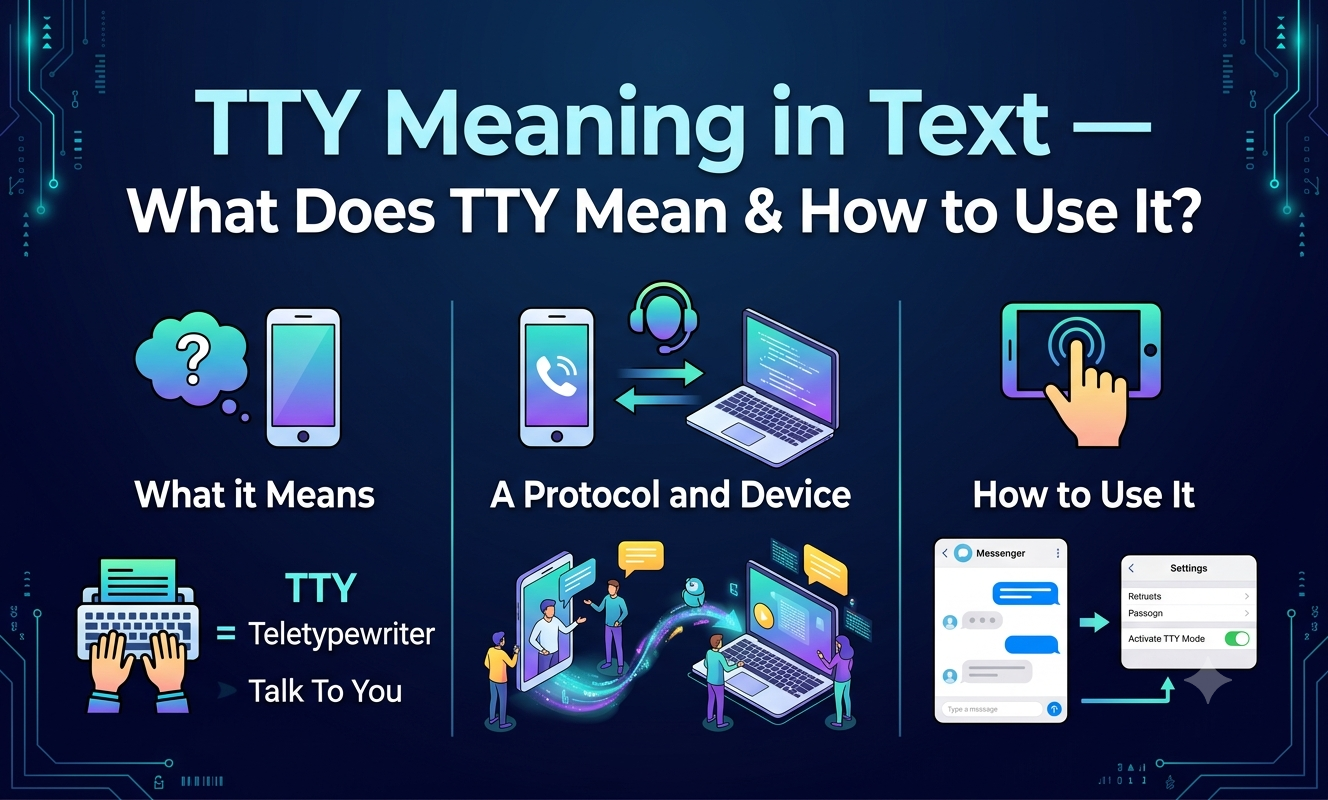
Quick Answer: In texting, TTY most commonly means “Talk To You” — as in “TTY later” or “TTY tomorrow.” It’s a casual sign-off used when someone wants to continue a conversation another time. TTY can also refer to a teletypewriter, a communication device originally built for people who are deaf or hard of hearing.
Introduction
Ever gotten a text that just says “TTY tmrw” and had no idea what it meant? You’re not alone. Texting is full of shortcuts like this, and TTY is one that trips up a lot of people, especially parents trying to keep up with their kids’ messages.
The tty meaning in text depends a bit on context, but in casual chats it almost always means “Talk To You.” It’s a quick, friendly way to wrap up a conversation without sounding cold or abrupt.
In this article, you’ll learn where TTY came from, what it fully stands for, how people use it in real conversations, and how its meaning shifts slightly across apps like WhatsApp, Snapchat, TikTok, and Instagram in 2026. We’ll also cover the older, more formal meaning of TTY so you’re not caught off guard if you see it in a different setting.
What Does TTY Mean?
TTY has two very different meanings depending on where you see it, and knowing the difference matters.
In everyday texting, TTY is shorthand for “Talk To You.” It’s usually paired with a time reference, like “TTY later,” “TTY soon,” or “TTY tomorrow.” Think of it as a lighter, more casual version of saying “talk soon” or “catch you later.”
In telecommunications and accessibility, TTY stands for teletypewriter, a device that lets people who are deaf, hard of hearing, or have speech difficulties type and read messages over a phone line instead of speaking. This meaning has been around since the 1960s and is still used today in emergency services and government documents.
By 2026, the casual texting use of TTY has become far more common among teens and young adults than the older technical meaning, thanks to how often it shows up in group chats and DMs. Most Gen Z and Gen Alpha users encounter TTY first as slang, not as the accessibility term, which is part of why the confusion between generations happens so often.
Quick refresher on tone: TTY is neutral to friendly. It’s not sarcastic, and it’s rarely used to end a conversation on a negative note. It usually signals “I have to go, but let’s keep talking later.”
TTY Full Form Explained
Since TTY is an acronym, breaking it down letter by letter makes the meaning click faster.
| Letter | Stands For | Explanation |
|---|---|---|
| T | Talk | Refers to continuing a conversation |
| T | To | Connects the action to the person |
| Y | You | Directed at the person you’re texting |
So TTY = “Talk To You” — a simple, three-word phrase condensed into three letters for quick typing.
Note: In the accessibility context, the letters stand for Tele-Type-Writer, referring to the physical device rather than an action.
How to Use TTY — Real Examples
TTY works best as a sign-off or a promise to reconnect. Here are common real-world examples across different emotional tones.
| Situation | Example | Emotion |
|---|---|---|
| Ending a call plan | “Gotta run, TTY after school!” | Casual |
| Reassuring a friend | “TTY tonight, don’t worry about it” | Comforting |
| Quick work break | “In a meeting rn, TTY in an hour” | Practical |
| Family check-in | “Love you, TTY when I land” | Warm |
| Group chat wrap-up | “Ok bye everyone, TTY tmrw for the plan” | Friendly |
| Apology follow-up | “Sorry, gotta go, TTY so we can talk properly” | Sincere |
| Excited plans | “Can’t wait, TTY when you’re free to finalize!” | Enthusiastic |
| Low-key mood | “Tired rn, TTY later ig” | Neutral/tired |
| Romantic context | “Miss you already, TTY tonight ❤️” | Affectionate |
| Professional-casual | “Stepping into class, TTY at lunch” | Neutral |
Notice how TTY rarely appears alone. It’s almost always followed by a time word like “later,” “tonight,” “tmrw,” or “soon,” which softens it and makes the intent clear.
TTY on Different Platforms (2026)
TTY shows up differently depending on the app, mostly because of how each platform shapes conversation speed and tone.
On WhatsApp
WhatsApp remains one of the top platforms for longer, ongoing conversations, especially across families and international friend groups. In 2026, TTY is commonly used at the end of voice-note threads, where someone types “TTY” after sending a long voice message to signal they’ll follow up by voice again later.
On Snapchat
Snapchat’s fast, disappearing nature makes TTY a quick way to close a Snap chat without ending the streak or relationship. Since Snapchat conversations are often short bursts throughout the day, “TTY” acts like a placeholder for “more coming later.”
On TikTok
On TikTok, TTY shows up mostly in comment sections and DMs rather than captions. In 2026, TikTok’s DM feature has grown into a major messaging space for younger users, and TTY is frequently used when a conversation moves from comments into a private chat: “TTY in DMs.”
On Instagram
Instagram DMs and close-friend Stories are where TTY appears most. It’s common to see TTY paired with a Story reply, especially when someone reacts quickly but wants to continue the real conversation elsewhere, like: “Omg TTY about this later.”
Across all four platforms, the core meaning stays the same — it’s about pausing, not ending, a conversation.
Is TTY Rude or Offensive?
TTY is not considered rude or offensive in any mainstream context. It’s a neutral, practical shorthand.
Why some people might think it feels dismissive:
- It can feel abrupt if used without warmth (“TTY.” with no emoji or explanation)
- Sent alone, without context, it might read as an excuse to leave a conversation
Why it’s generally seen as harmless:
- It’s almost always paired with a reassurance (“later,” “soon,” “tonight”)
- It’s widely understood as a normal part of digital shorthand, not a snub
- Parents and older users increasingly recognize it as standard texting behavior, not attitude
Context matters most. “TTY 💕” reads completely differently from a flat “TTY.” with no punctuation or emoji. The tone comes from what surrounds the acronym, not the acronym itself.
How to Reply to TTY
Replying to TTY is simple, since it’s really just an acknowledgment that you’ll talk again soon.
| Original Message | Good Reply | Tone |
|---|---|---|
| “TTY later!” | “Sounds good, talk soon!” | Friendly |
| “TTY tonight” | “Okay, I’ll be free after 8” | Practical |
| “TTY tmrw for the plan” | “Perfect, can’t wait” | Enthusiastic |
| “TTY when you’re free” | “Will do, ttyl!” | Casual |
| “TTY, gotta go” | “No worries, talk later!” | Understanding |
| “TTY ❤️” | “TTY! Miss you already” | Affectionate |
There’s no wrong way to reply, as long as your response confirms you’re on the same page about continuing the conversation later.
TTY Alternatives and Similar Slang
TTY belongs to a whole family of texting shorthand used for pausing or ending conversations.
| Slang | Meaning |
|---|---|
| TTYL | Talk To You Later |
| BRB | Be Right Back |
| GTG | Got To Go |
| TTFN | Ta-Ta For Now |
| CU | See You |
| L8R | Later |
| HMU | Hit Me Up |
| BBL | Be Back Later |
These terms are often interchangeable with TTY, though TTYL is the most similar since it directly extends TTY with a time reference built in.
Frequently Asked Questions (FAQ)
Q: What does TTY mean in a text message? A: In texting, TTY usually means “Talk To You,” used to signal that you’ll continue a conversation later, such as “TTY tonight.”
Q: Is TTY the same as TTYL? A: They’re closely related. TTY means “Talk To You,” while TTYL means “Talk To You Later.” TTYL already includes the time element, while TTY is often followed by a separate word like “later” or “soon.”
Q: Does TTY have a different meaning outside of texting slang? A: Yes. Outside of casual texting, TTY stands for teletypewriter, a device used by people who are deaf or hard of hearing to communicate over phone lines, and it’s still referenced in accessibility and emergency services today.
Q: Is TTY only used by teens? A: No. While it’s popular among teens and young adults, TTY is understood widely across age groups, including parents, since it’s been part of texting culture for years.
Q: What’s the difference between TTY and BRB? A: BRB (“Be Right Back”) implies a short pause, often just minutes, within the same conversation. TTY implies a longer gap, often hours, and signals the conversation will pick up later rather than immediately.
Q: Why do people use TTY instead of just saying “talk later”? A: Texting slang like TTY exists mainly for speed and convenience. It lets people wrap up a chat quickly without typing a full sentence, especially in fast-moving group chats.
Conclusion
TTY is one of those texting terms that looks confusing at first but makes total sense once you know it simply means “Talk To You.” Whether it shows up on WhatsApp, Snapchat, TikTok, or Instagram, the intent stays the same: someone wants to pause the conversation and pick it back up soon.
It’s not rude, it’s not exclusive to teens, and it even has a completely separate, important meaning in accessibility technology. The next time you see “TTY later” pop up in your messages, you’ll know exactly how to read it — and how to reply.
Also read JP Meaning in Text — What Does JP Mean & How to Use It?

1 Comment
Pingback: WYGG Meaning in Text — What Does WYGG Mean & How to Use It?