
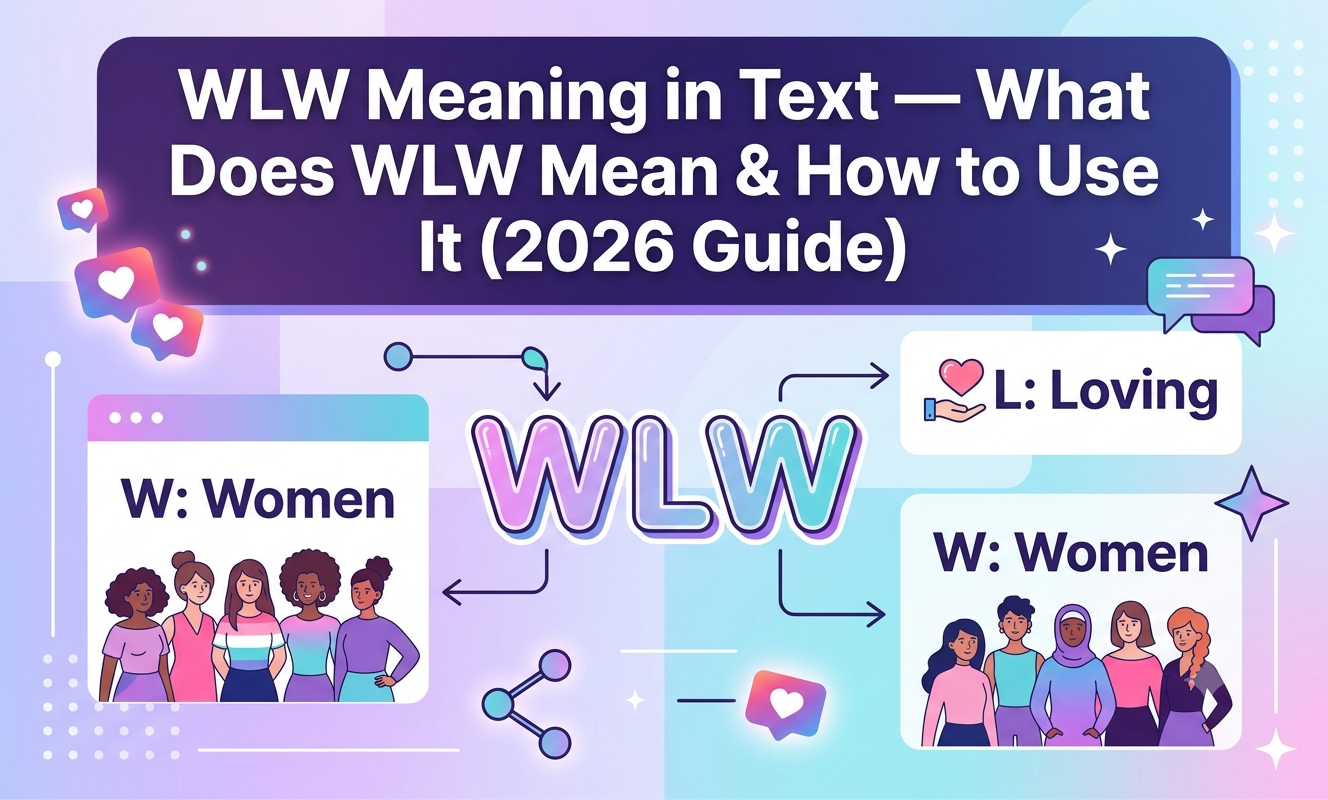
Quick Answer: WLW stands for “Women Loving Women.” It’s an umbrella term used to describe lesbian, bisexual, and queer women, or relationships and attraction between women. You’ll see it in bios, captions, hashtags, and casual texting to describe someone’s identity or to tag content that celebrates women who love women.
Introduction
Scrolled through TikTok or Instagram and spotted “wlw” in someone’s bio and wondered what it actually means? You’re not alone — this three-letter term shows up everywhere from dating app profiles to fan-fiction tags, and it’s not always obvious at first glance.
WLW meaning in text boils down to “Women Loving Women,” a simple but important label used across social media and everyday messaging. It’s used by real people to describe their identity, by content creators to categorize their posts, and by fans to talk about relationships they ship in shows and movies.
In this guide, you’ll learn exactly what WLW means, where it came from, how people use it on different apps in 2026, whether it’s ever considered offensive, and how to reply if someone uses it with you. We’ll also cover similar terms so you’re never confused by internet slang again.
What Does WLW Mean?
WLW is short for “Women Loving Women.” It’s a broad, inclusive term that covers lesbian, bisexual, pansexual, and queer women — basically any woman who experiences romantic or sexual attraction to other women. It’s also used to describe relationships, fictional pairings, or media that centers women loving women.
The term grew out of LGBTQ+ online spaces in the 2010s as a shorthand that didn’t require someone to specify an exact label like “lesbian” or “bisexual.” Instead, it acted as an umbrella term that felt more casual and inclusive for everyday use.
By 2026, WLW has become a normal part of mainstream internet vocabulary, not just niche LGBTQ+ forums. It’s used in:
- Social media bios to signal identity
- Hashtags to categorize queer content and media
- Fan communities discussing same-gender romantic pairings (“ships”)
- Everyday texting between friends discussing relationships or crushes
It’s closely related to the term “sapphic,” which is often used interchangeably, though sapphic leans slightly more literary/poetic while WLW feels more casual and text-friendly.
WLW Full Form Explained
Since WLW is an acronym, here’s a simple letter-by-letter breakdown:
| Letter | Stands For | Meaning |
|---|---|---|
| W | Women | Refers to women or people who identify as women |
| L | Loving | Describes romantic or emotional attraction |
| W | Women | The women being loved or attracted to |
Put together: Women Loving Women — a term describing attraction, relationships, or identity between women.
How to Use WLW — Real Examples
WLW can pop up in a lot of different everyday situations, from casual chats to social media captions. Here’s a table showing common ways it’s used, along with the emotion behind each one.
| Situation | Example | Emotion |
|---|---|---|
| Bio description | “wlw 🌈 she/her” | Pride/identity |
| Talking about a crush | “ngl I think I might be wlw, I can’t stop thinking about her” | Confusion/excitement |
| Fan content caption | “posting more wlw edits because this ship deserves it” | Enthusiasm |
| Supporting a friend | “so proud of you for coming out as wlw, love you” | Support/love |
| Dating app bio | “wlw looking for someone real, not just a fling” | Hopeful |
| Instagram caption | “date night with my favorite person 💕 #wlw” | Happiness |
| Coming out text | “hey mom, I think I’m wlw and wanted you to know” | Vulnerability |
| Book/show recommendation | “if you love wlw romance novels, you need to read this” | Excited/recommending |
| Group chat | “wait is that couple wlw?? they’re so cute” | Curiosity |
| Pride month post | “celebrating all my wlw friends this pride month 🏳️🌈” | Celebration |
As you can see, WLW isn’t limited to one tone — it can show up in emotional coming-out conversations just as easily as it shows up in a lighthearted meme caption.
WLW on Different Platforms (2026)
Each social platform has its own flavor of how WLW gets used. Here’s how it looks across the apps teens and young adults use most in 2026.
On WhatsApp
WhatsApp usage of WLW is mostly private and personal — think one-on-one chats between close friends or partners. It’s less about hashtags and more about genuine conversations, like a friend explaining their identity or two people discussing a relationship. Status updates sometimes include WLW-related emojis (like 🏳️🌈 or 💕) alongside the term.
On Snapchat
Snapchat’s WLW usage in 2026 is largely tied to captions on Snap Map stories and private snaps between couples or friend groups. Because Snapchat feels more casual and intimate, WLW here often appears alongside inside jokes or relationship updates rather than public statements.
On TikTok
TikTok remains the biggest hub for WLW content. Creators use #wlw and related tags (#sapphic, #wlwtiktok) to categorize relationship content, comedic skits about queer dating, and edits of favorite same-gender fictional couples. In 2026, WLW-tagged videos continue to rack up billions of views, especially around Pride Month and Sapphic Awareness Week.
On Instagram
Instagram sees WLW mostly in bios and captions. Many users add “wlw” directly next to their pronouns as a quick identity marker. It’s also common in carousel posts celebrating queer couples, relationship milestones, or Pride-related content.
Is WLW Rude or Offensive?
WLW is not considered offensive in itself — it’s a term the LGBTQ+ community created and uses to describe its own members. It’s similar to terms like “gay,” “bi,” or “sapphic” in that it’s meant to be descriptive and inclusive, not derogatory.
That said, context matters:
- Respectful use: Using WLW to describe yourself, a friend (with their consent), a fictional relationship, or media content is completely normal and welcomed.
- Disrespectful use: Using the term to mock someone, “out” someone without their permission, or make fun of relationships is where it becomes a problem — not because of the word itself, but because of the intent behind it.
If you’re unsure whether it’s okay to use the term about a specific person, the safest approach is simple: ask them how they identify and use whatever term they’re comfortable with.
How to Reply to WLW
If someone tells you they’re WLW, or uses the term in conversation, here are some natural, supportive ways to respond.
| Message Received | Reply Example | Tone |
|---|---|---|
| “I think I’m wlw” | “Thank you for telling me, I’m really happy you shared that with me” | Supportive |
| “wlw 🏳️🌈” (in bio) | “Love your bio! 💕” | Casual/friendly |
| “is that couple wlw?” | “Yeah, they’ve been together for two years, they’re adorable” | Informative |
| “I came out as wlw today” | “That takes courage, I’m proud of you” | Encouraging |
| “do you know what wlw means?” | “Yep, it means women loving women — kind of an umbrella term” | Helpful |
| “posting wlw content today” | “Can’t wait to see it!” | Enthusiastic |
WLW Alternatives and Similar Slang
WLW isn’t the only term floating around — here are similar words and acronyms you might come across in the same context.
| Term | Meaning |
|---|---|
| Sapphic | A broader, often poetic term for women attracted to women, inspired by the poet Sappho |
| MLM | “Men Loving Men,” the male equivalent of WLW |
| WLNB | “Women Loving Non-Binary people,” an inclusive variation |
| NBLW | “Non-Binary Loving Women,” another inclusive variation |
| Queer | A general umbrella term for anyone outside heterosexual/cisgender norms |
| Bi/Pan | Short for bisexual or pansexual, describing attraction to multiple genders |
| Femslash | A fandom term for fan fiction depicting romantic relationships between women |
| GNC | “Gender Non-Conforming,” sometimes used alongside WLW in bios |
Frequently Asked Questions (FAQ)
Q: What does WLW mean in text? A: WLW stands for “Women Loving Women,” a term used to describe lesbian, bisexual, or queer women, or relationships between women.
Q: Is WLW the same as lesbian? A: Not exactly. WLW is a broader umbrella term that includes lesbian, bisexual, and other identities where women are attracted to women, while “lesbian” specifically refers to women attracted only to women.
Q: What is the WLW full form? A: The full form of WLW is “Women Loving Women.”
Q: Is WLW an offensive term? A: No, WLW is a term created and used within the LGBTQ+ community and is generally seen as respectful and inclusive when used appropriately.
Q: What’s the male version of WLW? A: The male equivalent is MLM, which stands for “Men Loving Men.”
Q: Where is WLW most commonly used? A: WLW is most commonly seen on TikTok, Instagram, and in fan communities, usually in bios, hashtags, or captions related to identity or relationships.
Conclusion
WLW meaning in text comes down to one simple idea: Women Loving Women — a term that celebrates identity, relationships, and representation online. Whether you’ve seen it in a TikTok caption, an Instagram bio, or a text from a friend coming out, now you know exactly what it means and how it’s used across different platforms in 2026.
From casual bios to heartfelt coming-out messages, WLW is simply part of how people express who they are and who they love. Bookmark this page next time you spot unfamiliar internet slang — you’ll always have a quick, clear answer.
Also read AF Meaning in Text — What Does AF Mean & How to Use It?
