
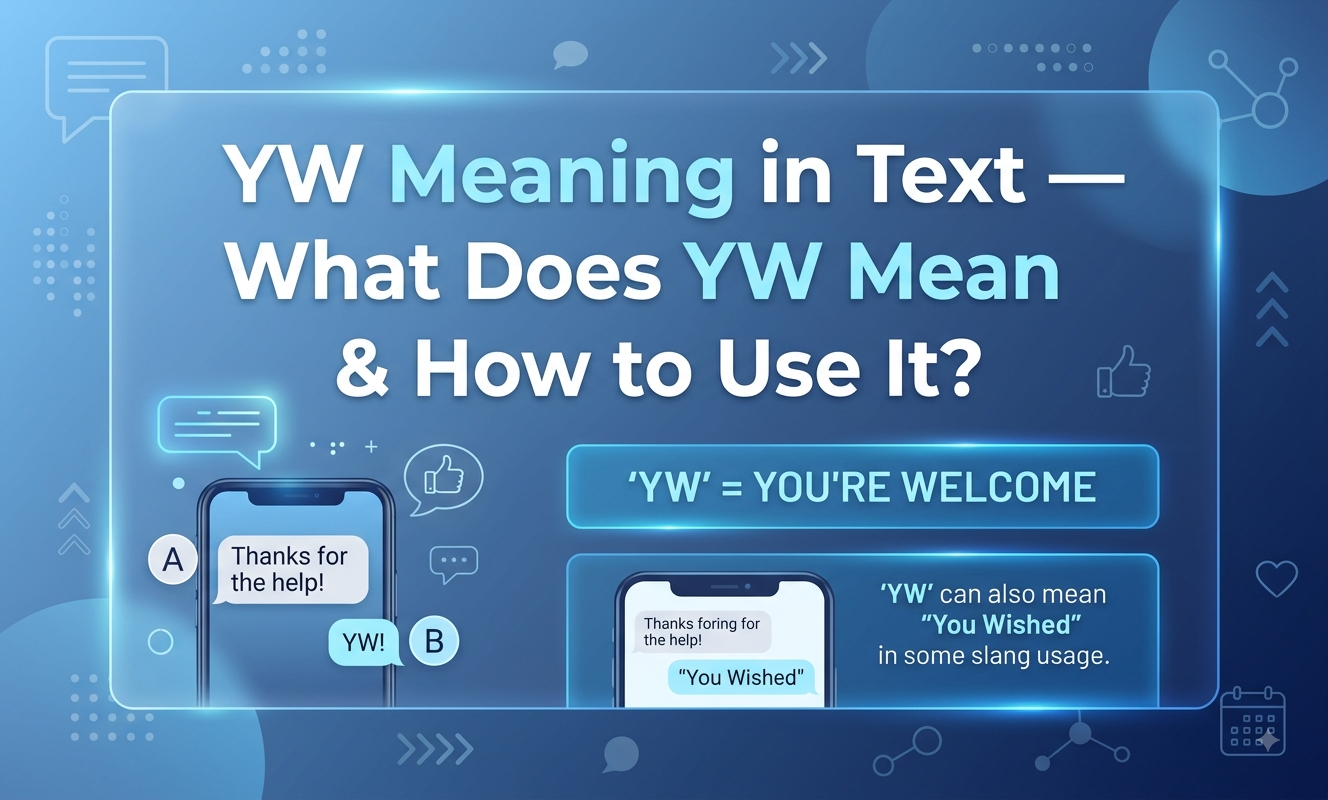
YW meaning in text is “You’re Welcome.” It’s a short, casual reply people use after someone says “thank you,” most often on WhatsApp, Snapchat, TikTok, and Instagram. It can sound friendly, polite, or even a little sarcastic depending on the tone of the conversation.
Quick Answer Before We Dive In
If a friend texts you “thanks!” and you reply “yw,” you’re just saying “you’re welcome” in the fastest way possible. That’s really all there is to it — but how and when you use it can completely change what it means. Keep reading, and by the end of this article you’ll know exactly when yw fits, when it feels rude, and what to say instead.
Introduction
Ever gotten a text that just says “yw” and wondered if the person is being sweet or shady? You’re not alone. Texting shorthand moves fast, and yw meaning in text is one of those abbreviations that looks simple but carries a lot of tone depending on context.
In this guide, we’ll break down what yw actually stands for, where it came from, how teens and adults use it differently across WhatsApp, Snapchat, TikTok, and Instagram in 2026, and whether it can come across as rude. You’ll also get real example conversations, reply ideas, and a list of similar slang terms so you never have to guess again. Whether you’re a teen texting friends or a parent trying to decode your kid’s messages, this article has you covered.
What Does YW Mean?
YW is a texting abbreviation for “You’re Welcome.” It’s used as a quick, casual response after someone thanks you for something — whether that’s help with homework, a compliment, a favor, or just holding a door.
The abbreviation belongs to a broader family of short texting replies like np (no problem), ty (thank you), and ily (I love you). These shortcuts became popular as texting and instant messaging replaced phone calls, and they’ve stuck around because typing three letters is a lot faster than typing eleven.
YW isn’t new slang — it’s been used in chatrooms and SMS messages since the early 2000s. What has changed is where it shows up. In 2026, yw is used far more inside disappearing chats, comment replies, and voice-to-text captions than in traditional SMS, simply because so much daily communication has shifted to apps like WhatsApp, Snapchat, and Instagram DMs. Younger users increasingly default to short-form replies like yw because platform messaging is built around speed — quick back-and-forth exchanges rather than long, formal sentences.
YW Full Form Explained
YW is an initialism, meaning each letter stands for the first letter of a word in the phrase.
| Letter | Stands For |
|---|---|
| Y | You’re |
| W | Welcome |
That’s it — no hidden meaning, no double definition. Unlike some slang terms that have multiple interpretations depending on platform, yw almost always means “you’re welcome” across every messaging app and social platform.
How to Use YW — Real Examples
The letters never change, but the feeling behind yw depends entirely on context — punctuation, capitalization, and what came before it all matter. Here are examples across different emotional situations.
| Situation | Example | Emotion |
|---|---|---|
| Friend thanks you for advice | “ty for helping me study” → “yw, you’ll do great” | Warm, supportive |
| Casual favor | “thanks for the ride” → “yw np” | Friendly, easygoing |
| Sarcastic reply to no thanks | “…” → “yw btw” (after doing something unacknowledged) | Sarcastic, passive-aggressive |
| Formal-ish reply to a teacher/parent | “Thank you for your help” → “You’re welcome!” (full form preferred) | Polite, respectful |
| Quick group chat exchange | “thanks for setting this up” → “yw 🙌” | Cheerful, upbeat |
| Flirty context | “aww ty for the compliment” → “yw ;)” | Playful, flirty |
| After a big favor | “omg thank you so much for covering my shift” → “yw, anytime” | Genuine, caring |
| Dismissive or cold | “thanks” → “yw.” (with a period, no emoji) | Blunt, distant |
| Between siblings | “thanks for not telling mom” → “yw… this time” | Teasing |
| Customer-style reply | “Thanks for the quick response!” → “You’re welcome! Let me know if you need anything else.” | Professional |
Notice the pattern: a lowercase “yw” with an emoji usually reads as friendly, while “yw.” with a period and nothing else can feel cold or sarcastic. Context always wins over the letters themselves.
YW on Different Platforms (2026)
Texting slang doesn’t behave the same way everywhere. Here’s how yw shows up on the platforms teens and young adults use most in 2026.
On WhatsApp
WhatsApp remains the dominant messaging app for both casual friend groups and family chats in many regions, and yw is common in both. In family group chats, it’s often paired with a full sentence for politeness (“yw, glad I could help”), while in one-on-one friend chats it’s usually left short and bare.
On Snapchat
On Snapchat, yw tends to appear in chat replies rather than on Snaps themselves, since Snaps are visual-first. Because Snapchat conversations disappear, users lean even more into ultra-short replies like yw, np, and ty — there’s less pressure to sound formal when the message vanishes after viewing.
On TikTok
On TikTok, yw shows up mostly in comment sections. A common pattern in 2026: someone comments a helpful tip, another user replies “ty!!”, and the original commenter responds “yw 🙏.” It’s also used sarcastically in comment threads when someone points out something obvious that nobody asked for.
On Instagram
On Instagram, yw appears frequently in DMs and comment replies, especially after someone tags a friend or gives a shoutout. Instagram’s caption and Story reply culture has made short acknowledgments like yw a normal part of everyday interaction, particularly among younger users who prioritize quick, low-effort responses over longer replies.
Overall 2026 trend: Across all four platforms, short-form abbreviated replies like yw continue to dominate casual conversation, largely because messaging habits have shifted toward speed and volume — people are sending more messages per day, so shorter replies have become the norm rather than the exception.
Is YW Rude or Offensive?
This is where a lot of confusion happens — yw is not inherently rude, but it can feel that way depending on how it’s delivered.
Why it can feel dismissive:
- No punctuation or emoji can read as cold or flat
- Replying “yw” to something you clearly didn’t help with can come across as sarcastic or petty
- In formal settings (texting a teacher, boss, or someone you don’t know well), an abbreviation can feel too casual or even disrespectful
Why it’s usually totally fine:
- Between close friends, short replies are the norm, not an insult
- It’s simply faster typing — most people don’t intend anything negative by it
- Adding an emoji, exclamation point, or extra word (like “yw np” or “yw 😊”) almost always signals warmth
The bottom line: context and relationship matter more than the abbreviation itself. If you’re unsure how a “yw” was meant, it’s usually safe to assume it was neutral or friendly unless the rest of the conversation suggests otherwise.
How to Reply to YW
Sometimes you don’t need to reply to a “yw” at all — but if the conversation is still going, here are natural options.
| Their Message | Your Reply | Tone |
|---|---|---|
| “yw” | “😊” | Simple acknowledgment |
| “yw np” | “you’re the best” | Warm, appreciative |
| “yw.” | “ok” or leave it | Matching their short tone |
| “yw anytime” | “I’ll hold you to that 😂” | Playful |
| “yw 🙏” | “🙏🙏” | Mirroring |
| “yw.” (feels cold) | “everything ok?” | Checking in if tone feels off |
YW Alternatives and Similar Slang
YW isn’t the only short way to say “you’re welcome” — here are other common variations and related texting terms.
| Term | Meaning |
|---|---|
| np | No problem |
| ofc | Of course |
| anytime | You’re welcome, happy to help again |
| nw | No worries |
| yr welcome | Casual spelled-out version of “you’re welcome” |
| welc | Shortened “welcome” |
| 🫡 (salute emoji) | Wordless “you’re welcome” / acknowledgment |
| ty / tysm | Thank you / thank you so much (the phrase yw usually responds to) |
Frequently Asked Questions (FAQ)
Q: What does yw mean in text from a girl or guy? A: The meaning doesn’t change based on gender — yw always means “you’re welcome.” The tone (friendly, flirty, or sarcastic) depends on the conversation, not who’s sending it.
Q: Is yw the same as np in texting? A: They’re similar but not identical. Yw (“you’re welcome”) is a direct response to thanks, while np (“no problem”) downplays the favor as if it wasn’t a big deal. Both are polite, casual replies.
Q: Why do people reply yw instead of writing “you’re welcome”? A: Mostly for speed. Texting culture favors short replies, especially in fast-moving group chats or disappearing messages on apps like Snapchat, where typing a full sentence feels unnecessary.
Q: Can yw be used in professional or formal texting? A: It’s best to avoid it in formal or professional contexts. Spelling out “You’re welcome!” is safer when texting a teacher, boss, client, or someone you don’t know well.
Q: What does it mean if someone replies yw with a period? A: A period at the end (“yw.”) often makes a message feel more blunt, flat, or even annoyed, since periods in texting are frequently read as a sign of seriousness or coldness rather than casualness.
Q: Does yw mean the same thing on every platform? A: Yes — the meaning stays consistent across WhatsApp, Snapchat, TikTok, and Instagram. What changes is the context it’s used in, like comments versus private DMs.
Conclusion
YW is simply short for “you’re welcome,” and it’s one of the most common replies you’ll see across WhatsApp, Snapchat, TikTok, and Instagram in 2026. On its own, the abbreviation is neutral — it’s the punctuation, emojis, and relationship between the two people texting that shape whether it reads as warm, playful, sarcastic, or cold. Now that you know the full meaning, the platform trends, and how to reply naturally, you’ll never have to second-guess a “yw” text again. Bookmark this page so you can quickly check yw meaning in text — or any other texting abbreviation — whenever it pops up in your messages.
Also read OFC Meaning in Text — What Does OFC Mean & How to Use It?
