
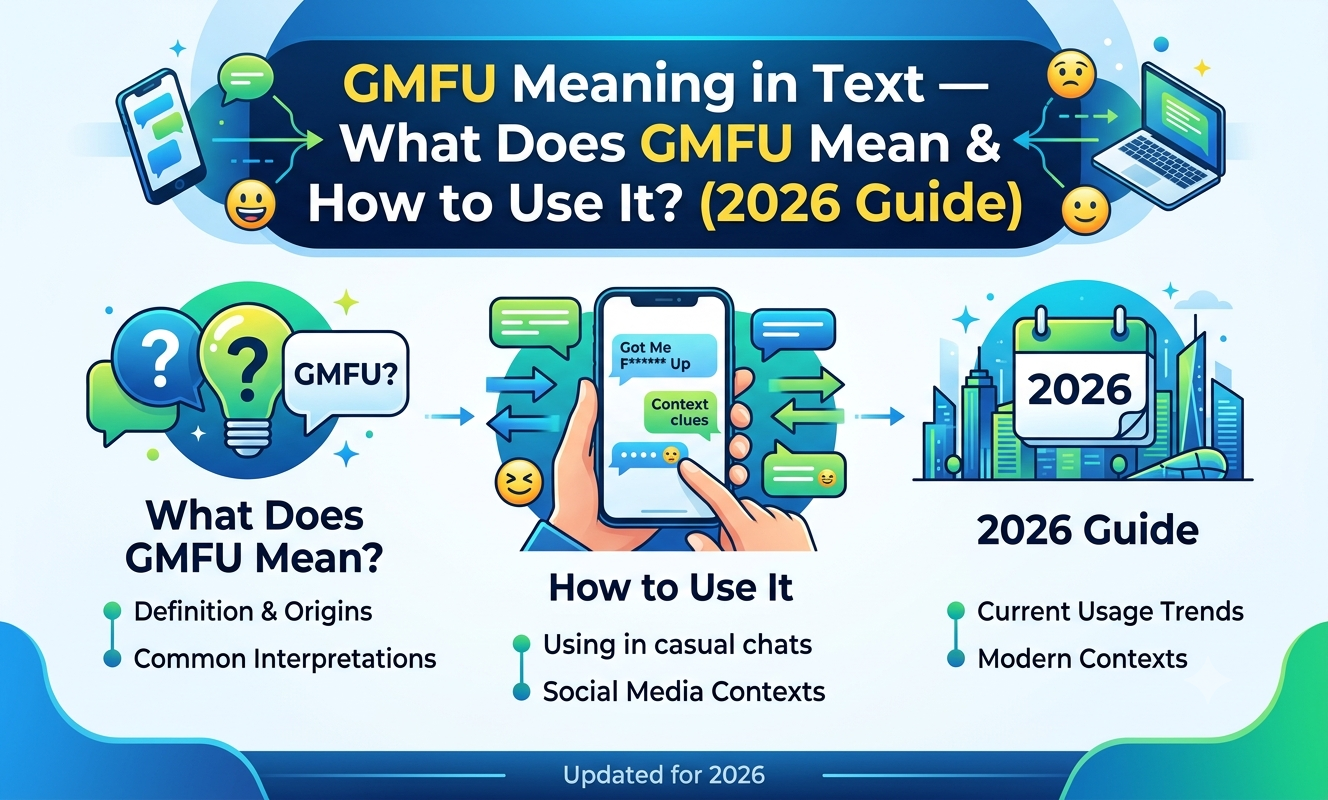
Quick Answer: GMFU stands for “Got Me F**ked Up.” It’s slang used to express shock, disbelief, frustration, or strong disagreement — basically a dramatic way of saying “I can’t believe this” or “that’s not okay with me.”
Introduction
Ever scrolled through a group chat and seen someone reply with just “GMFU 💀” and had absolutely no idea what was going on? You’re not alone. The gmfu meaning in text trips up a lot of people the first time they see it — especially parents trying to keep up with how their kids text.
GMFU is one of those short, punchy internet abbreviations that carries a lot of emotional weight in very few letters. It shows up in comments, DMs, and captions when someone is shocked, annoyed, or just reacting big to something unexpected.
In this guide, you’ll learn exactly what GMFU means, where it came from, how people use it across different apps in 2026, whether it’s considered rude, and how to reply when someone sends it to you. By the end, you won’t just know the definition — you’ll know how to actually read the tone behind it.
What Does GMFU Mean?
GMFU is internet slang that stands for “Got Me F**ked Up.” At its core, it’s an emotional reaction phrase — not a neutral one. When someone types GMFU, they’re saying that something has caught them completely off guard, whether that’s because it’s shocking, disrespectful, funny, or just plain unbelievable.
The phrase has roots in African American Vernacular English (AAVE), where expressive, rhythmic language has long been part of everyday conversation. The full phrase “got me f**ked up” was already common in spoken slang for years before it got compressed into an abbreviation for texting.
The acronym version picked up steam in group chats and comment sections as more conversations moved to short-form messaging. By 2026, GMFU is a fixture of casual Gen Z and younger millennial texting, especially in reaction-based conversations — replying to a screenshot, a hot take, or a piece of gossip.
What makes GMFU tricky is that it isn’t locked into one single emotion. It flexes depending on tone, punctuation, emojis, and who’s saying it to whom. That’s part of why it confuses parents and newer texters — the letters stay the same, but the meaning shifts with context.
GMFU Full Form Explained
Breaking the acronym down letter by letter makes it much easier to remember.
| Letter | Stands For |
|---|---|
| G | Got |
| M | Me |
| F | F**ked |
| U | Up |
Put together: “Got Me F**ked Up.” In plain, everyday English, that roughly translates to “you’ve genuinely thrown me off” or “I’m not okay with what just happened.” It’s intense phrasing, which is exactly why people use it — it’s meant to carry more punch than a plain “wow” or “really?”
How to Use GMFU — Real Examples
GMFU shows up in a wide range of emotional situations. Here are common ways people use it in everyday texting.
| Situation | Example | Emotion |
|---|---|---|
| Friend cancels plans last minute | “You said you’d come and now you’re bailing? GMFU.” | Frustration |
| Unbelievable gossip | “Wait, they broke up over THAT? GMFU.” | Shock |
| Someone disrespects you | “You talked about me behind my back? GMFU.” | Anger |
| A wild opinion | “You think pineapple belongs on pizza? GMFU.” | Playful disagreement |
| Getting caught off guard by good news | “You got the job?! GMFU, let’s go!” | Excited disbelief |
| Feeling underestimated | “You thought I wouldn’t finish the project? GMFU.” | Defensive pride |
| A dramatic plot twist in a show | “She was the killer this whole time? GMFU.” | Stunned surprise |
| Someone lowballs a price | “You want to pay me $5 for this? GMFU.” | Mild offense |
| A joke that goes too far | “That joke wasn’t even funny, GMFU.” | Annoyance |
| A savage comeback from a friend | “Bro really said that with a straight face, GMFU.” | Amused shock |
Notice how the same three letters can express anything from genuine anger to lighthearted teasing — the emojis and punctuation around it usually signal which one it is.
GMFU on Different Platforms (2026)
Slang doesn’t behave the same way everywhere. Here’s how GMFU tends to show up depending on the app.
On WhatsApp
WhatsApp conversations tend to be more personal and one-on-one, so GMFU here usually shows real frustration or disappointment rather than jokes for an audience. It often appears in family group chats or close-friend threads reacting to news or plans falling through.
On Snapchat
Snapchat’s fast, disappearing nature makes GMFU feel more spontaneous and raw. It’s common in Snap captions reacting to something someone just sent — a screenshot, a video, or a spicy update — often paired with an exaggerated expression or filter.
On TikTok
On TikTok, GMFU shows up heavily in comment sections reacting to a video’s twist, a bold statement in a duet, or a stitched reaction. As short-form video reactions have grown into 2026, comment-based slang like GMFU spreads fast because a single viral clip can push a phrase into millions of comment threads within hours.
On Instagram
On Instagram, GMFU appears frequently in captions and comments reacting to drama, memes, or relationship posts. It’s also popular in Instagram Stories replies, where a quick emotional reaction fits the format better than a full sentence.
Across all four platforms, the underlying meaning stays consistent — a strong, often exaggerated emotional reaction — but the tone shifts from genuinely upset (WhatsApp, private chats) to performative and comedic (TikTok, Instagram comments).
Is GMFU Rude or Offensive?
This depends heavily on context.
The case that it can be rude: The full phrase behind GMFU includes strong language, and when used aggressively, it can come across as confrontational — especially if directed at someone in anger or used in a professional or formal setting.
The case that it’s usually harmless: In casual friend groups, GMFU is often used jokingly, almost like an exaggerated “no way” or “I can’t.” Many younger texters don’t even consciously register the underlying words anymore; it functions more like an emoji than a literal statement.
The safest rule of thumb: GMFU is fine in casual texting with friends who use similar slang, but it’s not appropriate for work chats, messages to teachers or elders, or formal writing. If you’re unsure how someone will take it, it’s better to skip it.
How to Reply to GMFU
If someone sends you GMFU, how you respond depends on whether they seem genuinely upset or just being dramatic for effect.
| Their Tone | Reply Example | What It Does |
|---|---|---|
| Joking/light | “Lol my bad, I didn’t mean it like that 😂” | Defuses with humor |
| Genuinely upset | “I hear you, let’s talk about it” | Shows you’re taking it seriously |
| Shocked/surprised | “I know, right?? Wild.” | Validates their reaction |
| Confused about what you meant | “Wait let me explain what I meant” | Clears up the misunderstanding |
| Playfully teasing you | “GMFU right back 💀” | Matches their energy |
| Wants space | “Okay, I’ll leave you be for now” | Respects their mood |
GMFU Alternatives and Similar Slang
If you’re trying to expand your slang vocabulary or just want to understand related terms, here are some phrases with a similar feel.
| Term | Meaning |
|---|---|
| SMH | Shaking My Head — mild disapproval |
| WTH | What The Heck — confusion or disbelief |
| FR | For Real — emphasizing sincerity or agreement |
| NGL | Not Gonna Lie — being honest about a reaction |
| ICBW | I Can’t Believe What (context-dependent shock) |
| TF | The F**k — shorter, blunter shock expression |
| GG | Good Game — often sarcastic in competitive contexts |
| SN | Says Nothing / Sarcastic Note — dismissive reaction |
Compared to milder terms like SMH, GMFU generally carries more emotional intensity — it’s less “I’m mildly annoyed” and more “this genuinely got to me.”
Frequently Asked Questions (FAQ)
Q: What does GMFU mean in text? A: GMFU means “Got Me F**ked Up.” It’s slang used to express strong emotional reactions like shock, frustration, or disbelief.
Q: Is GMFU an acronym or slang? A: It’s slang expressed as an acronym — a shortened way of writing a full spoken phrase for faster texting.
Q: Can GMFU be used in a positive way? A: Yes. While it often signals frustration, it can also express amazed excitement, like reacting to genuinely great news or an impressive achievement.
Q: Is it okay to use GMFU with parents or teachers? A: It’s best to avoid it in formal or respectful contexts, since the full phrase behind it includes strong language that isn’t appropriate for professional or elder conversations.
Q: Where did GMFU come from? A: GMFU has roots in African American Vernacular English (AAVE) and became widely used online as texting and social media comments shifted toward short, expressive abbreviations.
Q: What’s the difference between GMFU and SMH? A: SMH expresses mild disapproval or disappointment, while GMFU carries a stronger, more intense emotional charge — closer to genuine shock or anger.
Conclusion
GMFU might look confusing the first time you see it, but once you know it stands for “Got Me F**ked Up,” the context usually makes the meaning pretty clear. Whether it’s showing up in a WhatsApp group chat, a TikTok comment section, or an Instagram Story reply, the core idea stays the same: someone’s reacting strongly to something surprising, frustrating, or hard to believe.
Understanding the gmfu meaning in text helps you read the room in digital conversations — and know when it’s playful versus when someone genuinely needs a moment. Bookmark this page so you’re never caught off guard the next time GMFU pops up in your messages.
Also read FN Meaning in Text — What Does FN Mean & How to Use It?

1 Comment
Pingback: PS Meaning in Text — What Does PS Mean & How to Use It?