
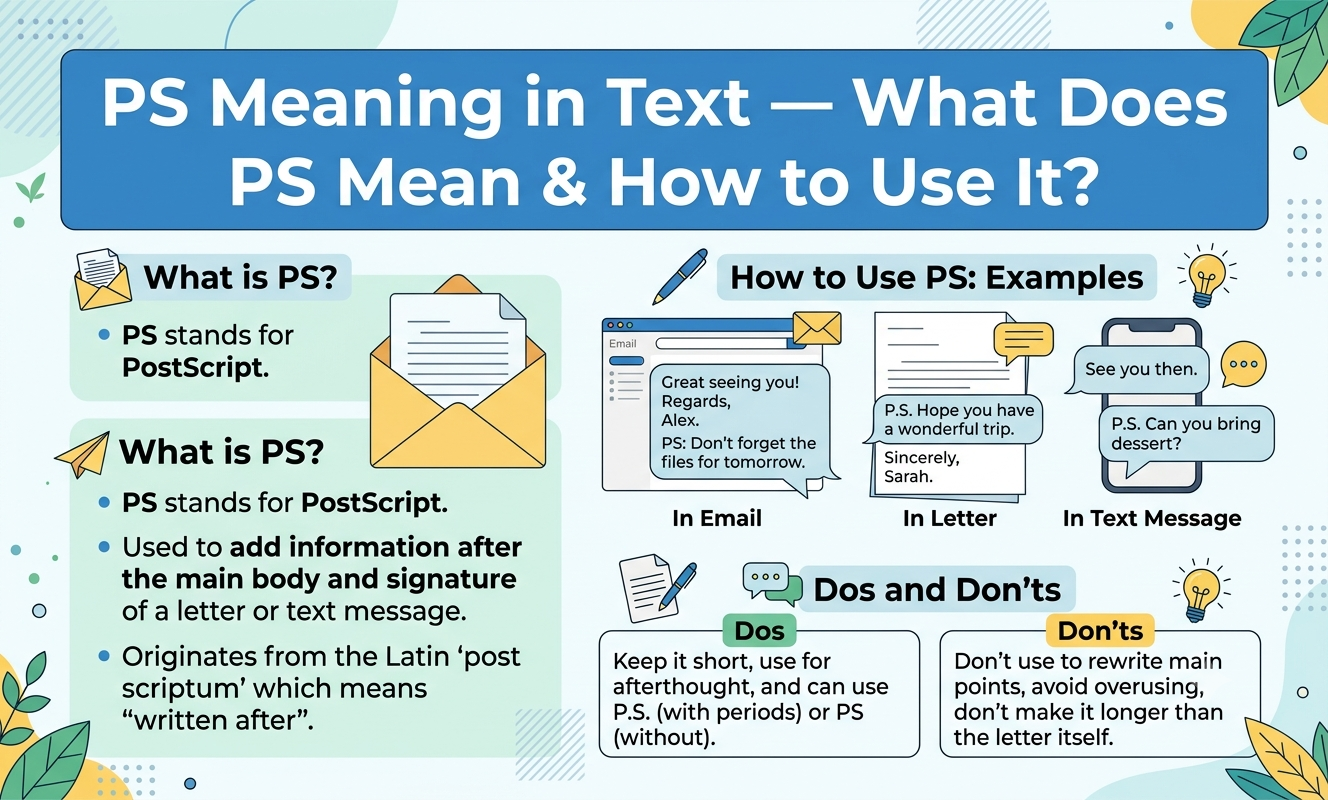
Quick Answer: PS in text stands for “postscript,” a Latin-rooted term meaning “written after.” It’s used to add an extra thought, reminder, or afterthought once you’ve already finished your main message — like “PS, don’t forget your key” after signing off a text.
Introduction
Ever finished typing a message, hit send, and then remembered one more thing you meant to say? That’s exactly where PS meaning in text comes into play. Instead of writing a whole new message, people just tack on a quick “PS” line at the end.
You’ve probably seen it in texts, emails, DMs, and even in old-school handwritten letters your grandparents wrote. It’s one of those abbreviations that has survived for centuries and made a smooth jump into modern chat apps.
In this guide, you’ll learn exactly what PS means, where it came from, how teens and adults use it differently, whether it can come across as rude, and how to reply when someone sends it to you. We’ll also cover how PS shows up on WhatsApp, Snapchat, TikTok, and Instagram in 2026, plus similar terms you might be mixing it up with.
What Does PS Mean?
PS stands for “postscript,” which comes from the Latin phrase post scriptum, meaning “written after.” Historically, it was used in letters when someone wanted to add a thought after they had already signed the letter — rather than rewriting the whole thing, they’d simply write “PS” followed by the extra note.
This habit carried over from handwritten letters to typed letters, then to emails, and now it’s a normal part of everyday texting. Even though most people today text instead of mail letters, the abbreviation stuck around because it’s short, familiar, and instantly understood.
In texting and messaging apps, PS is now used far more casually than in formal letters. It can introduce:
- A reminder you forgot to mention
- A funny aside or joke
- An emotional afterthought (“PS, I miss you”)
- A logistical detail (time, place, link)
Unlike newer internet slang that changes every year, PS has stayed remarkably stable in meaning. It doesn’t really have a “trending” moment — it’s just quietly useful, which is part of why it keeps showing up in casual chats alongside newer abbreviations like btw, fyi, and ngl.
PS Full Form Explained
Since PS is an abbreviation of a Latin phrase rather than an English acronym, it doesn’t spell out an English sentence letter by letter the way something like “LOL” does. Instead, each letter maps to part of the original Latin term.
| Letter | Stands For | Meaning |
|---|---|---|
| P | Post | “After” (Latin) |
| S | Scriptum | “Written” (Latin) |
| Full Form | Post Scriptum | “Written after” |
| Common English Meaning | Postscript | An added note after the main message |
So when someone types “PS,” they’re essentially saying: “Here’s something I’m adding after I already finished writing.”
How to Use PS — Real Examples
PS can fit into almost any kind of conversation — casual, romantic, professional, or just plain random. Here are examples across different emotional tones.
| Situation | Example | Emotion |
|---|---|---|
| Reminder to a friend | “See you at 6! PS bring your charger” | Neutral/Helpful |
| Romantic text | “Goodnight. PS I can’t stop thinking about you” | Affectionate |
| Apology follow-up | “Sorry again about earlier. PS I really do feel bad” | Sincere |
| Funny afterthought | “Meeting went fine. PS your cat walked across my screen” | Playful |
| Work message | “Sent the file. PS let me know if the formatting looks off” | Professional |
| Group chat plan | “We’re meeting at the mall. PS parking is full on weekends” | Informative |
| Sad/vulnerable text | “I’m okay, just tired. PS thanks for checking on me” | Grateful |
| Sarcastic tone | “Sure, I ‘forgot.’ PS I definitely didn’t forget” | Sarcastic |
| Excited update | “Guess who got the internship!! PS I’m still shaking” | Excited |
| Family text | “Coming home Friday. PS mom, save me some food” | Warm/Casual |
Notice how PS almost always comes after the main point, and often shifts the tone slightly — sometimes softer, sometimes funnier, sometimes more personal.
PS on Different Platforms (2026)
While PS started in written letters, it’s now part of everyday digital communication. Its usage looks a little different depending on the platform, especially as messaging habits keep shifting toward shorter, faster exchanges.
On WhatsApp
WhatsApp remains one of the most common places to see PS used in its more “classic” sense — as a follow-up message or reminder, especially in family groups, work groups, and long-distance friend chats. Because WhatsApp threads are often longer and more conversational than other apps, PS fits naturally as a way to add a quick extra note without breaking the flow.
On Snapchat
On Snapchat, where messages tend to be shorter and more visual, PS shows up less as a formal add-on and more as a quick caption addition — for example, added to the end of a snap caption as a cheeky extra comment. It’s less about logistics and more about tone or humor.
On TikTok
In TikTok comments and captions, PS is often used for a punchline or extra joke at the end of a caption, similar to how creators use “plot twist” or “also.” It gives creators a way to add a second layer to their message without needing a whole new sentence structure.
On Instagram
On Instagram, especially in DMs and captions, PS often works as a soft, personal add-on — something slightly more intimate or reflective tacked onto a caption or story reply. It’s common in close-friend interactions and comment replies where the main message has already been made.
Across platforms in 2026, the overall trend is the same: PS survives because it’s short, universally understood across age groups, and doesn’t require any explanation — unlike some slang that only certain age groups recognize.
Is PS Rude or Offensive?
No — PS is not inherently rude or offensive. In fact, it’s one of the more neutral, even polite, abbreviations you’ll come across in texting.
That said, context can shift how it feels:
- Friendly/Neutral context: Used to add reminders, jokes, or extra thoughts — completely normal and often appreciated.
- Passive-aggressive context: Occasionally used sarcastically, like “PS I saw you left me on read,” which can feel a little pointed depending on tone and relationship.
- Professional context: Considered polite and standard in emails and work messages, similar to its traditional letter-writing use.
Unlike slang terms that can carry hidden meanings or generational gaps, PS rarely causes confusion or offense. Its tone almost entirely depends on what comes after it, not the abbreviation itself.
How to Reply to PS
Replying to a PS line is usually simple — you just respond to whatever the extra note was about, the same way you’d respond to any other part of a message.
| Their PS Message | Good Reply Example |
|---|---|
| “PS bring your charger” | “Got it, packing it now!” |
| “PS I can’t stop thinking about you” | “Same here, honestly 🥹” |
| “PS let me know if formatting looks off” | “Looks good, no changes needed” |
| “PS your cat walked across my screen” | “Haha classic, tell her I said hi” |
| “PS thanks for checking on me” | “Always here for you” |
| “PS I definitely didn’t forget” | “Sure you didn’t 😏” |
The key is treating the PS line as its own mini-topic — it often deserves its own quick acknowledgment rather than being ignored.
PS Alternatives and Similar Slang
If you’re seeing PS often, you might also come across similar abbreviations used for follow-up thoughts, reminders, or extra notes.
| Term | Meaning |
|---|---|
| BTW | By The Way — introduces a side note, usually before or during a topic |
| FYI | For Your Information — shares useful info, often more formal |
| NGL | Not Gonna Lie — used before an honest or blunt statement |
| TBH | To Be Honest — similar to NGL, introduces a candid opinion |
| PPS | Post-Postscript — a second afterthought, added after a PS |
| EDIT | Common in captions/comments to add updated info after posting |
| UPDATE | Similar to EDIT, used to add new info to an earlier message |
| JK | Just Kidding — sometimes added at the end like a PS to soften a joke |
While these terms overlap in purpose (adding extra info), PS specifically implies the message was already “finished” before the extra thought was added — which is what makes it slightly different from BTW or FYI.
Frequently Asked Questions (FAQ)
Q: What does PS mean in a text message? A: PS means “postscript,” a short note added after the main message is already complete, often used for reminders, jokes, or extra thoughts.
Q: Is PS the same as an edit or update? A: Not exactly. PS is added by the sender within the same message as an afterthought, while an edit or update usually refers to changing or adding info to something already posted or sent.
Q: Can PS be used in a romantic text? A: Yes, PS is very common in romantic texting to add a soft, personal, or emotional line after the main message, like “Goodnight. PS I miss you already.”
Q: What does PPS mean if PS is already used? A: PPS stands for “post-postscript,” meaning a second afterthought added after an initial PS note.
Q: Is it okay to use PS in professional or work messages? A: Yes, PS is considered polite and professional, especially in emails, and has been used this way for decades before texting even existed.
Conclusion
At its core, PS meaning in text comes down to one simple idea: it’s a quick, friendly way to add something you almost forgot to say. Whether it’s a reminder, a joke, or a heartfelt line, PS fits naturally into texts, DMs, and captions across WhatsApp, Instagram, TikTok, and Snapchat alike.
Unlike a lot of internet slang, PS isn’t rude, confusing, or generation-specific — it’s understood by teens and parents alike, which is exactly why it has lasted this long. Bookmark this page next time you’re curious about what PS means in a text, or want quick examples of how to use it yourself.
Also read GMFU Meaning in Text — What Does GMFU Mean & How to Use It? (2026 Guide)

1 Comment
Pingback: DND Meaning in Text — What Does DND Mean & How to Use It?